Wednesday, June 18, 2014

GEORGIANS BELTED BY AGGRESSIVE BLACK SHANK

Where did this aggressive black shank come from?
asks pathologist Paul Bertrand. 
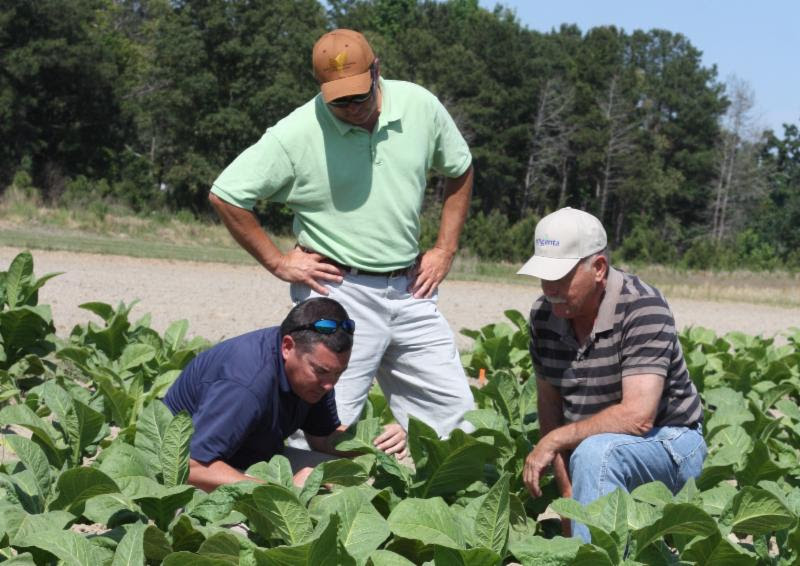
Black shank rose up "with a vengeance" in Georgia and Florida in the last month, says J. Michael Moore, Extension tobacco specialist for the two states. "We are seeing it in some fields where we wouldn't expect it--fields with a good rotation and even some fields that hadn't had tobacco in years," says Moore. A good example: The Ben Smith farm in Coffee County, Ga., which Paul Bertrand, Georgia plant pathologist, said was struck by "the most aggressive black shank we have ever seen (see photo above). The field had been in pecan trees for the last half century, with pasture surrounding the trees. The trees were removed and what was believed to be the first tobacco crop ever grown in this field was planted in 2013. The second was planted in 2014, but it didn't last long. The damage was so bad that the farmer has disced it up since this picture was taken on June 11.  

A further explanation of how to treat black shank in burley. Editor's Note--The following item appeared in a shorter form in the last issue of Tobacco Farmer Newsletter. Since then, I have received a corrected and extended version of the same piece from the original source, former Extension plant pathologist in Kentucky Kenny Seebold. Since it contains good additional information, I am going to run the amended version here. Apologies for the duplications: "Where black shank has been a problem in the past, consider making a pre-plant application of Ridomil Gold at a half pint per acre if applied in setter-water or one pint per acre if applied as a broadcast spray to soil. This would be the same as a half quart per acre of Ultra Flourish or four to six quarts of MetaStar. For light-to-moderate disease pressure, the first application of fungicide can be delayed one to two weeks after transplanting. For extended control of black shank, make a supplemental fungicide application (one pint of Ridomil, one quart of Ultra Flourish, or two quarts of MetaStar) at layby or at first cultivation and again at layby. Sprays made after transplanting should be directed toward the soil and incorporated immediately by cultivation or irrigation. An inch or two of rain will also incorporate these products. Best results are generally obtained when resistant varieties are planted."


Price outlook holding: Unless flue-cured acreage is up much more than expected or unless the growing season is poor, the price for the current flue-cured crop should remain strong, says N.C. Extension economist Blake Brown. But it probably not as strong as in 2013, when the average price was estimated by USDA at $2.115 a pound. The March Planting Intentions report projected 232,000 acres, up 3,500 acres from the 228,800 acre 2013 crop. Based on past experience, that may be a low projection. "In previous years, planting intentions were as much as 10,000 acres below the actual crop acreage for the year in question," says Brown. But the supply of transplants may not have been adequate to support a much larger crop.
  
The plant shortage never materialized in Kentucky. "Even now, from what I am hearing, you can still find plants available if you need them," says Bob Pearce, Kentucky Extension tobacco specialist. But not many do--85 percent or perhaps 90 percent of the state's burley has been seeded already. The crop has gotten off to a good start, but because of cloudy days, there has been some early blooming. "I think we might see some more," Pearce says.

There was definitely a shortage of plants in Georgia and Florida. "We saw quite a scramble at the end," says Moore. "All ours were set, and the last plants that went in were from North Carolina. But I think nearly everybody was able to plant the acres they wanted to." He makes a very rough estimate of 15,000 acres planted in Georgia and 1,500 acres in Florida. The crop started out about two weeks behind in both states but has caught up by at least half a week. He expects harvest to begin in 2 ½ weeks.

Planting in the N.C. Piedmont appears complete. "I don't know anyone who is not done planting," says Dennis White, owner of the Old Belt Tobacco Sales auction warehouse in Rural Hall, N.C. "There weren't many plants to spare but everyone was able to plant the acres they wanted." So far, the tobacco looks good, he says. Some of it was laid by last week.
  

Spotted wilt infestations are much higher in Georgia and Florida than predicted considering the cold winter. Says Moore, "It defies logic to have so much TSWV after such cold weather. I would place the average infestation now at 15 to 20 percent of the plants." That is not the worst incidence of spotted wilt Type 14 tobacco has ever had. "But it certainly was a surprise," says Moore.

Position changes: Kenny Seebold (see earlier item) has left his longtime post as Kentucky Extension plant pathologist and is now working as product development manager for the fungicide line of Valent USA...Jeff Vice is now the tobacco specialist for the Burley Tobacco Growers Cooperative Association. He will be responsible for grading and purchasing of burley with the goal of increasing the amount of tobacco purchased and expanding marketing to the trade. Vice is definitely an old hand in the leaf business--he has 38 years experience, starting with Universal Leaf and later with Philip Morris USA/Altria.

If you are hand weeding tobacco, pull the weeds from the soil before set occurs, says Matthew Vann, N.C. Extension tobacco specialist. "Once weed seed develop, you can actually spread them by hand removal." He also recommends that once you pull the weeds, you remove them from the field. "In rare situations, weeds such as grass and amaranth species have been known to 're-root' when left on the soil surface," he says.

Dates to remember:

  • June 26, 8 a.m. Tobacco Field Day. UT Highland Rim Ag Research and Education Center Springfield, Tn. Contacts: Barry Sims at 615-382-3130 or bsims@utk.edu.
  • July 14-15. N.C. Tobacco Tour. Tuesday: Opening dinner, 6 p.m. Wednesday: Tour Upper Coastal Plain Research Station, Rocky Mt., N.C. Further events to follow. 
  • July 30, 3 p.m. to 7 p.m. Virginia Tobacco Field Day. Southern Piedmont AREC, Blackstone, Va. Contact: Margaret Kenny, 434-292-5331 or  makenny@vt.edu.
  • July 31, 7:30 a.m. to 1 p.m. Grains and Tobacco Field Day. UK REC, Princeton, Ky. Contact: 270-365-7541 ext 264.
  • August 7, 5:30 to 8:30 p.m. Tobacco Twilight Tour, Murray State University West Farm, Murray, Ky. Contact: Andy Bailey, tobacco specialist, at 270-365-7541 ext. 240.
Tytun rated 1

BIG M TOBACCO WAREHOUSE 
1723 Goldsboro St. SW, Wilson, N.C., 
in the old Liberty Warehouse


Greg Goins is the auctioneer at Big M Warehouse.

We will hold both sealed bid auctions
and live auctions.
We promise 
HONEST AND TRUSTWORTHY 
SERVICE
For more information, contact Mann Mullen at 919-496-9033 
or the warehouse switchboard at 252-206-1447.

Wednesday, June 4, 2014

BLACK SHANK BUSTS OUT IN GEORGIA, THRIPS IN N.C.


Tractor
A flue-cured grower near Four Oaks, N.C., raises dust as he cultivates his tobacco on June 2.
 REPORTS FROM THE FIELD June 4, 2014

FLUE-CURED  
In North Carolina, transplanting is nearly complete, says Loren Fisher, N.C. Extension tobacco specialist. "A few farms are still transplanting in the Piedmont. I expect they will finish this week. Layby is just beginning 
Thrips
Inspecting for thrips: Loren Fisher (left), N.C. Extension tobacco specialist, checks young flue-cured tobacco for thrips at the N.C. Central Crops Research Station in Clayton, N.C., at a field day on June 2. Looking on are TGANC executive Graham Boyd (standing), and farmer Bennie Lee, Sanford, N.C.
in the East." The supply of plants was tight but most intended acres were planted, he says. But there may be more late-set plants out there this year than the state has ever had, says Graham Boyd, executive vice president of the Tobacco Growers Association of N.C. "There were significant plantings with plants from re-seeded greenhouses." Fisher says that based on research, there is not much reason to expect a yield reduction on plants set before May 24. But a hot June could cause problems... 
In Virginia, the flue-cured crop has gotten off to a good start, says David Reed, Virginia Extension tobacco specialist. A few growers are still transplanting while some of the earliest will be laid by this week. Transplanting is probably 98 percent complete. Plant supply was tight but most growers managed to find available transplants, says Reed. "Very few acres will be left unplanted"... In South Carolina, Georgetown County Extension agent Kyle Daniel said in a June 2 report that "tobacco is really starting to look better and better as warmer weather and good moisture is allowing the crop to grow at a steady pace"... In Georgia, black shank is a problem. One farmer reported 80 percent black shank in an 11-acre field that had only been in tobacco one year (2013) out of the last 100. "We don't know how the inoculum got in there," says Moore. "In recent years, it had been in pastures and pecan trees." Fortunately, it is not that intense for most of the state, but black shank is above normal, he says. "The reason is probably that we had a lot of weather events after planting that involved excessive rain, then drying." Roots and stems were injured, allowing the black shank pathogen to enter the plant. Some plants collapsed without ever yellowing. 

In Kentucky, Kenny Seebold, until recently Extension plant pathologist, suggests that where black shank has been a problem in the past, consider making a pre-plant application of Ridomil Gold at a half pint per acre if applied in setter water, or one pint per acre if applied as a broadcast spray to soil. This would equal a half quart per acre of Ultra Flourish or four to six quarts of MetaStar. If the disease pressure is light to moderate, you can delay the first application one to two weeks. For extended control of black shank, make a supplemental fungicide application (one pint of Ridomil Gold or one quart of Ultra Flourish, or two quarts of MetaStar) at lay by, or at first cultivation and again at lay by Best results are generally obtained when resistant varieties are planted. In middle Tennessee, Extension agent Jason Evitts in Trousdale County said in a June 2 report, "It has been a great couple of weeks, and tobacco transplanting has caught up from a late start. But tobacco already transplanted could use some rain"... In southwest Virginia, there will be a shortage of burley plants because fewer farmers are growing plants. "Most of the growers who sell plants have sold out already," says Danny Peek, Virginia District Extension director in Abingdon, Va. "If anything goes wrong that requires replanting, our supply could turn out way short."


OUTSIDE THE U.S... Transplanting in Canada got going in earnest last week, which is a little late, a source in Ontario tells TFN. "We are about a week behind schedule," he said. "The weather has been cold and cloudy, and we have had more than our fair share of precipitation. Transplant quality and supply seem to be quite good." He doesn't see any of the problems with plants that so many American farmers are experiencing. "Over 95 percent of the greenhouses here have furnaces, so our plants are nice--but expensive," he says. He expected setting to be going at full speed by now. Almost all Canada tobacco is flue-cured grown in southern Ontario.

In other tobacco developments: 

Unusually large numbers of thrips are appearing on flue-cured tobacco in North Carolina. Counts between 30 and 50 thrips per leaf are common, and some classic "silver-leafing" foliar damage, which is caused by thrips' rasping the upper leaf surface, has been seen. Hannah Burrack, N.C. Extension entomologist, says, "The current thrips are likely the third generation, and if so they arrived about as predicted. The fourth generation flight (in Wilson County) is expected to begin around June 10, so we may observe additional thrips populations there soon." Also, some of the winter annual weeds that are overwinter hosts to thrips seem to be dying off at fast pace now, forcing thrips to find a new host. Nevertheless, Burrack does not recommend spraying of thrips at this time. "The foliar feeding damage by thrips now is likely negligible," she says. "It is occurring early in the season on leaves that will be on the lower part of the plant and subject to much more abuse before harvest." Foliar treatments are generally not very effective against thrips because they are not persistent and are difficult to time, she adds. Read the N.C. State recommendations at TSWV Risk and Thrips Forecasting Tool. 
A tobacco landmark changes hands: The historic Reynolds Building has been sold by R.J. Reynolds Tobacco Company to a 
Reynolds Bldg.
The Reynolds Building
company that will convert it into a hotel, restaurant and upscale apartments. Located in downtown Winston-Salem, N.C., the 22-story building was completed in 1929, and with its strong resemblance to the Empire State Building (built by the same architectural team), it has been an imposing fixture on the city's skyline ever since. A statement from RJRT said the new owners are expected to honor its place in the community as they transform it to its new use. The parent company, Reynolds American, decided that the building was expendable in 2008.
  
Dates to remember: 
  • June 9, 7 p.m. Georgia-Florida Tobacco Tour, begins with a supper in Live Oak, Fl., and end near Baxley, Ga., after lunch on June 11. Contact: J. Michael Moore at 229-392-6424.
  • June 26, 8 a.m. Tobacco Field Day. UT Highland Rim AgResearch and Education Center Springfield, Contact: Barry Sims 615 382 3130 or bsims@utk.edu.
  • July 14-15. N.C. Tobacco Tour. Details to follow. 
  • July 30, 3 p.m. to 7 p.m. Virginia Tobacco Field Day. Southern Piedmont AREC, Blackstone, Va. Contact: Margaret Kenny, 434 292 5331 or makenny@vt.edu.
  • July 31, 7:30 a.m. to 1 p.m. Grains and Tobacco Field Day. UK REC, Princeton, Ky. Contact: 270-365-7541 ext 264.
  • August 7, 5:30 to 8:30 p.m. Tobacco Twilight Tour, Murray State University West Farm, Murray, Ky. Contact: Andy Bailey, tobacco specialist, at 270-365-7541 ext. 240.
Edited by Chris Bickers, Raleigh, N.C., Phone 919 789 4631 or email chrisbickers@gmail.com


Tytun rated 1

BIG M TOBACCO WAREHOUSE 
 
1723 Goldsboro St. SW, Wilson, N.C., 
in the old Liberty Warehouse
 
 
Greg Goins is the auctioneer at Big M Warehouse.
 
We will hold both sealed bid auctions
and live auctions.
 
 
We promise 
HONEST AND TRUSTWORTHY 
SERVICE
 
 
For more information, contact Mann Mullen at 919-496-9033 
or the warehouse switchboard at 252-206-1447.

Tuesday, May 20, 2014

CHILD LABOR ACCUSATIONS--DOCUMENTS

Government, Companies Should Provide Protection
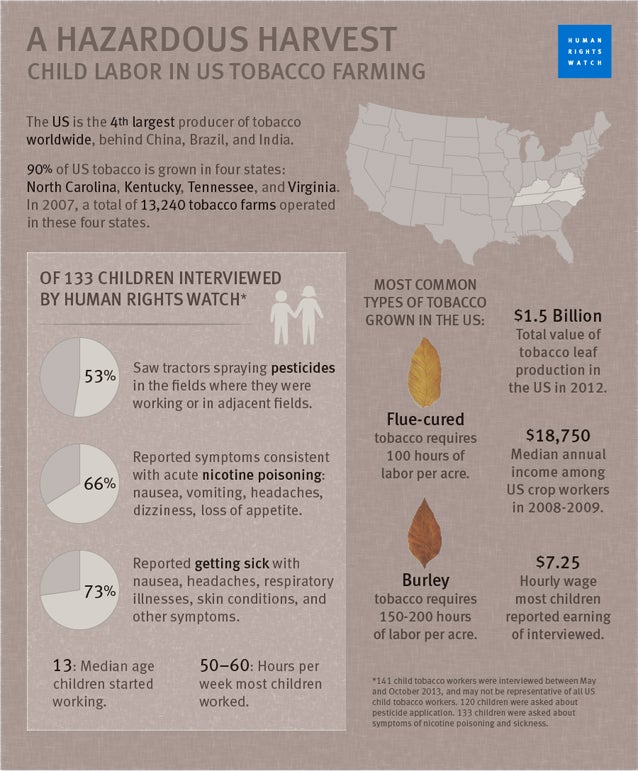
Children working on tobacco farms in the United States are exposed to nicotine, toxic pesticides, and other dangers, Human Rights Watch said in a report released today.
Big tobacco profits from child labor in US tobacco fields. Take action now:  http://www.hrw.org/ChildFreeTobacco %23ChildFreeTobacco
While US law prohibits the sale of tobacco products to children, children can legally work on tobacco farms in the US. The world’s largest tobacco companies buy tobacco grown on US farms, but none have child labor policies that sufficiently protect children from hazardous work.
The 138-page report, “Tobacco’s Hidden Children: Hazardous Child Labor in US Tobacco Farming,” documents conditions for children working on tobacco farms in four states where 90 percent of US tobacco is grown: North Carolina, Kentucky, Tennessee, and Virginia. Children reported vomiting, nausea, headaches, and dizziness while working on tobacco farms, all symptoms consistent with acute nicotine poisoning. Many also said they worked long hours without overtime pay, often in extreme heat without shade or sufficient breaks, and wore no, or inadequate, protective gear.
“As the school year ends, children are heading into the tobacco fields, where they can’t avoid being exposed to dangerous nicotine, without smoking a single cigarette” said Margaret Wurth, children’s rights researcher at Human Rights Watch and co-author of the report. “It’s no surprise the children exposed to poisons in the tobacco fields are getting sick.”
The report is based on interviews with 141 child tobacco workers, ages seven to 17.
Children working in tobacco farming face other serious risks as well, Human Rights Watch said. They may use dangerous tools and machinery, lift heavy loads, and climb several stories without protection to hang tobacco in barns. Children also reported that tractors sprayed pesticides in nearby fields. They said the spray drifted over them, making them vomit, feel dizzy, and have difficulty breathing and a burning sensation in their eyes.
Many of the pesticides used in tobacco production are known neurotoxins, poisons that alter the nervous system. The long-term effects of childhood pesticide exposure can include cancer, problems with learning and cognition, and reproductive health issues.Children are especially vulnerable because their bodies and brains are still developing.Human Rights Watch sent letters to 10 US and global tobacco companies and met with many of them to encourage these companies to adopt policies, or strengthen existing policies, to prevent hazardous child labor in their supply chains.
“Tobacco companies shouldn’t benefit from hazardous child labor,” Wurth said. “They have a responsibility to adopt clear, comprehensive policies that get children out of dangerous work on tobacco farms, and make sure the farms follow the rules.”

Health Hazards for ChildrenSeveral hundred thousand children work in US agriculture every year, but no data is available on the number working in tobacco farming. Many children interviewed by Human Rights Watch described going to work on tobacco farms at age 11 or 12, primarily during the summer, to help support their families. Most were the children of Hispanic immigrants who lived in communities where tobacco was grown and who attended school full-time.
Children Human Rights Watch interviewed described feeling suddenly, acutely ill while working on tobacco farms. “It happens when you’re out in the sun,” said a16-year-old girl in Kentucky. “You want to throw up. And you drink water because you’re so thirsty, but the water makes you feel worse. You throw up right there when you’re cutting [tobacco plants], but you just keep cutting.” A 12-year-old boy in North Carolina described a headache he had while working:“It was horrible. It felt like there was something in my head trying to eat it.”
Acute nicotine poisoning – often called Green Tobacco Sickness – occurs when workers absorb nicotine through their skin while handling tobacco plants, particularly when plants are wet. Common symptoms include nausea, vomiting, headaches, and dizziness. Though the long-term effects are uncertain, someresearch suggests that nicotine exposure during adolescence may have consequences for brain development.
Several children told Human Rights Watch that they had been injured while working with sharp tools and heavy machinery. In Kentucky, Tennessee, and Virginia, children often hand-harvest tall tobacco plants by cutting them with small axes and spearing the stalks onto long sticks with pointed ends. The children said they often cut or puncture themselves on the hands, arms, legs, and feet. A 16-year-old boy described an accident while harvesting tobacco in Tennessee: “I cut myself with the hatchet.… I probably hit a vein or something because it wouldn’t stop bleeding and I had to go to the hospital…. My foot was all covered in blood.” One 17-year-old boy interviewed by Human Rights Watch lost two fingers in an accident with a mower used to trim small tobacco plants.Almost none of the children Human Rights Watch interviewed said that employers had given them health and safety training or protective gear. Instead, children typically covered themselves with black plastic garbage bags in an attempt to keep their clothes dry when they worked in fields wet with dew or rain.
Federal data on fatal occupational injuries indicates that agriculture is the most dangerous industry open to young workers. In 2012, two-thirds of children under 18 who died from occupational injuries were agricultural workers, and there were more than 1,800 nonfatal injuries to children under 18 working on US farms.Most children interviewed by Human Rights Watch said they had no access to toilets or a place to wash their hands at their worksites, leaving them with tobacco and pesticides residue on their hands, even during mealtimes.

Lack of Protection Under US LawUnder US labor law, children working in agriculture can work longer hours, at younger ages, and in more hazardous conditions than children in any other industry. Children as young as 12 can be hired for unlimited hours outside of school hours on a farm of any size with parental permission, and there is no minimum age for children to work on small farms. At 16, child farmworkers can do jobs deemed hazardous by the US Department of Labor. Children in all other sectors must be 18 to do hazardous work.Regulations proposed by the Labor Department in 2011 would have prohibited children under 16 from working on tobacco farms, but they were withdrawn in 2012.
“The US has failed America’s families by not meaningfully protecting child farmworkers from dangers to their health and safety, including on tobacco farms,”Wurth said. “The Obama administration should endorse regulations that make it clear that work on tobacco farms is hazardous for children, and Congress should enact laws to give child farmworkers the same protections as all other working children.”

Role of Tobacco CompaniesHuman Rights Watch presented its findings and recommendations to 10 companies that purchase tobacco grown in the United States, including eight cigarette manufacturing companies: Altria Group (parent of Philip Morris USA), British American Tobacco, China National Tobacco, Imperial Tobacco Group, Japan Tobacco Group, Lorillard, Philip Morris International, Reynolds American, and two international leaf merchants who purchase tobacco leaf and sell to manufacturers: Alliance One and Universal Corporation.
All of the companies except China National Tobacco responded and said they are concerned about child labor in their supply chains. However, the companies’ approaches do not sufficiently protect children from hazardous work, Human Rights Watch said. In some cases, companies allow for lower standards of protection for children in their US supply chain than for children working on tobacco farms in all other countries from which they purchase tobacco.
Philip Morris International has the most comprehensive global child labor policy among the companies contacted. Since 2010, Philip Morris International has sought to carry out the policy through training and monitoring in its supply chain worldwide. In 2009, Human Rights Watch documented abuses on farms supplying tobacco to a Philip Morris International subsidiary in Kazakhstan.
Human Rights Watch urged companies to prohibit children from engaging in all tasks that pose risks to their health and safety, including any work involving direct contact with tobacco plants or dry tobacco, due to the risk of nicotine exposure. Companies should also establish effective internal and third-party monitoring of labor policies.“Farming is hard work anyway, but children working on tobacco farms get so sick that they throw up, get covered by pesticides, and have no real protective gear,”Wurth said. “Tobacco companies should get children out of hazardous work on tobacco farms and support efforts to provide them with alternative educational and vocational opportunities.”
Big tobacco profits from child labor in US tobacco fields. Take action now:  http://www.hrw.org/ChildFreeTobacco %23ChildFreeTobacco


May 14, 2014

Tobacco Growers Respond to Human Rights Watch Report

Today the Human Rights Watch released a report entitled “Tobacco’s Hidden Children”. The report makes note that greater than 90% of US tobacco production occurs in four primary states which includes North Carolina. It makes allegations that the presence of children working on farms is wide spread and a prolific problem. While the United States labor laws permit children to be engaged in certain agricultural work endeavors, the report is careful to point out that its findings are not an illegal problem in America. 

The HRW report suggests that child labor is an acceptable practice, and that it goes largely “unchecked”. The Tobacco Growers Association of NC (TGANC) takes issue with such distortions of facts. In the United States, enforcement of child labor laws is the jurisdiction of both the US Department of Labor as well as the State Departments of Labor. It is also known that any worker may anonymously report concerns or violations to these resource agencies. 

Further, the departments of labor are required to make random and unannounced inspection visits to farms in order to assure compliance of all related laws and regulations. Data reports that the US Department of Labor only recorded one incident of child labor violations in NC in the crop season for 2012. 

It is widely understood that agriculture can be a labor intensive vocation and is known to embody long hours of work needs during peak periods given its often perishable condition of certain crops being harvested. Federal agencies rank agriculture as the second most hazardous occupation in America behind mining. These are not new facts to emphasize in the HRW report. 

These conditions are also well understood by any person who chooses to become engaged in farming either as an owner/operator or employee of a farm. It is incumbent upon farmers who employ workers to understand labor laws and to work diligently to obey these requirements. It is the opinion of the Tobacco Growers Association of NC that the great majority of the farmers in the state place tremendous value and appreciation on the workforce that is willing to help them harvest crops. Most farmers go beyond what is required of them in terms of labor compliance. 

Protecting and providing support for workers is an important aspect in maintaining a stable and quality workforce. Farmers understand that mistreatment of workers or violations of labor laws is the quickest way to create a situation of insufficient workers to harvest a crop in a timely and quality fashion. Every farmer in NC will tell you that their employees are among the greatest asset in the success of the family farming operation. There is absolutely zero benefit in mistreating farm workers.

TGANC condemns any mistreatment or misuse of workers. The fact that HRW points to 141 incidents of children working in a farm environment should be considered as isolated and rare occurrences in the United States and most certainly in North Carolina. The findings in this report should be viewed in this country as the exception rather than the norm. Additionally, it is unfortunate that the report chose to only focus on the crop of tobacco when there are dozens of other commodities that depend on hand harvest labor. It brings to question either a hidden agenda or some other adverse motivation that is anti-tobacco.

Our state produces approximately 400 million pounds of flue-cure tobacco in a season on 180,000 acres of land. It is estimated that the approximate number of farms in the state is 1,600 to 2,000. On average these farms may employ an average of 15-20 workers at peak periods. 

This calculation would equate to roughly 30,000 employees. Most of these workers will be seasonal and a high percentage will be classified as “guest workers”. If all 141 incidents in the HRW report had occurred in NC alone, that would be a ratio of .004 percent of the workers. 

Could the statement be made that 99.006 % are doing it correctly? And, again the USDOL only reported one incident of child labor in 2012 in NC.

Great strides have been achieved in the US tobacco industry over the past four decades to drastically reduce the amount of labor required to grow and harvest a crop of tobacco. In a 1965 NC State University report by the agricultural economics department it recorded that the crop required 600 man hours per acre grown and delivered and average yield of 1,600 pounds. In 2013 that statistic is 50-75 man hours per acre and the yield average is above 2,300 pounds. 

Fifty percent of the tobacco in NC is in fact, machine harvested. All modern operations use bulk curing barns and 100% of farm tobacco is packaged by automatic bailing machines in preparation for sale. Many farms use mechanized “topping” devices and precision sucker control products that have helped to reduce that labor demand by 50% as well. All of this mechanization is important in reducing the workers exposure to raw leaf tobacco.

Further, the advent of larger curing box systems and the attention to reduce leaf damage from excessive moisture in the curing process has resulted in many operators not starting field harvest when tobacco leaves are wet. This practice has also helped reduce any potential risks to “green tobacco sickness” that can result from handling wet leaves.

We see two important points coming from the HRW report. First, it is additional evidence that guest worker polices in this country need to be further addressed and improved in the ongoing immigration debate. Second, as an industry we will continue to prioritize the need to completely remove hand labor as a requirement in this crop so that its cultural practice can be similar to that of basic row crops such as corn, soybean and cotton. It remains the goal of TGANC to lead the technology discoveries that may someday result in tobacco that is not touched by human hands.

For additional Information: Graham Boyd, Executive Vice President, Phone: 919-614-0099. Email:grahamboyd@nc.rr.com.

PLANTING WINDS UP FOR FLUE-CURED, JUST GETTING STARTED FOR BURLEY

Setting
A transplanting crew sets out flue-cured plants near Kenly, N.C., on May 9.

FLUE-CURED: In North Carolina, at least 75 percent of the flue-cured has been transplanted. "Or maybe a touch more," says Matthew Vann, N.C. Extension tobacco specialist. "The vast majority of the east is done, maybe close to 100 percent except for farmers who are still scrambling for plants. The growers in the Piedmont are wide open now and should wrap up by next week if the weather holds up."  In South Carolina, area Extension agronomy agent William Hardee in Conway says he thinks that substantially all the tobacco in his area has been transplanted. Tobacco in the field in Georgetown County had begun to "flatten out" in almost every field making it suitable for cultivation, says Georgetown County Extension agent Kyle Daniel. In Georgia, transplanting was completed last week, says J. Michael Moore, Georgia Extension tobacco specialist. The plant supply was tight. "We used the very last plant available in the state. I'm estimating 15,000 acres, but of course we have no way of actually knowing how many acres are planted." About the time the last plants were set, much of the tobacco area got two to 5.5 inches of rain from last week's system. In  Florida, the crop is completely set, and some farmers are planning sucker control. 

BURLEY: In Kentucky, perhaps 25 percent of the burley crop has been set, says Bob Pearce, Kentucky Extension tobacco specialist. "We are farther along in the southern part of the state, but we are making prog
ress everywhere,” he says. The plant supply seems to have straightened out, probably because some expected contracts didn't come through and others came in late, he says. In southwestern Virginia, very little of the burley crop has been transplanted so far, according to Extension sources. A shortage of plants is expected. In west North Carolinatransplanting was a little farther along, with 39 percent of the burley crop estimated set by May 18. But that was still well behind the five-year average of 65 percent. In Tennessee,  farmers in the state's leading burley county are ahead of schedule on transplanting, says Macon County Extn. Director Steve Walker. "The tobacco that is out now looks scary good."

What if you can't get sulfate of potash? "It looks like some supply stores may not have it when you need it," says Pearce of Kentucky. "You should have a plan on how to deal with that." One possible alternative: "If your supplier can get sulfate of potash to you within a month of transplanting, you could still scatter it over the top and get good results." But be sure the tobacco is completely dry when you do it. If it's wet, there could be burning.

Tennessee farmers are having the same problems getting sulfate of potash as everyone else. "I hope we don't have to use much muriate," says Walker. "It interferes with curing." If you know a year beforehand that you will have to apply muriate to tobacco, put it out in the fall, he suggests. "The rain and snow will leach it out over the winter." But it's best not to use muriate at all on tobacco.

A "wait and see" approach could make nitrogen application more efficient, says Vann of N.C. You might want to apply 75 to 80 percent of your total nitrogen in two applications and then later apply the remaining 20 to 25 percent in the third. "A third application provides a lot of flexibility later in the season for producers using liquid nitrogen and drop nozzles," he says. "This provides the benefit of not applying too much nitrogen in a dry year, while still being able to make a leaching adjustment in a wet year."


Flexibility could come in very handy, considering the irregularity of weather patterns over the last few growing seasons--extremely dry in 2010 and 2011 and extremely wet in 2013 and early 2014. "We are just as likely--maybe more likely--to have a dry summer as a wet one," Vann said. "You don't want excess nitrogen to turn your tobacco green late in the season."

In other news:
ThompsonA new c.e.o. for the flue co-op--The U.S. Tobacco Cooperative (USTC) has appointed Stuart Thompson, its chief financial officer, to the apparently new position of chief executive officer. Thompson, 49, has 18 years of experience in senior management roles in several industries, but has only been involved in tobacco since he joined USTC in 2011. A statement from USTC's board chairman -- grower Jimmy Hill of Kinston -- noted Thompson's strong management and financial back ground but gave no indication of what his duties would include or what change if any there would be in the duties of USTC president J.T. "Tommy" Bunn. 

Tobacco was the target earlier this month when a human rights organization issued a report alleging significant use of child labor on leaf farms. Its clear goal was to try to embarrass cigarette manufacturers and to create some method of third-party monitoring to prevent their recurrence. "Children in tobacco fields can't avoid being exposed to dangerous nicotine, without smoking a single cigarette," said Margaret Wurth, children's rights researcher at Human Rights Watch (HRW) and co-author of the report. "It's no surprise the children exposed to poisons in the tobacco fields are getting sick." Graham Boyd, executive vice president of the Tobacco Growers Association of North Carolina (TGANC), responded that much of the report is a distortion. He noted that the report was based on 141 interviews with children ages seven to 17 who were reportedly working on tobacco farms in N.C., Virginia, Kentucky and Tennessee. The number was quite small in comparison to all tobacco workers. "If all 141 incidents in the HRW report had occurred in N.C. alone, that would be a ratio of .004 percent of the workers in N.C.," he said. "Could the statement be made that 99.006 percent are doing it correctly?" To see the short version that accompanied the report, along with the full text of Boyd's response, see elsewhere in this blog.

Dates to remember: 
  • May 23, 10 a.m. GAP Certification Meeting. Hancock Health Department, 178 Willow St., Sneedville, Tn.  Contact: 423-733-2526.
  • July 14-16. N.C. Tobacco Tour. Details to follow.
  • July 30. Virginia Tobacco Field Day. Southern Piedmont AREC, Blackstone, Va.


Tytun rated 1


BIG M TOBACCO WAREHOUSE 
1723 Goldsboro St. SW, Wilson, N.C., 
in the old Liberty Warehouse

Greg Goins is the auctioneer at Big M Warehouse.


We will hold both sealed bid auctions
and live auctions.
We promise 
HONEST AND TRUSTWORTHY 
SERVICE
For more information, contact Mann Mullen at 919-496-9033 
or the warehouse switchboard at 252-206-1447.


  SQM

Tuesday, May 13, 2014

A NEW CEO AT U.S. TOBACCO COOPERATIVE

This just in...The U.S. Tobacco Cooperative (USTC) has appointed its chief financial officer Stuart Thompson to the apparently new position of chief executive officer. Thompson, 49, has 18 years of experience in senior management roles in several industries, but has only been involved in tobacco since he joined USTC in 2011. A statement from USTC's board chairman Jimmy Hill of Kinston, N.C., noted Thompson's strong management and financial background but gave no indication of what his duties would include and what change if any there would be in the duties of USTC president Tommy Bunn.


Wednesday, May 7, 2014

LIQUID NICOTINE PRODUCTION IS NOW A REALITY IN THE U.S.


Brian Furnish (File Photo)
Liquid nicotine for e-cigarettes is now being produced on a commercial scale in the United States. The manufacturer is USA Liquid Nicotine, with extraction facilities in Albany, Ga., and buying and marketing offices in Harrisburg, Ky. Managing partner Brian Furnish, a farmer who served several years as general manager of Burley Tobacco Growers Cooperative Association in Lexington, Ky., says the company is acquiring American burley and is selling pure liquid nicotine extracted from it. "We believe we are the first company using American leaf to produce liquid nicotine in this country," Furnish tells TFN. Demand has been very good. "We have sold everything we have extracted. We will try to ramp up production in the near future, if possible." So far, Furnish says they have only used air-cured leaf, mainly burley, because of its higher nicotine content relative to flue-cured and other types. It is cured normally, then individual leaves are stripped and co collected for the extraction process. To date, all has been from Kentucky.

How big of a market could liquid nicotine be for American farmers? Furnish doesn't know, but he thinks if could be quite large. "All the major U.S. cigarette companies have committed to manufacturing  e-cigarettes ," he says.
Gold Eagle
"It will take a lot of tobacco to produce the liquid nicotine they will need." He thinks liquid nico-tine from American leaf will have a big competitive advan-tage because of the high quality stan-dards in this coun-try compared to China, India and Europe, the current major sources of e-cigarette nicotine. "Our tobacco is ful-ly traceable," Fur-nish says. Future growers will need to be prepared to adopt practices tailored to liquid nicotine pro-duction. Among the areas where new recommendations may have to be developed are choice of varieties on the basis of nicotine content, use of a newly designed fertility scheme and timing of topping and suckering. Watch for more details on this topic in future issues of TFN. 

A farmer in north Florida plows his flue-cured in late April. See Reports from the Field, below. Photo courtesy J. Michael Moore.

REPORTS FROM THE FIELD, MAY 2014
Kentucky: In the area around Mt. Sterling in the Bluegrass, little planting had taken place as of April 29, says burley grower Ford Patterson. "The planting date will probably be 10 days to two weeks behind normal due to the weather." The weather also appeared to have caused a short supply of plants, he says. "I have had calls from growers trying to find plants," he says. "One grower asked for 30 acres. But most were just looking for a few acres. They were afraid that they will fall short in their own plant production due to low germination and other weather related problems." Most, if not all, commercial growers in the area had sold out, he had learned. "The owner of one large plant producer said he may have extra plugs in a few weeks," Patterson says. "But these wouldn't be large enough to set until pretty late"...Near Louisville, Ky., burley grower Matthew Bush says, "A few days ago conditions were ideal, but now (April 30) we are drowned out and wet." But there didn't seem to be a plant shortage in that area, he says. "We should have some plants ready by May 9. But no one is in too much of a hurry to plant."
  
Kentucky-Tennessee: The 2014 dark air- and fire-cured crop could be the biggest combined crop since 2008. "There has been an increase in contracted pounds for both dark air cured and fire-cured," says Andy Bailey, KY-TN Extension dark tobacco specialist. Why? Bailey says it may reflect a cycle in inventory management by the manufacturers. "Dark air-cured contracts have been declining the last several years," he says. "Unless there has been a change in blends, the buyers were going to have to pick back up sometime. Maybe now is the time." Bailey has seen more spiral roots than normal. "Normal is about three percent but what we have now is from six percent to nine percent." The cloudy days and low light could lead to early flowering later, he added.
  
South Carolina: In the Pee Dee, farmers are still setting. "But most of our plants are out," says William Hardee, area Extension agronomy agent in Conway, S.C. "Nearly all our fields got off to a late start. I think everyone will get enough plants, but there will be few left over." There was an unusual problem in some greenhouses this season. "We would see a few plants that would overshadow and outgrow the smaller plants around them," say Hardee. "As a result, the grower wouldn't get the stand he was hoping for." It seemed to be caused by the many rainy and cloudy days the area experienced. "The plants just didn't seem to get enough sunlight."

Georgia-Florida: Transplanting in Florida is complete, and some farmers are plowing their tobacco, says J. Michael Moore, GA-FL Extension tobacco specialist. In Georgia, transplanting will probably continue to May 15 or close to it.

In other news:
A popular fertilizer product makes a comeback: After an absence from the market of 11 years, SQM is reintroducing what was formerly called "Soda Potash 15-0-14." It will now be called "Sodium Potassium Nitrate," and the analysis has changed slightly, to 15-0-15. As in the past, its nitrogen will be 100% nitrate nitrogen, and its potassium is chlorine free. It still has the pink color that growers recognized over the years. Supplies for this season will be limited, says George Simpson Jr., regional manager of Yara North America, and it will only be available in bulk and bulk bags. If you are interested, contact your dealer soon.  
   
Dates to remember:
  • May 23, 10 a.m. GAP Certification Meeting. Hancock Health Department, 178 Willow St., Sneedville, Tn.  Contact: 423-733-2526.
  • July 14-16. N.C. Tobacco Tour. Details to follow.
  • July 31. Virginia Tobacco Field Day. Southern Piedmont AREC, Blackstone, Va.
_________________________________________________

Editor's note: Tobacco Farmer Newsletter is edited and distributed by Chris Bickers of Raleigh, N.C. You may contact him at 919-789-4631 or chrisbickers@gmail.com. Please contact him if you would like to receive TFN sent directly to your email inbox. All those interested in the betterment of tobacco farmers are welcome to subscribe. There is no cost.--Chris Bickers 
 ____________________________________________________________________________________
Tytun rated 1
BIG M TOBACCO WAREHOUSE 
1723 Goldsboro St. SW, Wilson, N.C., 
in the old Liberty Warehouse
Greg Goins is the auctioneer at Big M Warehouse.
We will hold both sealed bid auctions
and live auctions.
We promise 
HONEST AND TRUSTWORTHY 
SERVICE
For more information, contact Mann Mullen at 919-496-9033 
or the warehouse switchboard at 252-206-1447.


SQM