|
Saturday, August 2, 2014
Why a bin-busting flue-cured crop may be on the way

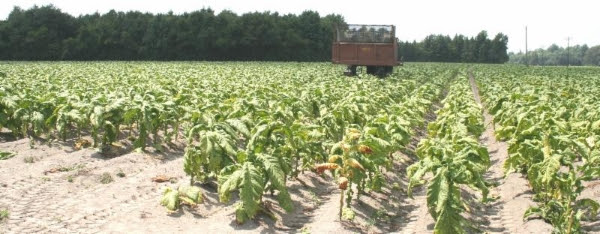
++2014+Season+(4-21-14).jpg)


Tuesday, July 22, 2014
How much flue-cured is really out there?
All indications are that we will have a big flue-cured crop. The NASS thinks it is going to be really big. On July 11, it projected flue-cured production at 536 million pounds, up 18 percent from 2013. Acreage was up only one percent at 232,000. For the individual states: NC--416.3 million pounds, up 15 percent, on 181,000 acres, up a little; VA--50.6 million pounds, up nearly seven percent, on 22,000 acres, up two percent; GA--35 million pounds, an unbelievable 56 per cent on 14,000 acres, up nine percent; SC--34.5 million pounds, up nearly 40 per cent, on 15,000 acres, up three percent. The highest state yield projection was 2,500 pounds in Georgia and 2,300 pounds in the other three states. Burley, dark and other types were not included in this report but will be in the one in August. Florida does not participate in the survey.
A Georgia yield of 2,500 pounds would have been "toppy" even before the hot weather of three weeks ago and continuing appearances of black shank, says J. Michael Moore, Extension tobacco specialist. "Now it seems very unlikely," he says. New incidences of black shank keep appearing, frequently on land that

A new era for NC tobacco: The long-awaited assessment on N.C. flue-cured finally became a reality on July 11. A referendum on the checkoff passed after a three-month balloting period. The assessment was approved on 88 percent of ballots in a mail-in referendum, considerably more than the two-thirds majority needed for approval. "The margin of support for this effort indicates the level of priority our farmers place on having a strong and organized voice to advocate on important issues," says TGANC President Tim Yarbrough of Prospect Hill, N.C. Buyers will collect the assessment and submit it to the N.C. Department of Agriculture for distribution to the association. Refunds can be obtained. A rate of up to 15 cents per hundred pounds of flue-cured sold in N.C. was approved, but TGANC plans to collect only 10 cents this year. Checkoff programs supporting tobacco research and export promotion in N.C. will continue.
With the approval on the referendum, growers now have an official voice to speak for them, says Yarbrough. "We can present a united front. Of course, no association's members are going to agree on everything, but we need a method of responding to issues as they arise. Six months ago, who would have thought that child labor on tobacco farms would be an issue? But Graham Boyd [TGANC executive vice president] has had to spend a world of time on this issue lately and will have to spend more. We must make sure can act quickly when questions like this are asked. The checkoff will help make it possible."
Long overdue: The statewide vote on a commodity promotion assessment for tobacco, the first ever in N.C., was long overdue. "Until now, tobacco was one of the few commodities in our state that didn't have a checkoff program to support its work," said N.C. Agriculture Commissioner Steve Troxler, himself a past TGANC board member. More details about the effect of the referendum will appear in future issues.
Four hundred years of American leaf export: In 1614, the first tobacco exported from what is now the United States made its way by ship from Jamestown, Va., to England. To honor this anniversary, a presentation on how the international trade in tobacco began will be part of the program at the Virginia Tobacco Field Day on July 30 at the Southern Piedmont Research Center. Wayne Randolph, an agriculture specialist at Colonial
DATES TO REMEMBER
|


Tuesday, July 8, 2014
BLACK SHANK ISN'T BACKING OFF
 |
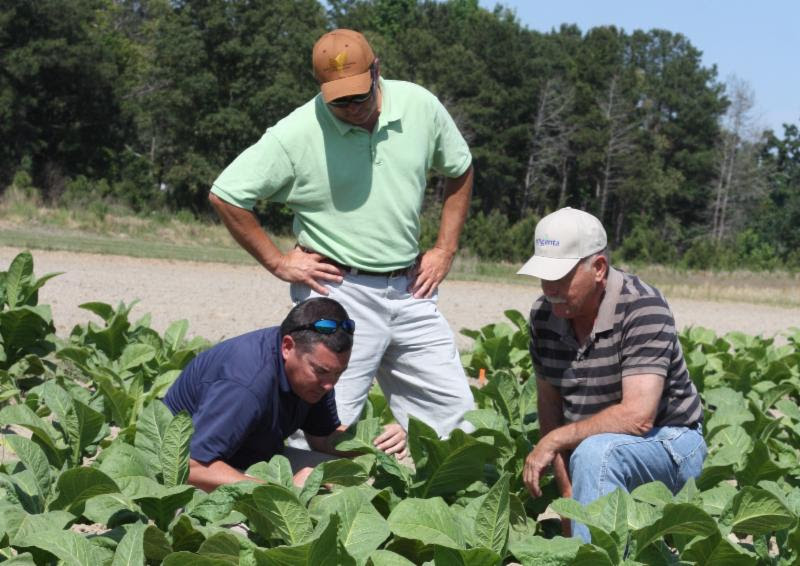
| July is for touring: The N.C. Tobacco Tour will begin July 14 in Wendell and finish July 15 at the Upper Coastal Plain Research Station, Rocky Mt. Above: A presentation at the Upper Coastal Plain station on the 2012 tour. See Dates to Remember for details of other tours. |
REPORTS FROM THE FIELD, July 8, 2014
Burley
in central Kentucky is
doing well, says grower Roger Quarles of Georgetown, Ky. "It
looks as good as you could ever want it to look," he says. "The
early-set tobacco is a week or 10 days from topping, and the
later-set looks good too." He said he hadn't heard of a single
instance of black shank in the area, not even in fields that have
been hotbeds for the disease in the past. He expects harvest to start
around August 1.
Topping
has just started for
dark growers in Kentucky
and Tennessee.
Planting appears to be done. "Some dark tobacco was set out on
June 30 near Murray, Ky.," said Andy Bailey, Kentucky-Tennessee
tobacco specialist. "I think that was the last that will be
planted. A lot of our larger growers finished 10 to 12 days ago."
No serious crop problems had developed. He saw some temporary
phosphorus deficiency on some of the lower leaves, but he predicted
that the plants would recover completely. There was no plant
shortage. "I am not aware of anyone who didn't get enough
plants," he says.
Just
enough plants in Tennessee: Jay
Head of Clarksville, Tn.,who grows dark tobacco and burley, also
produces commercial plants. He thinks farmers in his area were able
to locate the plants they needed. But it was close. "I sold the
last plants I intended to sell on July 3," he says. "When
we were done, we only had 100 trays left, out of about 6,000."
Hurricane
Arthur only affected some coastal
counties in North
Carolina. In Pender
County, 30 to 50 mile per hour winds did some damage,
says Mark Seitz, Pender County Extension agent. But in
general, he says, "Arthur's worst went north." Drought
was more widely reported last week. "Tobacco is very stressed
and drawn up," said Brian Parrish, Harnett County Extension
agent, in an NASS report. "Many farmers are beginning to
irrigate their tobacco." In the same report, Joey Knight,
Caswell County Extension, said black shank is showing up in tobacco
fields in his Piedmont county, especially in the 326 variety...A
little harvesting has taken place in eastern N.C. Most farmers
have applied a couple of contacts and are getting close to MH
application, says Matthew Vann, N.C. Extension tobacco specialist.
The supply of plants was adequate but some had to be brought in from
out of state, he says. "But in the Piedmont, we heard of
farmers having extra plants."
Some
growers started harvesting in South
Carolina last
week, but most, at least in the Pee Dee region, are still topping.
"Generally, the crop looks pretty good," says William
Hardee, area Extension agronomy agent for Horry and Marion counties.
"We have some tobacco that looks great around the Green Sea and
Nichols area (near the North Carolina line). Some is chest high now."
But other tobacco doesn't look so good. "Some looks like it
was stunted by the heavy rainfall," Hardee says. There have been
few problems. "I have seen a bit of tomato spotted wilt virus
and a little bacterial wilt and black shank, but not much," he
says.
Extreme
heat is making it difficult for Georgia and Florida growers
to apply sucker control chemicals, says J. Michael Moore, Extension
tobacco specialist for the two states. And that is not all that is
making this crop difficult in the Deep South. "Heavy
infestations of black shank continue to occur," Moore says. "We
see plants melt down more quickly now than normal, again because of
the heat." A curious note: "There's been extensive damage
this season in fields that had reasonable rotations," says
Moore. "And it doesn't seem to matter what the variety is."
The
four types grown in Pennsylvania all
got off to a good start, says Jeff Graybill, Pa. agronomy Extension
educator. "I would describe the condition of the tobacco crop as
good to excellent," says Graybill, who is stationed in
Lancaster. "We have good uniform stands, and I have had very few
calls on disease issues." The supply of plants was tight, but
Graybill says as far as he knows, no fields went unplanted. He
estimates acreage at close to 9,000, a little more than last year.
Burley accounted for more than 3,000 acres, Southern Maryland for
about 3,000, Pennsylvania seedleaf around 2,500 and Green River dark
air-cured perhaps 300 acres. Green River is still relatively new in
Pennsylvania, but Graybill says farmers have been successful in
producing marketable leaf of this type.
OUTSIDE
THE U.S...
Zimbabwe
will exceed 200 million kilograms in sales for
the first time in quite a while, if it hasn't already. Auction and
contract markets in Zimbabwe are well on their way to selling the
country's largest crop in 14 years, said the Tobacco Industry and
Marketing Board (TIMB) last month. TIMB said that 193.1 million
kilograms had been sold at the country's three auction floors and at
contract facilities through the eightieth day of marketing (June 16),
32 percent more than in the same period last year. At least 125 total
sales days are expected. If daily sales average--as expected--a
million kilograms a day, the total would come in at around 230
million kilograms. That would be short of the previous high of 260
million kilograms in 1998 but better than the 227 million kilograms
of 2000, the last time volume exceeded 200 million.
The
Canadian flue-cured crop is
up and growing, says Fred Neukamm, chairman of the Ontario tobacco
board. "We are three to four weeks from topping," he says.
"The crop is about on schedule, or maybe a few days behind. It
is getting to the point that we could use some rain. Some growers are
beginning to irrigate." Because of the cold and the cloudy
weather experienced this winter, the plants didn't "toughen"
in the greenhouse. "But in the field, the crop is not too bad,
considering." Production is expected to be down slightly from
2013. "Both acreage and poundage are down by six percent, and
two fewer growers contracted to grow tobacco this year," he
says.
Ontario
growers have benefited considerably since
Grand River Enterprises (GRE) began selling leaf to China two years
ago. The company, which processes leaf in a factory in Simcoe, Ont.,
is owned by the Six Nations Indian reservation, which is located on
the edge of the Ontario leaf production area. GRE is now the number
two buyer of Ontario leaf, after Alliance One.
INDUSTRY
NOTE
Who
will own Lorillard? Or RJR? Or Santa Fe? The speculation
has been rife in recent months about possible sales or mergers of
cigarette companies neighboring or associated with RJR. A respected
tobacco financial analyst has predicted that an acquisition of
Lorillard by RJR is all but a sure thing. Bonnie Herzog of Wells
Fargo Securities says she believes there is a 90 percent chance it
will happen. She also thinks that such a deal could result in a sale
or spinoff of RJR's subsidiary Santa Fe Natural Tobacco Company,
which could be worth as much as $6 billion, about 166 percent more
than what Reynolds paid for it.
Still
another possibility: British
American might buy more of R.J. Reynolds' stock than the 42 percent
it currently owns. It could potentially buy a controlling share,
assuming regulatory agencies approve.
DATES
TO REMEMBER
- July 10, 8:15 a.m. South Carolina Tobacco Tour, Pee Dee Research and Education Center, 2200 Pocket Rd., Florence, S.C. The tour will end at 3:30 in Sumter County.
- July 14, 3 p.m. N.C. Tobacco Tour. Edwards Farm, 200 Salem Church Rd., Wendell, N.C. 5 p.m., 6:30 p.m. Welcome Dinner (registration required), Fargo Cattle Company, 1007 Shepard School Rd,, Zebulon, N.C.
- July 15, 8 a.m. N.C. Tobacco Tour. Upper Coastal Plain Research Station, 2811 Nobles Mill Pond Rd, Rocky Mt., N.C. Ends with lunch at noon.
- July 30, 3 p.m. to 7 p.m. Virginia Tobacco Field Day. Southern Piedmont AREC, Blackstone, Va. Contact: Margaret Kenny, 434-292-5331 or makenny@vt.edu.
- July 31, 7:30 a.m. to 1 p.m. Grains and Tobacco Field Day. UK REC, Princeton, Ky. Contact: 270-365-7541 ext 264.
- August 4-5. Lexington, Kentucky. Tobacco Industry Tour. Contact: Bob Pearce, (859) 257-5110.
- August 7, 5:30 to 8:30 p.m. Tobacco Twilight Tour, Murray State University West Farm, Murray, Ky. Contact: Andy Bailey, tobacco specialist, at 270-365-7541 ext. 240.
| ||||||||
|
Wednesday, June 18, 2014
GEORGIANS BELTED BY AGGRESSIVE BLACK SHANK
 |
| Where did this aggressive black shank come from? asks pathologist Paul Bertrand. |
Black shank rose up "with a vengeance" in Georgia and Florida in the last month, says J. Michael Moore, Extension tobacco specialist for the two states. "We are seeing it in some fields where we wouldn't expect it--fields with a good rotation and even some fields that hadn't had tobacco in years," says Moore. A good example: The Ben Smith farm in Coffee County, Ga., which Paul Bertrand, Georgia plant pathologist, said was struck by "the most aggressive black shank we have ever seen (see photo above). The field had been in pecan trees for the last half century, with pasture surrounding the trees. The trees were removed and what was believed to be the first tobacco crop ever grown in this field was planted in 2013. The second was planted in 2014, but it didn't last long. The damage was so bad that the farmer has disced it up since this picture was taken on June 11.
A further explanation of how to treat black shank in burley. Editor's Note--The following item appeared in a shorter form in the last issue of Tobacco Farmer Newsletter. Since then, I have received a corrected and extended version of the same piece from the original source, former Extension plant pathologist in Kentucky Kenny Seebold. Since it contains good additional information, I am going to run the amended version here. Apologies for the duplications: "Where black shank has been a problem in the past, consider making a pre-plant application of Ridomil Gold at a half pint per acre if applied in setter-water or one pint per acre if applied as a broadcast spray to soil. This would be the same as a half quart per acre of Ultra Flourish or four to six quarts of MetaStar. For light-to-moderate disease pressure, the first application of fungicide can be delayed one to two weeks after transplanting. For extended control of black shank, make a supplemental fungicide application (one pint of Ridomil, one quart of Ultra Flourish, or two quarts of MetaStar) at layby or at first cultivation and again at layby. Sprays made after transplanting should be directed toward the soil and incorporated immediately by cultivation or irrigation. An inch or two of rain will also incorporate these products. Best results are generally obtained when resistant varieties are planted."
Price outlook holding: Unless flue-cured acreage is up much more than expected or unless the growing season is poor, the price for the current flue-cured crop should remain strong, says N.C. Extension economist Blake Brown. But it probably not as strong as in 2013, when the average price was estimated by USDA at $2.115 a pound. The March Planting Intentions report projected 232,000 acres, up 3,500 acres from the 228,800 acre 2013 crop. Based on past experience, that may be a low projection. "In previous years, planting intentions were as much as 10,000 acres below the actual crop acreage for the year in question," says Brown. But the supply of transplants may not have been adequate to support a much larger crop.
The plant shortage never materialized in Kentucky. "Even now, from what I am hearing, you can still find plants available if you need them," says Bob Pearce, Kentucky Extension tobacco specialist. But not many do--85 percent or perhaps 90 percent of the state's burley has been seeded already. The crop has gotten off to a good start, but because of cloudy days, there has been some early blooming. "I think we might see some more," Pearce says.
There was definitely a shortage of plants in Georgia and Florida. "We saw quite a scramble at the end," says Moore. "All ours were set, and the last plants that went in were from North Carolina. But I think nearly everybody was able to plant the acres they wanted to." He makes a very rough estimate of 15,000 acres planted in Georgia and 1,500 acres in Florida. The crop started out about two weeks behind in both states but has caught up by at least half a week. He expects harvest to begin in 2 ½ weeks.
Planting in the N.C. Piedmont appears complete. "I don't know anyone who is not done planting," says Dennis White, owner of the Old Belt Tobacco Sales auction warehouse in Rural Hall, N.C. "There weren't many plants to spare but everyone was able to plant the acres they wanted." So far, the tobacco looks good, he says. Some of it was laid by last week.
Spotted wilt infestations are much higher in Georgia and Florida than predicted considering the cold winter. Says Moore, "It defies logic to have so much TSWV after such cold weather. I would place the average infestation now at 15 to 20 percent of the plants." That is not the worst incidence of spotted wilt Type 14 tobacco has ever had. "But it certainly was a surprise," says Moore.
Position changes: Kenny Seebold (see earlier item) has left his longtime post as Kentucky Extension plant pathologist and is now working as product development manager for the fungicide line of Valent USA...Jeff Vice is now the tobacco specialist for the Burley Tobacco Growers Cooperative Association. He will be responsible for grading and purchasing of burley with the goal of increasing the amount of tobacco purchased and expanding marketing to the trade. Vice is definitely an old hand in the leaf business--he has 38 years experience, starting with Universal Leaf and later with Philip Morris USA/Altria.
If you are hand weeding tobacco, pull the weeds from the soil before set occurs, says Matthew Vann, N.C. Extension tobacco specialist. "Once weed seed develop, you can actually spread them by hand removal." He also recommends that once you pull the weeds, you remove them from the field. "In rare situations, weeds such as grass and amaranth species have been known to 're-root' when left on the soil surface," he says.
Dates to remember:
- June 26, 8 a.m. Tobacco Field Day. UT Highland Rim Ag Research and Education Center Springfield, Tn. Contacts: Barry Sims at 615-382-3130 or bsims@utk.edu.
- July 14-15. N.C. Tobacco Tour. Tuesday: Opening dinner, 6 p.m. Wednesday: Tour Upper Coastal Plain Research Station, Rocky Mt., N.C. Further events to follow.
- July 30, 3 p.m. to 7 p.m. Virginia Tobacco Field Day. Southern Piedmont AREC, Blackstone, Va. Contact: Margaret Kenny, 434-292-5331 or makenny@vt.edu.
- July 31, 7:30 a.m. to 1 p.m. Grains and Tobacco Field Day. UK REC, Princeton, Ky. Contact: 270-365-7541 ext 264.
- August 7, 5:30 to 8:30 p.m. Tobacco Twilight Tour, Murray State University West Farm, Murray, Ky. Contact: Andy Bailey, tobacco specialist, at 270-365-7541 ext. 240.

BIG M TOBACCO WAREHOUSE
1723 Goldsboro St. SW, Wilson, N.C.,
in the old Liberty Warehouse
 | ||
| Greg Goins is the auctioneer at Big M Warehouse. |
We will hold both sealed bid auctions
and live auctions.
We promise
HONEST AND TRUSTWORTHY
SERVICE
For more information, contact Mann Mullen at 919-496-9033
or the warehouse switchboard at 252-206-1447.
Email: shrimpmann@embarqmail.
Wednesday, June 4, 2014
BLACK SHANK BUSTS OUT IN GEORGIA, THRIPS IN N.C.
|



Subscribe to:
Posts (Atom)