Thursday, September 10, 2015

COULD YOU MAKE MONEY GROWING ENERGY TOBACCO?


Join Our Mailing List
Silage cutting tobacco
Densely planted, no sucker control, then cut like silage: Energy tobacco will cost much less to produce than conventional. (Photo provided by Tyton)

A company in Virginia will soon begin signing contracts with farmers to produce tobacco for the manufacture of ethanol and biodiesel. Tyton BioEnergy Systems of Danville wants farmers to grow "energy" tobacco for delivery to its extractor in Danville (or to another extractor that is in the works in Raeford, N.C.) No information yet on prices or what scale of production of the company is looking for, but all that should be available fairly soon.

Cheaper to grow: The cost of producing energy tobacco should be much less than that of flue-cured, burley or any of the dark types. There will be no cost of plant production: Tyton will provide the transplants. Spacing of rows need not change but the spacing within the row will be much denser. You may need to tweak your fertility program to some degree but Tyton leaders don't expect a significant increase in total fertilizer per acre. You won't need to control suckers since suckers produce the end product just as well as leaf. But topping is desirable, although it apparently didn't get done in the photograph above. Control of insects and diseases will not be affected. You will harvest with a silage chopper, probably in mid summer, which would be the time of peak sugars, and perhaps once more at the end of the season. Curing is a thing of the past--the energy tobacco will go straight from the field to Tyton.

Eventually, beltwide plantings of energy tobacco are the goal. But for 2016, most contracting farmers will be in the vicinity of the two extractors. The company expects to expand into Kentucky-Tennessee and Georgia-Florida in the near future. Tyton's basic varieties--which were derived from flue-cured breeding material--will be planted in all current tobacco-producing areas.

Contracting to grow energy tobacco has not yet begun but will soon. No information yet on prices or what scale of production of the company is looking for, but all that should be available fairly soon too. It sure wouldn't hurt to get into company's database now. You can do that by sending an email to farmer@tytonbio.com.

EDITOR'S ASSESSMENT:  I am not a tobacco farmer, never have been. But if I was, I would run to my word processor and get my name in the hat to grow this new type. What could be the down side, as long as the price is high enough to return production costs and a reasonable profit? You don't have to grow plants, you don't have to control suckers, and you don't need workers to hand harvest. Best of all, no curing is required, or at least not by you. The company will take care of whatever processing is needed after harvest. This seems like an effort with infinite promise. I urge you now or tomorrow or the next day to send an email (you should be able to do it by clicking on the address above) and get on the list. There is no obligation; you're just letting Tyton know you might be interested.--Chris Bickers 

In other tobacco news: A new organic tobacco company begins accepting leaf deliveries this week. The two receiving stations for tobacco contracted by Swiss Organic Tobacco (SOT) will begin this week taking deliveries every other week. It will be on a rotating basis. The station in Wilson, N.C.--at R.C. Commodities, 1801 London Church Rd.--will begin receiving for SOT this Friday, September 12, while the one inKernersville, N.C.--W/S Tobacco Services, 1459 Brookford Rd.--will begin Friday, September 18. Each will take SOT deliveries on alternate Fridays till the market closes.

Believe it or not, domestic cigarette sales and production are both actually slightly higher for the first five months of 2015 compared to the same period last year, says Will Snell, Kentucky Extension tobacco economist. "How can that be the case? After all, the extreme cold weather in many parts of the U.S. this past winter likely limited ...lighting up outside in midst of growing in-door smoking restrictions. Plus, cigarette price increases have been running four times the overall inflation rate." 

Possible explanations: Lower gas prices might be impacting cigarette sales as convenience stores (most of which sell gasoline) sell an estimated 65 to 70 percent of smokes. The growth in electronic cigarettes may be waning as tobacco consumers prefer to get their nicotine from cigarettes. Or it might be just some inventory adjustment by the manufacturers or a short term anomaly? "At this point, it is unclear how this surprising short-term trend may impact the market for the 2015 crop and contract volume for 2016," says Snell. (This was derived from an article on the Council for Burley Tobacco webpage. For more, go to www.councilforburleytobacco.com and click on "News.") 

Plenty of tobacco, not much demand. American Tobacco Exchange its fourth sealed bid auction of the season Wednesday afternoon, and sales remain in the doldrums. "All we saw till today was fair to low quality lugs," says Randy Brandon, manager of the auction. "We got a few cutters today but no leaf at all." Volume has been about what he expected. The quality of offerings should improve soon, he thinks, because of late rains and farmers' commitment to letting their leaf get ripe.

Editor: Chris Bickers/903-9 Shellbrook Ct./Raleigh NC 27609/chrisbickers@gmail.com/ 919 789 4631
TMI
BIG M TOBACCO WAREHOUSE 
1723 Goldsboro St. SW, Wilson, N.C., 
in the old Liberty Warehouse
Greg Goins is the auctioneer at Big M Warehouse.
We hold sealed bid auctions
We promise 
HONEST AND TRUSTWORTHY 
SERVICE
We will be GAP certified 
For more information, contact Mann Mullen at 919-496-9033 
or the warehouse switchboard at 252-206-1447.


Bigger is better
  
How burley bloomed in the Blue Ridge


For an easy-to-read account of how burley came to east Tennessee and western North Carolina in the late 1800s, along with oral history interviews with some of the best of the older generation burley farmers, and much more, order The History of Burley Tobacco in East Tennessee & Western North Carolina by Billy Yeargin and Christopher Bickers. Send a check for $25 to Chris Bickers, 903-9 Shellbrook Ct., Raleigh, N.C. 27609. Questions? Contact Bickers by phone at 919 789 4631 or via email at chrisbickers@gmail.com.

  
Best of the Piedmont
FARMERS TOBACCO WAREHOUSE

209 Harding St., Danville, Ky.
PH: 859-236-4932

Full-service burley warehouse

Jerry Rankin, Owner


  Call for information.

Tuesday, September 1, 2015

MORE FLUE-CURED GOING TO AUCTION


What is this crop worth: George Hunt (center) of the buying company Tobacco Rag Processors (TRP) questions a particular lot of flue-cured that was on sale at the Big M warehouse on August 19. Consulting with Hunt are Barry Garner (left) of TRP and Merion Haskins, a TRP contract buyer.


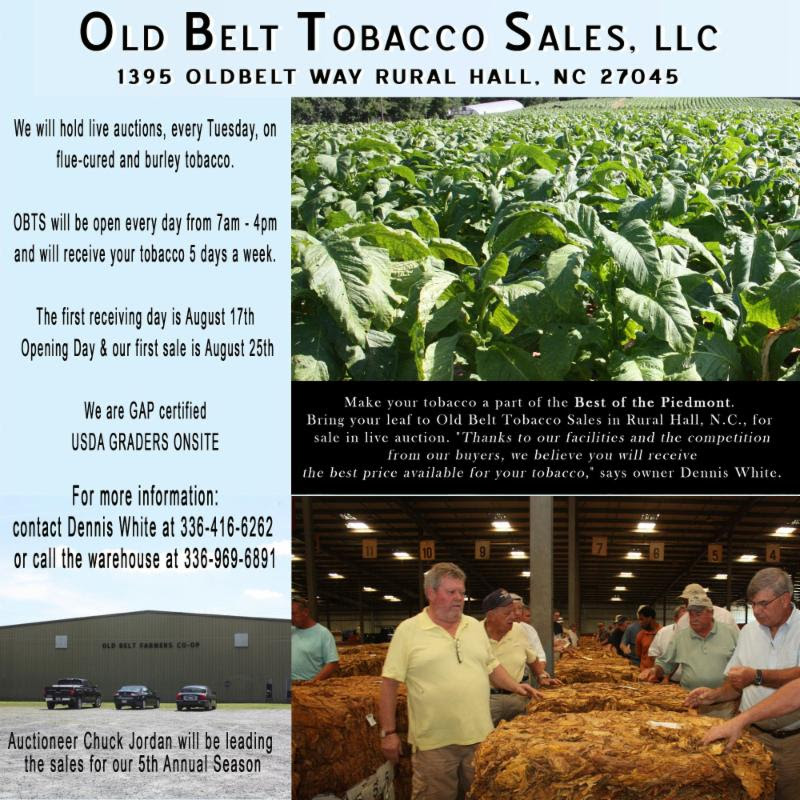
The opening day offerings on August 25 at the Old Belt Tobacco Sales warehouse in Rural Hall, N.C., were all dry weather lugs with no body, says warehouse owner Dennis White. "The five buyers we had didn't put any in number one grades," he says. "But I think we did as good as the receiving stations." The best tobacco brought $1.35 to $1.40, while fourth grade tobacco brought $1 to $1.10 and fifth grades 50 cents to 65 cents. "I was satisfied," he says. Very few bids were rejected, White says. White is optimistic about the next round of leaf. "We have had some rain in the Piedmont since the lugs went into the barn." He sold 160,000 pounds at the sale and expects to sell more at his second sale today.

Two sales a week in Wilson: Big M warehouse in Wilson, N.C., has started selling on Monday as well as Weednesday, says owner Mann Mullen. Sales have gone well so far. "We had fair prices, given the low demand for dry weather lugs of any types," he says. A few number ones and number twos sold well.

Several farmers have expressed concern to TFN that Swiss Organic Tobacco, the new company buying organic tobacco in the states, has not yet begun accepting deliveries of the tobacco it contracted with them. Son Butler, a spokesman for the company, told TFN that he is confident that the station will open no later than early next week (the week beginning with Labor Day) and perhaps earlier. He insisted that the relatively late opening will not prevent the full delivery of the company's purchase.

Less than half the Georgia crop has been marketed so far, and the best is still in the field, says J. Michael Moore, Georgia Extension tobacco specialist. "We have sold part of the first harvest and a little of the second," he says. "There has been a quality problem in the lower stalk, and we have very seldom seen number one grades." But the price at receiving stations is creeping up to $2.05. "We could use some rain now to help ripen the crop."

Flue-cured is flourishing in the N.C. Piedmont. Grower Stanley Smith of King, N.C., says there were some rough moments earlier, especially four straight weeks with very little rain. "But now, the crop is good," he says. The quality will be above average, Smith thinks. "But we will have to see what the market is demanding. I have heard that the companies are grading awful strict."

The balance of burley supply and demand is better now thanks to the weather this season, says Will Snell, Kentucky Extension ag economist. "The 2015 U.S. burley crop was projected [in the recent USDA crop report] at 157.3 million pounds (-26 percent), with Kentucky's estimate forecast to total 117.8 million pounds (-28 percent).  Beltwide, acres are down 18 percent, while the average U.S. burley yield is off 11 percent." This much smaller crop may be more in line with--or perhaps even below--anticipated U.S. burley needs in the current demand environment, he says.

In Tennessee, the rain started up again in August and interfered with harvest on the burley farm of Tony Hutson of Bell Buckle, 50 miles south of Nashville. "I have been spearing and hanging this week," he said on August 20. "But I couldn't wilt it because of the rain. I had to hang it green to keep the mud off." Marketing is uncertain because he didn't contract this year. "I have been selling my tobacco at the [Farmers Warehouse] auction in Danville, Ky." It has worked out reasonably well. "I sold last year at the third-from-last sale. I averaged $1.80 a pound," he said.

Dark fire-cured harvest is progressing well in Appomattox County, Va., says Bruce Jones, Extension tobacco agent. But there are still some dry sections in the county that need rain. "Most areas received a little rainfall [recently] but it was very spotty," Jones says. "Some areas only received a few tenths of an inch."


Dewitt Gooden
Editor's Note: Tobacco has lost two old friends. Earlier this summer, Dewitt Gooden, the longtime tobacco Extension specialist in South Carolina, died in Florence.He had a long career and was still trying hard in his Seventies to meet the informational needs of the state's farmers. He was known among agricultural journalists as a very resourceful specialist who could always find a way to make our stories come alive. I remember the first time I met him: I think it was in 1974. I was working my way through the University of Georgia writing press releases for the College of Agriculture, and I was assigned to interview a fellow named Gooden who had been (if I remember correctly) hired to be a soybean specialist in Statesboro. The interview was scheduled to last 20 minutes, but he had so many fascinating things to say that I think we talked for two hours. I remember thinking, "This is the 'countriest' man I have ever met in Extension, and that's saying something."  He will be missed, by many others besides me.

I met Robert Shipley of Vilas, N.C., in the Eighties when he came to Raleigh to 
Robert Shipley
speak to the leadership of the Tobacco Growers Association of N.C., for which I was doing publicity. It was the start of a very valuable relationship for me, as over the years he could always tell me the mountain burley context of any tobacco question. And he was damned good company. For many years he was a vocational agriculture teacher in Watauga County, and he was also a successful cattleman, but what I always remember is his long tenure representing North Carolina on the board of the Burley Stabilization Corporation, then in Knoxville, Tn. To say that he had a long and full life would be an understatement: On August 8, when he was 103, he came out in a pasture on his home farm and helped his son and grandson unveil their new steroid-free, antibiotic-free, pasture-based beef herd. A week later, he passed on. It was hard to feel sorrowful for a man who did as many things for others as he did. I just hope people have as good an opinion of me when I am gone as they have of Bob.

Chris Bickers / 903-9 Shellbrook Ct. / Raleigh NC 27609 / 919 789 4631 / chrisbickers@gmail.com


How burley bloomed in the Blue Ridge
For an easy-to-read account of how burley came to east Tennessee and western North Carolina in the late 1800s, along with oral history interviews with some of the best of the older generation burley farmers, and much more, order The History of Burley Tobacco in East Tennessee & Western North Carolina by Billy Yeargin and Christopher Bickers. Send a check for $25 to Chris Bickers, 903-9 Shellbrook Ct., Raleigh, N.C. 27609. Questions? You can contact Bickers via email at chrisbickers@ gmail.com or by phone at 919 789 4631.


TMI


BIG M TOBACCO WAREHOUSE 
1723 Goldsboro St. SW, Wilson, N.C., 
in the old Liberty Warehouse
Greg Goins is the auctioneer at Big M Warehouse.
We hold sealed bid auctions
We promise 
HONEST AND TRUSTWORTHY 
SERVICE
We will be GAP certified 
For more information, contact Mann Mullen at 919-496-9033 
or the warehouse switchboard at 252-206-1447.

Bigger is better

Best of the Piedmont

FARMERS TOBACCO WAREHOUSE

209 Harding St., Danville, Ky.
PH: 859-236-4932

Full-service burley warehouse

Jerry Rankin, Owner


  Call for information.

Tuesday, August 18, 2015

BURLEY DOWN 26%, FLUE-CURED DOWN 17%, PROJECTS USDA

Crew in tobacco field
Topping out: Flue-cured grower Stanley Smith (right) directs his workers as they top on August 7 on his farm near King in the Piedmont of N.C.

SERIOUSLY SMALLER FLUE-CURED, 
BURLEY CROPS IN 2015 THAN 2014

THE USDA AUGUST 12 PRODUCTION ESTIMATE
Production projections plus estimated change from 2014
FLUE-CURED: Georgia--29.25 million pounds, down 15 percent. North Carolina-- 365.5 million pounds, down 19 percent. South Carolina--27.17 million pounds, down 18 percent. Virginia--51.450 million pounds, down nearly five percent. All U.S.--473 million pounds, down 17 percent.
BURLEY: Kentucky--117.8 million pounds, down nearly 28 percent. Tennessee--20,800, down 23 percent. Pennsylvania--11,280 m, down 11.5 percent. Ohio--3,325 million pounds, down 22.6 percent. Virginia--2,080 million pounds, down almost 29 percent. North Carolina--1,980 million pounds, down 25.5 percent. All U.S.--157 million pounds, down 26 percent.
OTHER TYPES: Fire-cured (Kentucky/Tennessee/Virginia) -- 56.6 million pounds, down four percent. Dark air-cured (Kentucky/ Tennessee)--16.6 million pounds, down five percent. Cigar types (Connecticut /Massachusetts/Pennsylvania)--nine million pounds, no change. Southern Maryland (Pennsylvania)--4.4 million pounds, down six percent.
ALL U.S. TOBACCO PRODUCTION is forecast at 717 million pounds, down 18 percent from 2014. 

Reports from the field

FLUE-CURED
VIRGINIA--Flue-cured growers have nearly completed pulling their crop the first time, says David Reed, Virginia Extension tobacco specialist. "It will probably take another week," he says. "The quality is reasonable. But these are first primings and the market for them is soft." Rain in the Southside has been spotty, but some areas have had four to six inches of rain recently. "We will be selling less than last year," says Reed. "The recent USDA report has us at 21,000 acres, up from its earlier estimate of 19,500. That is down from 22,500 acres last year and sounds about right to me." NASS reported that 21 percent of the crop had been harvested by August 8.

NORTH CAROLINA--Harvest is wide open in much of the state, although in the Piedmont it has just gotten started, says Matthew Vann, N.C. Extension tobacco specialist. "Overall, I would say we are about two to three weeks late because it was so hot and dry earlier. This is a dry weather crop and difficult to cure." The big news:
Black shank may be as bad as it's been in the last 10 years, perhaps because of the prolonged heat and dry conditions. Also, there has been some late pressure from Granville wilt and some hollow stalk. "In a few cases, the disease pressure has been enough that the farmers have stripped some fields in order to save them."

SOUTH CAROLINA--Almost all of the tobacco (all flue-cured) has been cropped at least once, says William Hardee, area Extension agronomy agent in the Pee Dee area. "And much of it has been cropped a second time. I would say we are at least halfway through the harvest season. Bacterial wilt has hit us hard here lately, and symptoms have progressed very quickly due to the added drought/heat stress on the plants." Many growers have started stripping their crop to keep from losing leaf in the field. 
GEORGIA--About half of the crop (which is all flue-cured) had been harvested by August 8, said NASS, which projected production at 29.5 million pounds, down about 15 percent from last year.
BURLEY
KENTUCKY--Things are looking up since a month ago. "Overall, we have a fair crop now," says Bob Pearce, Kentucky Extension tobacco specialist. "We have pockets where the crop was drowned out, and in some cases we weren't able to spray on a timely basis. But harvest has started and what is coming in looks pretty good." It will be a wet weather crop, not a bumper crop, but as of now, it looks reasonably good. "Growers have done a good job getting all there is to get," Pearce says. After a mostly wet season, the last two weeks have been more or less normal. "A lot of fields have dried out. Topping is about 75 percent complete and maybe 10 to 15 percent of the crop has been harvested."

TENNESSEE--Harvest of burley in Bradley County in the southeastern part of the state was about 30 percent completed through August 9, said Patrick Sweatt, county Extension agent. "Weather has been dry and mild for the past two weeks (July 27 to August 8), punctuated with heat in the mid-90s (but) only a couple of times." Statewide, about 65 percent of the burley crop had been topped by August 8, NASS said.
NORTH CAROLINA--If the research plots at Laurel Springs and Waynesville are any indication, the burley crop in western North Carolina should be terrific, says Vann. "In Laurel Springs, the burley is absolutely beautiful. You have to say the crop looks very good." Black shank has not been the issue for burley growers in the state, he says...In Madison, the leading burley county in the state, Extension tobacco agent Kendra Norton says it had been damp earlier, but now some fields could use rain. A blue mold scare (see below) may cause farmers to top a little ahead of schedule.
DARK
KENTUCKY-TENNESSEE--The Black Patch has dried considerably, says Andy Bailey, Extension tobacco specialist. "In particular, Springfield, Tn., has been dry the last two or three weeks. It is pretty good harvest weather. We have cut 40 percent of the crop on some farms, none on others. Maybe 10 to 15 percent of all acres has been cut by now. That would be about normal." This crop won't weigh as much as expected, Bailey says. "The cured weight will be low compared to the green weight." There has been quite a bit of black shank the past two weeks, but a bigger problem has been wind damage and blown over tobacco. "We had to use more MH than normal because of crooked stalks which made it difficult to use rundown application of (non MH) sucker control chemicals." Bailey thinks dark farmers have lost five to 10 percent from what they expected when they set, mostly to water and wind.

VIRGINIA--The tiny fire-cured crop in Virginia seems to be doing well, according to Reed. USDA estimates plantings at 350 acres, up six percent since last year, and production at 805,000 pounds, up almost 11 percent from last year.

In other tobacco news:
Blue mold blows away. Back on June 2, blue mold was found on burley transplants in Greene County in northeastern Tennessee. The site was a greenhouse at the University of Tennessee tobacco research station in Greeneville, where sanitation is routinely maintained at a high level. Apparently, a shower of blue mold spores occurred, presumably on such a small scale that only the one greenhouse was affected. Since then, there have been a few cases of blue mold, one in a field near the greenhouse, and others in nearby Tennessee counties. Perhaps the last incidence of the season was found in July in Madison County, N.C., which adjoins Greene County to the south. The farmer topped and had no problems after that. None of the incidences caused an economic impact. The tobacco plant is less conducive to blue mold after topping, but Pearce of Kentucky says it could still appear. "It appeared about this time a year ago so it could still have an impact," he says.
Impact of Chinese devaluation? China devalued its currency recently, rendering the yuan about three or four percent less valuable relative to the dollar than it was before. Considering that China is our leading customer for leaf tobacco, should be we concerned? I am no economist, but this devaluation is so small that it seems very unlikely that there will be any noticeable effect on our exports. Also, tobacco is traded internationally in U.S. dollars, as it has been my whole adult life. The relative costs between producing countries should continue to be the factor that determines where China goes for tobacco.
Auctions opening for flue-cured: The American Tobacco Exchange will begin conducting silent auctions this Wednesday at the old Planters Warehouse in Goldsboro. Street address is 1002 U.S. Hwy. 117 Bypass South. The sale will take place from 8 a.m. to 3 p.m. Delivery has begun so if you would like to sell there, call Randy Brandon or Sonya Jackson at 919 429 8900...The season's first sale at Big M Warehouse in Wilson, N.C., will take place this Wednesday at 10 a.m. It will be a sealed bid auction. Deliveries have begun. Call 919 496 9033 to sell there...The Old Belt Tobacco Sales warehouse will begin live auctions on Tuesday, August 25, at 10 a.m. or maybe a little later. Delivery has begun. Call 336 416 6262 or 336 969 6891 if you want to sell there.

Will there be any other flue-cured auctions this season? If you know of any other than the ones listed above, let me know at chrisbickers@gmail.com or call me at 919 789 4631. In a future issue I will list burley auctions for the coming season. 


Bigger is better
 

Best of the Piedmont


FARMERS TOBACCO WAREHOUSE

209 Harding St., Danville, Ky.

Full-service burley warehouse

Jerry Rankin, Owner


  Call for information.


TMI

BIG M TOBACCO WAREHOUSE 
1723 Goldsboro St. SW, Wilson, N.C., 
in the old Liberty Warehouse
Greg Goins is the auctioneer at Big M Warehouse.
We hold sealed bid auctions
We promise 
HONEST AND TRUSTWORTHY 
SERVICE
We will be GAP certified 
For more information, contact Mann Mullen at 919-496-9033 
or the warehouse switchboard at 252-206-1447.


Quality does not cost, it pays


For the history-minded among you
History

For an easy-to-read account of how burley came to east Tennessee and western North Carolina in the late 1800s, along with oral history interviews with some of the best of the older generation burley farmers and much more, order a copy of The History of Burley Tobacco in East Tennessee & Western North Carolina, by Billy Yeargin and Christopher Bickers (editor of this newsletter) Send a check for $25 to Chris Bickers, 903-9 Shellbrook Ct., Raleigh NC 27609. Questions? Contact Bickers  at 919-789 4631 or atchrisbickers@gmail.com.

Monday, August 3, 2015

AN EARLY AUGUST CROP REPORT


Harvester in action
An Old Belt flue-cured grower harvests his leaf near Forbush, N.C.
 DROUGHT, HEAT PLAGUE FLUE-CURED
WHILE RAIN SUBSIDES FOR BURLEY 
FLUE-CURED

North Carolina--Harvest is well under way in the flue-cured areas. "We appear to be right on time," says Matthew Vann, N.C. Extension tobacco specialist. "The Piedmont was a bit early getting plants to the field." Quality reportedly ranges from moderate to exceptional coming out of the barn. "There are still fields that remain untouched all over the state, but for the most part, all ripe leaf has been pulled," he says. "Dry weather continues to plague the vast majority of flue-cured growers, but showers over the past few weeks have made a decent crop in places. A little more rain would finish everything very nicely."

Georgia--Farmers have a reasonably good crop, perhaps a bit on the thin side. "We had some extensive heat in the last month that damaged the top the plant, but everyone is pretty upbeat now," says J. Michael Moore, Georgia Extension tobacco specialist. There has been greater than average incidence of tomato spotted wilt virus and some serious problems with black shank. But he expects a normal yield of around 2,200 pounds per acre across the state, on about 12,500 planted acres. Harvest is well under way. 

Florida--Harvest is proceeding here too. Farmers have a very good crop. There has been adequate rainfall, and Moore expects a yield in the range of 2,600 pounds, on about 1,250 planted acres. 

Georgia--Farmers have a reasonably good crop, perhaps a bit on the thin side. "We had some extensive heat in the last month that damaged the top the plant, but everyone is pretty upbeat now," says J. Michael Moore, Georgia Extension tobacco specialist. There has been greater than average incidence of tomato spotted wilt virus and some serious problems with black shank. But he expects a normal yield of around 2,200 pounds per acre across the state, on about 12,500 planted acres. Harvest is well under way. 

Florida--Harvest is proceeding here too. Farmers have a very good crop. There has been adequate rainfall, and Moore expects a yield in the range of 2,600 pounds, on about 1,250 planted acres. Virginia--There has been no significant rain in two weeks, but the crop looks better than average, says Chris Brown, Extension tobacco agent in Halifax County. "We had enough rainfall to get it in top, and we can use irrigation if needed." Primings have been pulled on some farms, he says, and everyone else will begin soon. Yield is likely average to better-than-average this year. He adds that the small dark fire-cured crop in Halifax County is faring very well...USDA reported that through August 2, 12 percent of the flue-cured crop had been harvested statewide.

BURLEY
Kentucky--The rain has abated somewhat in the last two weeks, and the crop is no worse than it was--but probably not much better. It is growing reasonably well, though there are problems of poor root systems. "Harvest has been a bit delayed because the development of the crop has been delayed," says Pearce. Some cutting may have taken place already but it may be another week or so until harvest is going on in earnest. Good news: There still have been no confirmed cases of blue mold in Kentucky, Pearce says...Be careful what you wish for: A reader from Maysville, Ky., wrote after Tobacco Farmer Newsletter's last issue, "Weather for tobacco has been terrible. [We had] somewhere around 15 inches of rain in a month. A measurable amount of acres has gone down from all of the rain." The farmer remembered that in many July's in past, he has wished for a little rain. "But I never thought it would be like this." 

Ohio--There was way too much water in June and July and it fell on way too many days, says David Dugan, Ohio Extension educator. "Some places had as much as 28 inches of rain," said Dugan. "That was during a 40-day stretch when rain fell on 30 of them. A wet crop is not going to weigh good, so I would say we have lost 50 to 60 percent of our potential production in the state." That includes some abandonments. "The yield is going to be so poor in some fields that the grower won't be able to justify the labor to house it," says Dugan. Some of the crop was so far along that supplemental nitrogen would not help, he adds.

Tennessee--Topping is under way on burley, and harvest may begin in about two weeks. "If you are applying Quadris, resist the temptation to tank mix it with MH," says Eric Walker, Tn. Extension tobacco specialist. "It can result in leaf injury." The crop has experienced a lot of loss due to all the rainfall, particularly in middle Tennessee. Walker isn't ready to estimate the reduction in pounds, but he thinks it may be enough to offset to some degree the uncontracted acres that some Tennessee farmers planted back in the spring.

North Carolina--The burley crop in the western part of the state appears to be as good as any ever produced, says Vann. "Systemic suckercide applications are being made in the upper mountain region near Laurel Springs and should soon begin in the southern region near Asheville," he says. "Barring poor weather in the next 30 to 45 days, this crop will be finished fairly soon. Again, assuming good curing conditions, leaf quality should be exceptional."

In other tobacco news:

Blue mold has been found in just a few places in Tennessee since the original incidences at the research station in Greeneville. The later reports have all been in the northeast part of the state (as is Greeneville), and in some cases were reported after the fact. Walker thinks there may still be some blue mold out there that hasn't been reported and urges farmers to report it if they think they have it. "Blue mold is largely spread by weather conditions, and good producers get blue mold in their tobacco from time to time," he says. "By reporting it, you will be helping others look for and prevent or manage the disease." This just in: Some blue mold has been discovered in Madison County, N.C., which is just south of Greene County, Tn.

Keep an eye open for target spot. Don't let your guard down as the threat of blue mold fades, Walker says. "There could be a lot of target spot after topping," he says. 


BOOK EXCERPT
WHEN MOUNTAIN FARMERS GREW 
FLUE-CURED INSTEAD OF BURLEY

A History of Burley Tobacco
If you would like a copy, send a check for $25 to Chris Bickers, 903-9 Shell Brook Court, Raleigh, N.C. 27609. 
For more information, contact Chris at chrisbickers@gmail.com or 
Few remember now that flue-cured was planted--and was a viable crop--in the southern Appalachians before burley. It had been introduced at least by 1868 and possibly earlier. Ten years later, when the market for bright tobacco was booming and manufacturers were looking for anywhere to grow more of it, the type had become a significant part of the agricultural economy. Buncombe County, North Carolina; the county just north of it, Madison County, North Carolina; and the county just north of Madison, Greene County, Tennessee, all played particularly strong roles. Asheville and Greeneville developed markets that were at one time quite vigorous. It was grown extensively in Virginia, as well. Flue-curing technology and bright tobacco varieties were adopted in the mountains nearly simultaneously with their diffusion in the Piedmont of Virginia and North Carolina and the coastal plain of the Carolinas and Georgia, says Katie Algeo, geographer at Western Kentucky University. "This adoption...by large numbers of farmers in the 1870s and 1880s [in areas where burley is now grown] was a response to increased market access and the diffusion of innovations in tobacco culture." Peak production ran roughly from 1878 to 1890, but even then it was subject to highs and lows. For instance, in Madison County--nestled right on the border with Tennessee in the high mountains of the Blue Ridge--farmers took to flue-cured with abandon. They produced 807,000 pounds in 1879 at the beginning of the boom and then 2.2 million pounds ten years later. But starting in 1890, the bubble seemed to have burst, and by 1899 Madison Countians produced only 603,000 pounds. What happened? These were the years of the Tobacco Trust, and trust buyers may simply have lost interest in mountain flue-cured. But historian Nannie May Tilley thinks competition from better-suited production areas might be the real reason. "Increase in cigarette consumption [at that time] doubtless contributed to abandonment of Bright Tobacco in the mountain area, since a more suitable type [for cigarettes] could be produced in greater quantity in the coastal plain," says Tilley. Leaf dealer William E. Dibrell described the mountain production as "showy, leafy, silky and free of the disease but also rather 'greenish' always, with a decidedly unripe and ever rank flavor.'" In the final analysis,  soil and climate made it impossible to produce in the mountains the mild type of bright leaf the market demanded. A few holdouts continued flue-cured production on and off, but it seems to have disappeared by 1920. But the effort lived on in another sense: farmers and farms that had been involved in flue-cured production tended to be the ones to adopt burley production later. Note how Greene and Madison counties became the leading burley counties in their respective states.
--From The History of Burley Tobacco in East Tennessee & Western North Carolina. 


Bigger is better


Best of the Piedmont


FARMERS TOBACCO WAREHOUSE

209 Harding St., Danville, Ky.

Full-service burley warehouse

Jerry Rankin, Owner


  Call for information.


TMI


BIG M TOBACCO WAREHOUSE 
1723 Goldsboro St. SW, Wilson, N.C., 
in the old Liberty Warehouse
Greg Goins is the auctioneer at Big M Warehouse.
We hold sealed bid auctions
We promise 
HONEST AND TRUSTWORTHY 
SERVICE
We will be GAP certified 
For more information, contact Mann Mullen at 919-496-9033 
or the warehouse switchboard at 252-206-1447.