Wednesday, June 21, 2023

HOW LONG TILL TOBACCO TRANSPLANTING IS COMPLETE?


TOBACCO FARMER

NEWSLETTER

June II 2023


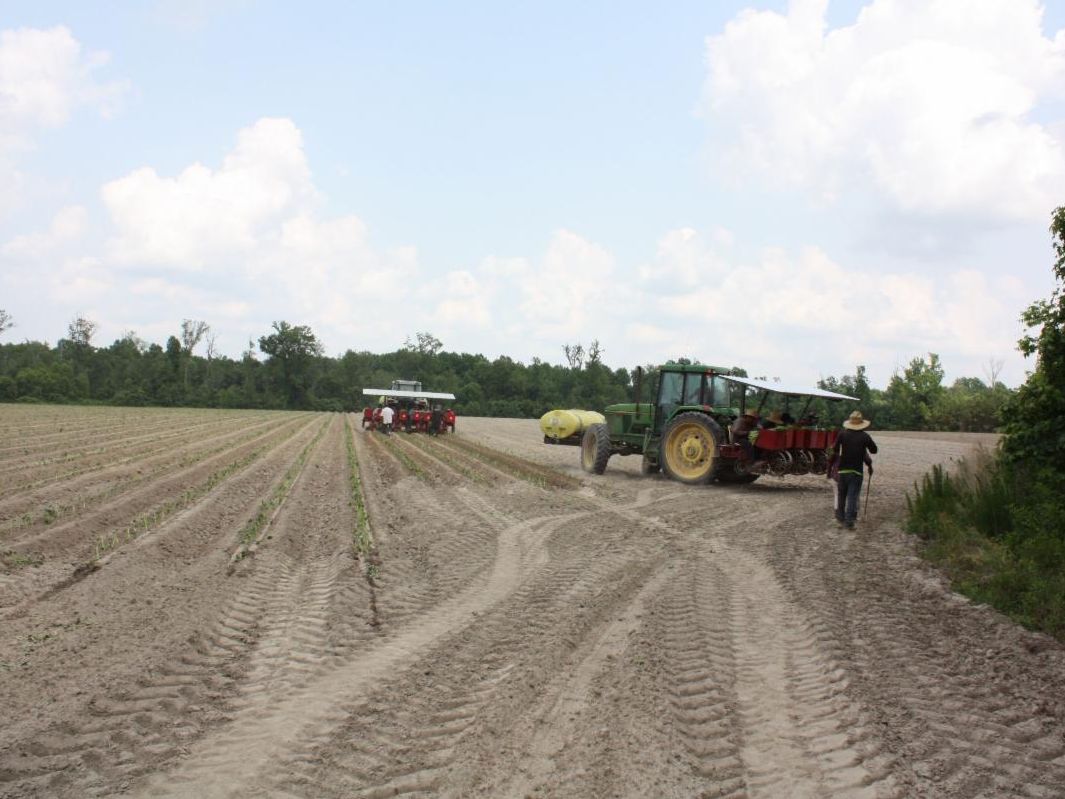
Loading the transplanter for nearly the last time in 2023: Workers prepare to set out some of the last burley plants on a farm in the Bluegrass of Ohio. File photo by Christopher Bickers.

In Kentucky, 85 percent to 95 percent of the expected acreage has been transplanted, thanks in part to a dry spell that allowed good progress in the field. “Now, we are in a wetter pattern,” says Bob Pearce, Kentucky tobacco Extension specialist. “It has been rainy in the last week after a dry spell.” The crop is in good shape now, he says. “We have had no major problems yet.” Burley plantings in the state may decline some but probably not much. Dark growers looking for a substitute after cuts in contracts by dark buyers are in some cases turning to burley, says Pearce.


The last of Tennessee’s tobacco was going to the field at a fast pace in mid June. “Most of our tobacco has been transplanted,” says Mitchell Richmond, Tennessee Extension tobacco specialist. It might have been a little farther along but some farmers had to pause because of an earlier spell of dry weather. “They wanted to avoid transplant shock.” The tobacco that is now in the field is looking generally good. “We have had some rains recently and soil conditions are good,” Richmond says.


In the Black Patch of Kentucky and Tennessee, transplanting has been going well. Almost too well in some areas: Some of the dark tobacco is so far ahead in development that growers are slowing down their transplanting, says Andy Bailey, Kentucky-Tennessee Extension tobacco specialist.. “If you don’t, there’s a danger that you might have to harvest too much at one time at the end of the season.” That can put pressure on facilities and labor…It has been very dry in the last two weeks, says Bailey. “But we are getting some rain this week.”


In Virginia, the flue-cured crop is all planted. “We have been on the dry side, but we had significant rains last week, and the crop looks good now,” says Stephen Barts, Extension agent in Pittsylvania County, Va. “But we are about two weeks behind where we should be.” That was partly because at the end of May, there was a period of cool mornings that slowed growth. “But it is growing well now.” There have been no developments that would cause concern. Close to half of the flue-cured has been laid by…The Virginia Southside also grows some dark and broadleaf, and those crops are growing well also. 


At times since the buyout, Pittsylvania County has had a number of burley growers. “But the demand is gone and we are down to one burley grower,” says Barts. “He has four or five acres.” A comeback of burley isn’t likely. “Burley isn’t a good fit under our conditions,” says Barts. “Our growers generally grew burley alongside flue-cured, and the labor needs of the two types frequently clashed. Also, farmers here weren’t able to get con-sistent good grades. Finally, burley didn’t yield well in the high temperatures that the Southside gets in the summer.”


Crop progress according to USDA-NASS and Extension (as of June 20): KY Burley/dark—9% planted; VA Burley--90% planted; NC Burley--84% planted; SC—9% topped; GA–11% topped; VA Flue--95% planted.


NEWS FROM OVERSEAS


In Zimbabwe, leaf sales have exceeded the record. But farmers are unimpressed...The crop currently being marketed here has set a record for tobacco volume sold in a single season--and the market still has a few sales to go. According to the Associated Press, the Zimbabwean government announced in mid June that 261 million kilograms of tobacco [almost all flue cured] had been sold since the market opened in March. The previous record of 259 million kilograms was set in 2019. But growers found little cheer in the news. “This is a momentous achievement for the sector [as a whole], but the benefits to farmers are minimal,” said George Seremwe, president of the Zimbabwe growers association. “It is worrying that most farmers are heavily indebted. We would be happier if this tobacco success story translates to improved livelihoods for farmers.”


DATES TO REMEMBER


  •  The 2023 Tobacco, Beef, and More Field Day will be held June 29 starting at 8 AM at the UT Highland Rim Research & Education Center in Springfield, TN. A trade show will be held in the morning. More information? Go to highlandrim. tennessee. edu or call Rita Hall at 615-382-3130.


  • The 2023 SC Tobacco Tour is scheduled for July 11 and 12 starting with supper in Georgetown at 6:30 PM. The tour will begin on July 12 at 9 AM in Georgetown County. It will include lunch at the Pee Dee REC around noon and end in Sumter County around 3:30. Register at form.jotform. com/231344605453148. More information? Call 843-222-8701.
Farm Family Life Museum

Bickers Editing Service | 903-9 Shellbrook Ct., Raleigh, NC 27609. 919 789 4631.

Tuesday, May 9, 2023

PLANTING REPORT IN THE NORTHERN END OF THE TOBACCO BELT, THE LAST OF THIS CROP IS HEADED TO THE FIELD


Photo: Transplanting flue-cured in North Carolina, File photo by Christopher Bickers.


In Virginia, transplanting got going last Friday in Charlotte County, says Joanne Jones, Charlotte Extension agent. “But it is just starting,” she says. “Most of the crop is still in the greenhouse.” Charlotte County growers grow flue-cured, burley and dark varieties. Flue-cured will be the leading type this year, with perhaps as many as 200acres. Burley acreage may be up a little, but Jones doesn’t have an estimate yet for this type. In Charlotte County, near the northern limit of tobacco production in the Old Dominion, burley is grown largely by Amish farmers. Dark types will probably be planted on 10 to 15 acres, she says.


In Kentucky, a small percentage of the state’s tobacco is in the ground, according to the USDA’s Crop and Production Report. Setting will ramp up as weather permits. The majority of the week was cool and dry through much of the state, then the weekend brought some scattered rain and storms. The average height of tobacco transplants is rated as 20 percent less than two inches, 45 percent two to four inches, and 35 percent larger than four inches. Transplant supplies are 99 per-cent adequate and one percent short as setting begins.


In the Black Patch, very little of the burley and dark tobacco has been planted. “But what I have seen in the field looks good,” says Andy Bailey, Kentucky-Tennessee Extension tobacco specialist. The greenhouse season went well, with no major issues, he says. “We have good plants though not a big supply”…There will probably be a reduction in dark plantings since major buyers cut contracts, in some cases substantially. Connecticut broadleaf will be down also, for the second season. But burley will be up in the Black Patch. “I expect to see more burley grown in western Kentucky than there has been in several years,” says Bailey.


In Tennessee, there have been no issues in the green-house, says Mitchell Richmond, Tennessee Extension tobacco specialist. “Most of our growers started taking plants to the field late last week or this past week,” he says. “I expect everyone will be planting early next week and perhaps we will finish two weeks or so from now”…The excitement over KT 222 continues to grow for the new (and probably last) hybrid from the Kentucky-Tennessee breeding program. Out of several strengths, Richmond said the best may be its excellent black shank

resistance: 10 out of 10 to race 0, nine out of 10 to race 1.


In North Carolina, Eastern Belt farmers got off to a really good start. "We got some cool weather, some rainfall, so when it got dry this week, our crop did real well," says Norman Harrell, Wilson Extension Director ...About 80% of the crop has been set out, he says. There was definitely no surplus of plants, Harrell says, but there was some creativity: "One of our farmers did a second seeding of one greenhouse to provide some extra plants." Most of those plants are still in the greenhouse but Harrell says this tactic looks like it will provide some extra plants if needed.


In South Carolina, it took Ben Teal of Patrick just a week--starting around April 15--to set out his small flue-cured crop. He farms in the northwest corner of the state’s tobacco area. “As of now,” he says, “I am optimistic: We have a good stand and are off to a good start.” The only problem so far has been some strong wind last week. He had enough plants to cover his needs, unlike some other S.C. growers…He has been hand harvesting his crop but plans to go 100% mechanical next year due the difficulty of finding local labor for an operation of his scale…Teal elected to plant 30 acres this year, the same as in 2022.


Crop progress according to USDA-NASS and Extension (as of May 8): GA–96% planted; FL--100% planted; SC—35% planted; NC Flue-- 62% plant-ed; VA Flue-- 19% planted; VA Fire-cured--19% plant-ed, VA Burley--10% planted; KY Burley, dark—2% planted.


And in Canada, the 2023 greenhouse season has been characterized by very few warm days and many cool and cloudy ones, according to the Canada Tobacco Research Foundation. “Nevertheless, most greenhouses have good seed germination and seedling uniformity,” the found-ation says. “Seedlings between farms vary in size depending on the type of production method being used and when seeding was started.”


A NOTE FROM THE EDITOR


Because of a surgical procedure I am having, I expect to have difficulty using a telephone for a few weeks. If you need to communicate with me {from now until June 1}, better use my email address: chrisbickers@gmail.com. Thanks.--Chris.

Farm Family Life Museum

Monday, April 24, 2023

PLANTING NEARLY COMPLETE IN GRORGIA


TOBACCO FARMER

NEWSLETTER


April II 2023


In the Piedmont of North Carolina, a planting crew sets flue-cured tobacco in this file photo from a past season. Photo by Christopher Bickers.


Transplanting in Georgia was spread out considerably in Georgia because of rain events, but J. Michael Moore, Georgia Extension tobacco specialist, thinks substantially all will be complete by the end of the month. "We have had a good transplanting season and the plants that are in the field look very good.” Some of the crop has been in the field four weeks.


There aren’t many problems in the field except for tomato spotted wilt. “We will still have losses to this disease but I believe our farmers took the control measures they needed to,” Moore says. There is nothing you can do to control TSWV after the crop is transplanted.


Every plant produced in Georgia will be taken to the field (see TFN March I). “And it still won’t be enough acres to service the contracts we have signed.” That was made worse by some very late requests for more contracted acres by companies. “As I understand it, plants are short everywhere,” says Moore.


But as of today, the outlook in the Deep South is good. “We are looking forward to producing a high quality crop that buyers will pay top dollar for,” he says.


At the other end of the tobacco belt, burley growers in Kentucky are still seeding greenhouses. Mild temperatures and dry conditions characterized most of the week, but a cold front passed through accompanied by some patchy frost. Greenhouse seeding is ahead of last year at 87 percent complete. Seeded transplants remain in mostly good condition. The average height of transplants is rated at (41 percent) less than 2 inches, (42 percent) 2-4 inches, and (17 percent) larger than 4 inches.


Crop progress according to USDA-NASS (through April 23): GA–72% planted; SC—19% planted; NC--24% planted; VA-Flue--2% planted, VA Fire-cured 1%--planted. KY—87% seeded.


Guano or bat manure: Organic tobacco farmers have shown an interest in using Peruvian seabird guano or bat manure for organic seedling production. Based on results of recent N.C. testing, the Peruvian seabird guano seems to be a better choice.


If you use seabird guano, closely monitor alkalinity levels in the waterbed closely and correct when necessary. Both organic products produced smaller seedlings and a lower percentage of usable seedlings than 16-5-16 in one study, but in another study, the seabird guano and 16-5-16 produced similar percentages of usable transplants.


The shrinking burley base: The Council for Burley Tobacco (CBT), which is responsible for the collection and investment of the Kentucky burley checkoff funds, has noted a sharp decline in those funds. "Over the last several years, we have watched as the check-off funds continue to decrease," says Darrell Varner, a burley grower and CBT president. Ten years ago, in the 2012-2013 season, CBT received $142,794.44 in check-off funds from 13 buyers, says Varner. "As we come to the close of the 2022-2023 marketing season, the checkoff funds total is $39,852.82."


With China’s return to the U.S. market in 2021, exports in 2021 increased, says Blake Brown, recently retired N.C. Extension economist. But China's purchase of tobacco from the U.S. decreased in 2022. And unfortunately, the China market in the future will be particularly volatile and susceptible to changes in U.S. relations.


In other tobacco news:


MORE DETAILS FROM

THE USDA PROSPECTIVE PLANTING REPORT


Here are state-by-state projections of plantings of the minor types.


--FIRE-CURED: Kentucky 8,100 acres, down 17 percent; Tennessee 6,300 acres, no change; Virginia 200 acres, up 33 percent.


--DARK AIR-CURED: Kentucky 5,000 acres, down 14 percent; Tennessee 3,400 acres, down eight percent.


--CIGAR FILLER: Pennsylvania. 2,600 acres, up four percent.


--SOUTHERN MARYLAND: Pennsylvania--100 acres, no change.


NEWS FROM OVERSEAS

In Malawi, the tobacco market (selling mostly burley) opened on April 12. The average sales price at auction rose from $1.8 per kilo to $1.88 per kg during the early sales days. Farmers were reportedly very happy with the price rise. In Zimbabwe, the tobacco market (selling mostly flue-cured) opened in early March. According to the Tobacco Industry & Marketing Board, through April 20 (Day 29), the average sales price was US$ 2.99 per kilogram.

Farm Family Life Museum

Thursday, April 6, 2023

PLANTING BEGINS IN THE DEEP SOUTH


April 5 2023


A Florida planting crew sets flue-cured tobacco in this file photo from a past season.


Georgia: Transplanting should get going this week, says J. Michael Moore, Georgia Extension tobacco specialist. “We had rains last week, but the fields are drying out well, so planting conditions should be good,” he says. Temperatures in the 90s are expected by the end of this week. Plants look good in the greenhouse. Disease is generally absent in them. “We could have used more plants in the greenhouse. As it is, we will not have enough plants to meet our contracts.”


South Carolina: SC farmers will be ready to begin transplanting this week or the next, says William Hardee, S.C. Extension tobacco specialist. “We’ve had some significant rainfall recently, so we’re hoping soils will dry out quickly.” Farmers have had a pretty good year in the greenhouse, though weather conditions early on after seeding were conducive to some fertilizer salts injury, and there was some pythium later on.


THE NEW USDA PROSPECTIVE PLANTING REPORT--which predicts the plantings that tobacco farmers intend in 2023 as indicated by a USDA survey--projects four percent less flue-cured acreage and nine percent higher burley acreage for 2023. Tobacco of all types was projected down two percent. Details follow:


FLUE-CURED                                    

North Carolina, 110,000 acres, down five percent from last year. Virginia, 11,000 acres, down 9 percent. Georgia, 7,000 acres, up 17 percent. South Carolina, 7,000 acres, up 21 percent. United States, 135,000 acres, down four percent.


BURLEY                                                     

Kentucky, 31,000 acres, up 11 percent. Tennessee, 3,000 acres, up 11 percent. Pennsylvania, 1,000 acres, down 33 percent. Virginia, 210 acres, down 16 percent. North Carolina, 160 acres, no change. United States 35,370 acres, up nine percent.


FIRE-CURED 14,600 acres, down 10 percent.


DARK AIR-CURED 8,400 acres, down 12 percent.


CIGAR FILLER: Pennsylvania Seedleaf (Only Pennsylvania plantings declared in this survey). 2,600 acres, up four percent.     


SOUTHERN MARYLAND: (Only Pennsylvania plantings declared in this survey). 100 acres, no change.  


ALL TOBACCO: United States, 197,070 acres, down two percent.


In other tobacco news:


Will more H-2A candidates be available? Earlier this year, it came to the attention of the Burley and Dark Tobacco Producers Association that H-2A visa interview spots at U.S. Consulates on Mexico were limited. “We reached out to our Congressional delegation asking for support in opening interview opportunities at more Consulates,” the association said in its recent newsletter. “We understand interview spots were increased.”


A new sucker control chemical for organic: Pure-Tac is a fatty alcohol produced and marketed by Drexel Chemical Company and is the first fatty alcohol product to receive EPA/ USDA “For Organic Production” approval. Pure-Tac is residue free and can be used on all tobacco types grown in organic and PRC culture. It should be available at traditional retail out-lets. For more information visit  www.DrexChem.com or contact your local Drexel Chemical Company representative. 


Correction: The phone number for Labor Services International listed in the last issue should have read 252 557 9528.


Farm Family Life Museum

Friday, March 24, 2023

GROWERS GEAR UP ON THE NORTHERN TIER


Locking down labor: Elaine Trujillo of Henderson, N.C., explains the services her company—Labor Services International, an organization that helps agricultural employers obtain labor through the H2A program--offers to farmers and other H2A users. Here, she chats with Darren Wallace of Rose Hill, N.C. One challenge for 2023: The new adverse effect wage rule, she says. For more information on LSI, call 252 557 9528,

Dark production takes a hit in the Black Patch. Contracted acreage will apparently fall 10% to 55% below last season, depending on the buyer, says Andy Bailey, Kentucky-Tennessee Extension dark specialist. But bur-ley plantings may be up. “Burley supply has reached rock bottom worldwide, and the price offerings for 2023 look pretty good. If this keeps going, I could imagine that we might see more burley grown in Western Kentucky than we have had in the last 10 years”…Connecticut broadleaf is still grown in Western Kentucky but not nearly as much…“Most of our greenhouses were seeded around the 15th, and seed coats are starting to crack on trays seeded five to seven days ago...“We have had a few shortages or production problems on some varieties this spring. Seed of DT 558 dark, KT 222 burley and Tennessee 90 burley varieties may all be in short supply,” says Bailey.


Most burley growers in Tennessee are seeding greenhouses or thinking about it, says Mitchell Richmond, Tennessee Extension tobacco specialist. “We had very cold weather for four days over the last two weeks. It got into the low 20s. I hope our growers delayed seeding to hold down on their heating bills. It is hard to tell about acreage just yet, he says. “But burley prices do seem to be better”…There is considerable interest in KT 222, the new—and probably last—burley variety from the Kentucky-Tennessee breeding program. It is a large, high-yielding hybrid with an erect growth habit similar in maturity to KT 215 and has high resistance to both race 0 and race 1 black shank.g or thinking about it, says Mitchell Richmond, Tennessee Extension tobacco specialist. “We have had very cold weather for four days over the last two weeks. It got into the low 20s. I hope our growers delayed seeding to hold down on their heating bills. “It is hard to tell about acreage just yet,” he says. “But burley prices do seem to be better”…There is considerable interest in KT 222, the new—and probably last—burley variety from the Kentucky-Tennessee breeding program. It is a large, high-yielding hybrid with an erect growth habit similar in maturity to KT215 and has high resistance to both race 0 and race 1 black shank.


Tillage of flue-cured fields in Southside Virginia has been slowed because of rain, says Stephen Barts, Extension agent in Pittsylvania County, Va. “This is the last of March, and not much land preparation has been done.” There have been no other major issues. About the only problem has been that fumigators have had a hard time because of the weather...Most of the greenhouses here were seeded at the end of February and beginning of March, says Barts. Farmers will likely go to field in late April and early May, he says. “We expect acreage to be flat compared to last year, if not indeed an increase—that’s if all the plants in the greenhouse make it into the field.” A couple of Pittsylvania growers announced they werre quitting in the offseason, but some remaining growers may increase plantings to make up the difference. "There seems to be more optimism here than in several years,” says Barts.

Temperatures in Kentucky were down into the teens for several mornings last week and daytime highs were in the 40s causing heaters to run more than normal. Fortunately, no reports of cold injury have been reported yet for greenhouses that were seeded, says Bob Pearce, Kentucky tobacco Extension specialist. Seeding in greenhouses is about 60% complete with the remaining greenhouses expected to be seeded in the next week to 10 days. Transplanting will probably begin in Kentucky in early to mid-May, he says. “Growers will be hard pressed to equal last year’s plantings. We can reasonably expect acreage to be down 10%,” says Pearce. “A few growers have indicated they will quit growing tobacco this season, and I haven’t heard of many growers planning to increase acreage who could make up the difference.”


Spray drift is becoming more of a problem in Canada, says the Canadian Tobacco Research Foundation. Seedling injury in greenhouses from spray drift in the field is 0appearing more often. Action plan: Awareness of what is going on near the greenhouse and taking appropriate measures with vents and fans to minimize the entry of outside air.   


In other tobacco news:


A new fungicide: Theia from AgBiome blocks fungal and bacterial pathogens with multiple modes of action. It was approved by EPA last year. It can be applied on flue-cured and burley with a zero day pre-harvest interval and it targets Pythium and collar rot. Another fungicide from AgBiome, still relatively new, is Howler, which delivers broad-spectrum activity and resistance management. Target pests for Howler include target spot, brown spot and Phytophthora.


Farm Family Life Museum

Thursday, March 9, 2023

PLANTS ENJOY A MILD WINTER SEASON


  • Plants growing in a Kentucky greenhouse in a file shot by Christopher Bickers.


In North Carolina, most farmers have finished seeding their green-houses, says Matthew Vann, N.C. Extension tobacco specialist. “We have had a good growing season with few negative issues. As early as this crop was seeded, and if conditions hold, we may see earlier planting dates across the state.”


This situation is not entirely benign. It may affect the pressure from pests. “We didn't have the normal winter weather to help control pests that we usually do,” says Vann. “In particular, since we didn’t get hard weather to kill thrips in native vegetation, we could see increased infestation of tomato spotted wilt virus later.”


You can get valuable information on thrips and TSWV intensity from the web link “Tobacco Thrips Flight and TSWV Intensity Predictor,” available from the North Carolina State Climate Office. 


In Georgia, plants are growing quite rapidly, says J. Michael Moore, Georgia Extension tobacco specialist. “Everyone is thinking about going to the field a little early.” It still is considered wise to transplant after April 7 to avoid exposure to thrips and subsequent tomato spotted wilt virus. 


Farmers in the two Deep South states will set out every plant produced in the two states this year. But that may not be enough, says Moore. “There were some later contracts that were signed too late for greenhouses to be seeded.”


Transplanting will likely get going in earnest in March in Florida and the last week of March in Georgia, Moore says. “We would sure like transplanting to be complete by May 1.”


The shortage of Admire Pro is definitely a concern for Georgians and Floridians, says Moore. He advises seeking out generic imidacloprid, which will give comparable results if you use it according to label instructions.


A database for Kentucky tobacco farmers: Joe Cain, Executive vice president for the Kentucky Burley & Dark Tobacco Producers Assn., says you can gain membership into the new association by writing him at kytobaccogrowers@outlook.com. He will be particularly grateful if you would help him set up a database of growers by including your e-mail address, cell phone number, and your type(s) of tobacco. Growers of all types of tobacco, including wrappers, are eligible to join. “And not just growers are invited,” Cain says. “The association will take as members plant producers and seed producers and other related industries.


There has been some interest in the association from ‘new’ tobacco growers, says Cain. But they are not exactly new—they are getting back into burley because barns and equipment are readily available.


The Kentucky association accepts members from other states, says Cain. So far, there are members from Southern Indiana and Tennessee, with smaller representations from Missouri, Ohio and Pennsylvania.


UPCOMING GAP MEETINGS

o Mon Mar 13, 6 pm CST, Glasgow, KY.

o Tue Mar 14, 9 am CST, Murray, KY.

o Tue Mar 14, 6 pm CST, Lafayette, TN.

o Tue Mar 21, 9 am EST, Quarryville, PA.

o Wed Mar 22, 9 am EST, New Holland, PA. 


Farm Family Life Museum