Sunday, July 23, 2017






Tuesday, July 4, 2017
BURLEY TRANSPLANTING ENDS, FLUE-CURED HARVEST BEGINS
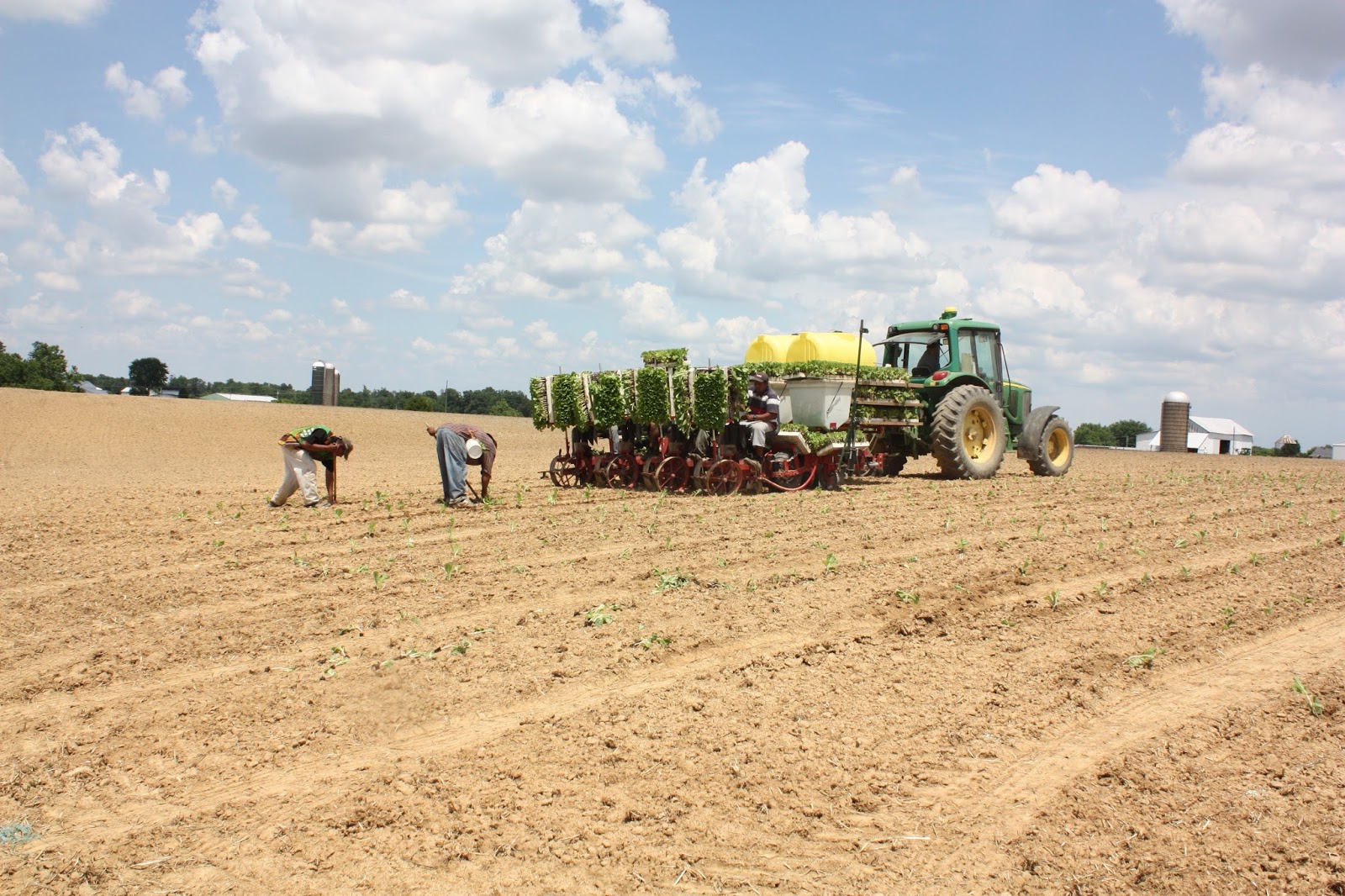
Transplanting appears to be done. One of the last to finish was the Raines burley farm in Seaman, Ohio, near Ripley, which wound up on June 13. Pat Raines, who farms with his sons Todd and Greg, says they finished just one day sooner than in 2016. But it was better because transplanting was more evenly spread out than last year, when late planting caused by rainy weather caused much of the crop to come off at the same time in late season.
For flue-cured, harvest has begun. With ample rain in the last two weeks that put
most of the crop in good condition, all Florida farmers are now harvesting, and
many in Georgia will start next week, says J. Michael Moore, Georgia Extension tobacco
specialist.
Tomato spotted wilt nearly towed Georgia and Florida away: A quarter of the Type
14 plants show some level of symptoms of spotted wilt, says Moore. "We are
looking at perhaps a 10 to 15 percent yield loss on some farms," he adds. "This
was the most damage in years." But it would have been worse if it had come right
 after transplanting. "Instead, we mainly saw it between layby and topping. I frankly
was afraid the damage would be worse based on the mild winter we had."
Blue mold is back. As bad as spotted wilt was, it hasn't been the issue in Georgia
and Florida recently. Instead, blue mold has been found now in 10 Georgia counties.
"Tobacco that is lapping in the middle now encourages the development of blue mold.
Also, temperatures have been five to seven degrees below normal lately, which favors
the blue mold organism." While some of the infection comes from about 10 greenhouses
that were identified as having the disease early in the season, there has apparently
been a spore show since then. "Blue mold has exploded since layby," says Moore.

(Left) Blue mold spores on downstalk tobacco in south Georgia.
In North Carolina, growers are transitioning to sucker control/first harvest, says
Matthew Vann, N.C. Extension tobacco specialist. A handful have started harvesting.
"Given what this crop has been through it is not half bad, as long as it escaped
 spotted wilt." Tomato spotted still continues to be a problem. But thrips have
moved on to other crops, and the wilt seems to have leveled off. "I think we have
seen about all we are going to see of tomato spotted wilt virus"...You would have
expected at least some spotted wilt in the Piedmont, but Vann hasn't had any reports
of it...County report: Tobacco growth is "up and down" in Caswell County because
 of late plantings, said Joey Knight, Caswell County Extension agent. Moisture certainly
hasn't been short, he adds. Over a two-week period in mid June, an excess of 10
inches of rain fell.
In South Carolina, despite several inches of rainfall that impeded field work in
 other crops, suckering and topping of the crop was at its peak in  the week ending
June 25, said Kyle Daniel, Extension agent in Georgetown County. "Tomato spotted
wilt virus, black shank and fusarium wilt are all plaguing tobacco, but overall,
the leaf crop is good," he adds. According to the USDA, 31 percent of the S.C.
crop (all flue-cured) had been topped by the 26th.
Another change at the U.S. flue-cured cooperative: Andrew Q. Shepherd of Blackstone,
Va., is the new chairman of the board of U.S. Tobacco Co-operative, succeeding James
Hill of Kinston, N.C., according to the cooperative's website.  Hill continues
as a member of the board. Earlier, Chief Financial Officer Edward Kacsuta had been
named chief executive officer on an interim basis after Stuart Thompson resigned.
Settlement fraud: An online promotion is giving consumers the erroneous impression
that they can receive money from the tobacco settlement through some sort of bond
purchase, says West Virginia Attorney General Patrick Morrisey. But the fraudulent
promotion leads only to subscriptions to a monthly report filled with spurious information.
"There is no mechanism for payments to consumers [from the settlement]," said Morrisey.
"Payments are made each year to the states and territories involved in the [original]
lawsuit." Numerous other law enforcement agencies have since agreed with Morrisey's
warning.
DATES TO REMEMBER

* July 24-26. N.C. Tobacco Tour.--Monday, 3:30 p.m.: Triple B Farms, Bentonville.
5:30 p.m.: Welcome reception/dinner (tentatively scheduled for Lane's Seafoods,
 McGee's Crossroads).--Tuesday, July 25: Oxford Tobacco Research Station, 7:45
am, Breakfast and Field Tour.--11 a.m. Lunch, then to Upper Coastal Plain Research
Station, Rocky Mount.--Wednesday, July 26: Lower Coastal Plain Research Station.
7:45 a.m. Breakfast and Field Tour. 11 a.m. Lunch and Tour Conclusion. Contact:
Tobacco.ces.ncsu.edu.

* July 27. VA Annual Tobacco Research Field Day, Southern Piedmont Center, Blackstone.
 Registration begins at 5 p.m., dinner at 5:30 p.m., and the Field tour at
 6 p.m. Contact Margaret Kenny at makenny @vt .edu or 434-292-5331.
Saturday, June 24, 2017
BURLEY CROP: SOME SET EARLY, SOME LATE
|

Kentucky burley stands are good but not
excellent, says Bob Pearce, Kentucky Extension tobacco
specialist. At least 90 percent crop had been set as of Friday. Big rains
yesterday and today will slow farmers a little. The average height of
tobacco in the field was 10 inches, compared to 9 inches last year.
A problem has appeared, the same one that appeared a
month ago in flue-cured. "There is more tomato spotted wilt than in
recent memory," Pearce says. "It is widespread." There has been
enough to reduce yield, but probably not by much, since tobacco can compensate
to some degree for lost plants. "At this point, we may be looking at
single digit (percentage)." Tennessee has had uncharacteristic TSWV infestations
too but as in Kentucky, the yield loss is not too great so far.
Tennessee experienced another later-set crop, but
very little remains to be transplanted now, says Eric Walker, Tennessee
Extension tobacco specialist. "Most everyone is finishing up," he
says. He estimated perhaps five percent of the crop remained to go in as of
Friday plus a little replanting. But heavy rains this week will probably keep
everyone out of the fields for a few more days. One way or another, although
the planting season was just a little longer than in a normal year, a
disproportionate number of acres were planted relatively late, so some late
harvesting seems likely.
The east Tennessee burley crop is 10 to 14 days
behind normal, says Don Fowlkes, manager of agronomy for Burley Stabilization
Corporation in Greeneville. "We were farther behind than that but we
mostly got caught up the week before last when we got some good weather,"
he says. He too thinks 95 percent or more of the expected crop in this region
has been transplanted. "We are still early in the season but so far it is
looking OK." He expects a few less acres planted in Tennessee when all is
said and done, but with an average yield--the 2016 yield was below
average--production might be the same or greater.
In southwestern Virginia, about three percent of the
burley [the type grown here] remained to be set, according to USDA. But some
areas were not as far along. "Unusually rainy weather has delayed tobacco
setting. Only limited field work was accomplished this week [through June 18]
with heavy showers scattered about the county almost every day," said
Grayson County Extension agent Kevin Spurlin. "There were reports of up
to eight inches this week in portions of the county, and flash flooding was
common."
In western N.C., setting was running behind. USDA
estimated that 74 percent had been transplanted by June 18. In Yancey County,
numerous thunderstorms and rain events that week limited field activities, said
Stanley Holloway, Extension agent. "Rainfall amounts were highly variable
across the county, with most areas receiving between 1.5 inches to 2.5 inches
for the week."
One imponderable in Kentucky and Tennessee: The
contract prices for the dark types were good, and there may well have been some
substitution of dark tobacco for burley. That confuses any production estimate
for these types.
In other tobacco news:
Be extremely pro-active when making your first
contact sucker control application if you are growing residue-free flue-cured,
says Matthew Vann, N.C. Extension tobacco specialist. "The
conventional rule of thumb is that first application should begin at the 50
percent button stage. But consider starting before 50 percent button is
reached, possibly at the 40 percent button stage. Beginning slightly earlier
should allow for sufficient control of suckers growing in some of the larger,
more advanced plants."
Target spot is showing up all over some counties in
eastern N.C. "We are seeing lots of target spot on tobacco," says Norman Harrell, Wilson County Extension
Director. "Quadris is labeled for control of target spot in
flue-cured tobacco. The fungicide works as a preventative for
leaf tissue that does not have target spot and should provide
about two weeks of protection. The label lists the use rates of 6.0 to 12.0
ounces per acre. In the current conditions, nine to 10 ounces per acre
should be okay." If you are growing residue-free tobacco, contact your
contracting company for approval to apply Quadris, he adds.
Greene County, N.C., missed many of the showers that fell
last weekend, though they were all around. "Topsoil is starting to get
dry, says Roy Thagard, Greene County Extension chairman. "Tobacco growers
are finding budworms above threshold. They are also spraying to manage suckers
and target spot."
Sunday, June 4, 2017
SPOTTED WILT BEATS A PATH THROUGH THE BRIGHT BELT
|

GEORGIA-FLORIDA--Tomato spotted wilt had appeared earlier in the season in the Type 14 states, but the pace picked up considerably in the week just ended, says J. Michael Moore, Georgia Extension tobacco specialist. "It doubled its infestation rate to around 20 percent of plants showing symptoms, and we have older tobacco in which the infestation is as much as 50 percent.

The symptoms run from dead plants to ones where one or two leaves on one side are dying." The mild winter was the culprit. It allowed the survival of alternate host crops and the survival and high populations of thrips, which vector spotted wilt. "There is just so much you can do about spotted wilt, and most of it has to be done by the time the crop reaches this stage. Once the tobacco is in the field, most measures are futile." But good sucker control may help in keeping the disease from spreading. "Clean your crop up and apply flumetralin and maleic hydrazide when it is needed," Moore says. "Precise sucker control is one of the few things that can help, along with any-thing that will maximize yields and use up lost nutrients." Other practices that might help:
NORTH CAROLINA--Tomato spotted wilt has broken out with a vengeance in the coastal plain counties of N.C. "In the last two weeks, we have seen a lot

of it," says Matthew Vann, N.C. Extension tobacco specialist. "The timing suggests it came here from Georgia." The mild to nonexistent winter is the cause. "We have suffered losses ranging from five percent to 40 percent. So far, it looks like it will be a record year for spotted wilt. It is worse in the tobacco that was transplanted early than the later crop." So far, there's been no spotted wilt west of Raleigh. "We don't really expect it there."
SOUTH CAROLINA--Much needed rain fell in the Pee Dee over last weekend as corn was starting to tassel, says Rusty Skipper, Extension agent in Horry County. But spotted wilt has broken out here too. "Tomato spotted wilt virus is more prevalent this year, and the damage is more extensive than in years past," he says."

VIRGINIA--Spotted wilt has even made an appearance in Virginia, says David Reed, Virginia Extension tobacco specialist. "There's not much, but it is more than we are used to," he says. "It is rarely a problem here." He visited a farm Friday that had two percent of its plants with symptoms. At this point, he doesn't expect to see many fields with more than four per cent....Flue-cured planting is subs-tantially complete, while dark and burley planting is at least 75 percent done, maybe more. "We got started early, then we were rained out for a while, so there is an early and a late crop: Some is just transplanted, and some of it has been laid by. All of it looks real good."

KENTUCKY--Things are going smoothly for Kentucky growers right now, says Bob Pearce, Kentucky Exten-sion tobacco specialist. "The crop is in excellent shape, and we have made good prog-ress on planting. Some areas are essentially done. Perhaps 60 percent to 70 percent of the crop has been plan-ted." He reports no major problems. There's been plenty of rain. "But whenever there has been a clear day, farmers have been ready to go."... Around Danville, Ky., grower warehouseman Jerry Rankin says he and his workers have been planting till 9:30 at night. "We are catching up now, but I would say we are a good two weeks behind," he says. "Much of this area (central Bluegrass) had tremendous rainfall. But the last four days, we are beginning to get back in the fields." He estimated 35 to 40 percent of fields in the area have been set by June 1.
TENNESSEE--Rain slowed things too in the Burley Belt's largest volume county, Macon in Tennessee. "We are not halfway done planting," says Keith Allen, county tobacco agent. "A lot is going to be planted. I have seen tobacco this season in fields where I have never seen it before--and I have been here 25 years." A lot will be put out, much more than last year. "We had a little more than 5,000 acres in 2016 in this county, [which is east of Nashville]. We might push 6,000 acres this season." The new acres are coming in part from land that has been in other row crops the past few years, Allen says.
More reports from the field--Notes from agents of the Extension Service and of the state Departments of Agriculture:
In other tobacco news--
Flea beetles on burley: Young plants are showing some flea beetle damage in Macon County. "We put a control chemical in the setter water but in many cases it was too damp for the plant to take the chemical up," says Allen. Now, there is beginning to be some concern about the condition of plants. "There are still a lot of plants in the greenhouse," says Allen. "We have had a good greenhouse season but the longer the plants stay in the greenhouse there is more chance for disease."
More on auxin drift: With the new dicamba-resistant soybeans, there is a danger in Kentucky of auxin herbicide drift on tobacco. "Not much of a problem is expected in eastern or central Kentucky, but western Kentucky [where significant acreages of grain crops are grown] may be a different story," Pearce says. "There could be potential concerns if growers don't take appropriate caution." Keep in contact with any neighbor who might be spraying an auxin, he says. "Communication is the key to preventing contamination by drift."
Management change at cooperative: After three years as chief executive of the of U.S. Tobacco Cooperative (USTC), Stuart Thompson resigned in May. He has been replaced on an interim basis by Chief Financial Officer Edward Kacsuta, the company said. Thompson joined USTC five years ago as CFO. "His departure comes at a time when there were differing opinions on business strategy," USTC said. USTC is owned by flue-cured growers and based in Raleigh, N.C.
DATES TO REMEMBER
|

Sunday, May 21, 2017
REPORTS FROM THE TOBACCO FIELDS
VIRGINIA--In the Virginia Piedmont, rains were hit and miss last week, Lunenburg County Extension agent Lindy Tucker said, "Farmers received some more rain this week (ending May 14). Hay land needs it, but crop producers wish it would hold off until tobacco is finished." But the tobacco planting is making good progress. Statewide, about 31 percent of the flue-cured had been transplanted by mid-May, compared to 12 percent of the burley crop and 19 percent of the small dark fire-cured crop.
NORTH CAROLINA--Transplanting of flue-cured was 73 percent complete by mid May, according to the USDA Progress Report. Moisture conditions varied: In Robeson County, transplants have suffered from rains, strong winds and cool temperatures, said Mac Malloy, Robeson Extension agent ... In Craven County, excessive rain fall of three to five inches saturated the soil and leached nutrients. Producers working to make nutrient adjustments. Approximately five percent of tobacco production will likely need to be transplanted again. Tomato spotted wilt evident in many tobacco fields, ranging from two to 10 percent common, said Craven County Extension agent Mike Carroll...But the weather was drier than expected last week in Greene County, allowing many farmers to catch up with planting. "I anticipate all tobacco growers to be finished early this week," says Roy Thagard, Greene County Extension agent.
SOUTH CAROLINA--The last nine percent of the S.C. crop was planted the week ending May 14, says the USDA Progress Report says. In the Pee Dee, the major tobacco-growing area, cooler daytime temperatures, lower humidity and an adequate supply of rainfall have led to tobacco growing well in Horry County, said Extension agent Hilda Shelley. The recent rains were very welcome in this area, which had been very dry though much of April.
GEORGIA--Planting is complete. In Candler County, near Savannah, it is a little dry, and a lot of farmers are waiting for some moisture. "Tobacco looks fair," said Chris Earls, Candler County Extension agent. Some replanting was reportedly continuing.
KENTUCKY--Tobacco setting is moving forward steadily, says USDA's Prog-ress and Condition Report. Tobacco transplant supplies were reported as one per cent very short, three percent short, 89 percent adequate, and seven percent surplus, the report says. Twelve percent of tobacco transplants were under two inches, with 37 percent between two to four inches, and 51 percent over four inches. Just over 10 percent of the crop had been planted by mid May.
In other tobacco news:
Never use your tobacco sprayer to spray herbicides on pastures, says Tennessee agronomists. "Pasture herbicides are very difficult to wash out of sprayers," they says. "Because of the sensitivity of tobacco to pasture herbicides, chemicals such as 2.4-D can cause serious damage." If you have pastures to spray, have a dedicated sprayer for them.
Control weeds at layby. As disrupted as weed control may have been to this point, this might be a good year to make a layby herbicide application, says Matthew Vann, N.C. Extension tobacco specialist. The options for herbicide application at layby on N.C. flue-cured are:
Given the concern placed on weed seed contamination in tobacco exports, it is critical that extra focus is placed on weed control management at all stages of this crop, says Vann.
DATES TO REMEMBER
|


Friday, May 5, 2017
BURLEY MAKES ITS WAY TO THE FIELD
 |
Burley transplanting in a conservation tillage field in
Kentucky (file photo by Bob Pearce).
|
.
In Kentucky, transplanting is just getting started, with perhaps one percent of the acreage planted, says Bob Pearce, Kentucky Extension tobacco specialist. "Just a few crops have been planted, and I doubt any of them are very far along." He expects setting to get in high gear the second week of May.
It's very unlikely there will be a shortage of burley transplants this year. Farmers had to start seeding greenhouses before contracts had been offered, and some have ended up with more than were actually needed, says Pearce.
How many acres? Pearce is skeptical about the USDA's March 31 estimate of 65,000 acres of burley in Kentucky this year, seven percent more than 2016. "I think that it is overly optimistic," he says. He calculates that planted burley acreage in the state will be similar to last year.
In Tennessee planting is also just getting started, with at most two percent set, says Eric Walker, Tennessee Extension tobacco specialist. Rains expected the middle and end of this week might slow things further. Farmers who manage to miss those rains can probably get started, he says. Others may have to wait for the ground to dry up.
In Georgia and Florida, the crop is completely transplanted except perhaps for some stragglers, says J. Michael Moore, Georgia Extension tobacco specialist. "There is a little replanting going on," he says. It was extremely hot the last two weeks, with air and soil temperatures in the 80s, and the stems of many small plants dried at the soil line and fell over. That will probably take up every available plant in the two states, says Moore. "But I think we will get planted everything the farmers intended."
Well under five percent of the Georgia-Florida flue cured crop is showing symptoms of tomato spotted wilt which is less than was expected, considering the warm winter and abundance of rain. "Our growers were intense in their use of Actigard and imidacloprid," says Moore. "That probably was a factor." But TSWV could still appear. "We can't be sure we have dodged that bullet," he says.
In South Carolina, the Pee Dee got plenty of rain in late April, but it was not a big problem. Since the area had been dry, the rain was welcome and benefited crops. Transplants are starting to take root nicely.
In North Carolina, 38 percent of the flue-cured crop had been transplanted by May 1. But progress varied widely between individual counties. Approximately 70 percent of the tobacco crop had been set before the rain event in Lee County, says Extension agent Zachary Taylor. "Leaching adjustments will be needed. Weed control will be a concern as many PRE herbicides have likely leached"...In Craven County, only a small per- centage of tobacco had been transplanted, so the impact was small, says Extension agent Mike Carroll.
In Virginia, only three percent of the state flue-cured crop had been transplanted by May 1, according to NASS. About one percent each of the burley and fire-cured had been transplanted...In Brunswick County, the heavy rain last week slowed down planting and left standing water in ditches and fields, says County Extension agent Cynthia Gregg. "Some producers were able to get back to planting tobacco, and others started planting tobacco this weekend."
In other tobacco news:
When making a leaching adjustment, consider using fertilizer sources absent of phosphorus, says Matthew Vann, N.C. Extension tobacco specialist. "Phosphorus is not very leachable in the soil profile," he says. "Therefore it is likely that the nutrient is still in place. This will reduce the cost of having to re-apply nutrients."
Brazil's 2017 flue-cured crop will apparently be roughly 50 percent larger than the short 2016 crop, approximately 1,300 million pounds to 900 million pounds. "Current quality appears to be good and in line with expectations," says Peter Sikkel, chief executive officer of Alliance One International. "We are expecting similar positive crop size increases in other key markets."
Subscribe to:
Posts (Atom)