Monday, July 8, 2013

SURPRISES IN USDA'S ACREAGE REPORT

Young burley
A burley field ready to take off in June near Boone, N.C.

USDA issued its planted acreage report at the end of June. It showed flue-cured up five percent and burley up one percent--hardly the avalanche of plantings that some observers (including the  editor of this publication) predicted just a few months ago. There was one big surprise, so big I am not sure we should believe it. South Carolina flue-cured acreage, which was projected to be up 25 percent in USDA's March Prospective Plantings Report (see TFN, April 3, 2013), is now projected be down 25 percent. Another drastic change: Ohio burley was projected at 2,000 acres in March but now is pegged at 2,500 acres (an increase in that time period of 25 percent). And another: In Georgia, a one third increase in plantings since last year was projected. "I don't see how we could have 15,000 acres (5,000 acres more than 2013) as projected by USDA. We had enough plants for a bigger crop but had to discard many of them because no one wanted them." Moore estimates Georgia plantings at about 11, 000 acres, same as last year. 

Below are the numbers from USDA's June projection with the percentage change from last year. Feel free to check back here in about a week for more details. 

FLUE-CURED: 
  • NC--170,000 acres, up 3.6%. 
  • VA--23,000 acres, up 15%. 
  • GA--15,000 acres, up 36%. 
  • SC--9,000 acres, down 25%. 
  • All US--217,000 acres, up 5.3%

BURLEY: 
  • KY--78,000 acres, up 5.1%. 
  • TN--13,000 acres, down 18.7%. 
  • PA--5,100 acres, up 8.5%. 
  • OH--2,500 acres, up 31.5%.
  • NC--2,300 acres, up 9.8%.
  • VA--1,700 acres, down 37%.
  • All US--102,600 acres, up 1.1%.
OTHER TYPES: 
  • Fire-cured--18,400 acres, up 13.5%. 
  • Dark air-cured--5,000 acres, down 3.8%. 
  • Cigar types--4,850 acres, up 8.6%.
  • Southern Maryland--2,000 acres, down 31%.  
 Crop reports from the field

In southern Ohio, Pat Raines of Seaman, Oh., says he thinks acres are increasing in his state. "Many growers expanded their contracts. Some people who had stopped producing before got back in this year." The weather delayed transplanting on many farms. "Based on plant sales, I would say we are 75 to 80 percent finished [on June 14]. If the weather turns off well, we could still have an excellent crop. But some fields in Ohio might get washed out if there are heavy rains later." 

In northern Kentucky, a lot of burley was still being planted after June 15 in the Maysville, Ky., area, says Eldon Ginn. Some of the increase is planted by existing farmers who are expanding and some by new growers or by growers who are returning to the crop. Ginn knows of one farmer who increased his burley plantings from 150 acres last year to 400 acres this year.

In the Bluegrass of Kentucky, Jerry Rankin of Danville, Ky., says, "We are a little behind where we normally are, maybe a week to 10 days. The plants didn't grow as fast because of the cool weather." He thinks production may fall short of goals. "A lot of tobacco ground is going into row crops," he says. "Hay, alfalfa and wheat in silos, along with corn and soybeans, have all been competing for land with tobacco." 

In western Kentucky, says burley and dark grower Rod Kuegel of Owensboro, Ky., farmers generally like to have all of their tobacco planted by June 15, but they didn't make that deadline this season. "It appears now that it will be well into July before we finish transplanting. That is not what we want to see. We don't want to have to cut tobacco at Halloween."


In southwest Virginia, burley grower Kenneth Reynolds of Abingdon, Va., says he finished transplanting probably 10 days later than usual because of the weather. Planting was nearly complete by mid-June. Most lands have been planted. He thinks planted acreage is at least stable. "It may be up but not by a significant amount." 

In the Highland Rim of Tennessee, Bill Maksymowicz, agronomist for the Burley Stabilization Corporation, Springfield, Tn., says he traveled extensively in Tennessee and Kentucky visiting burley farms in recent weeks. "We are wrapping up transplanting. Some topping began last week. We are a little later than the last two years." He has seen few foliar diseases and no black shank or blue mold.  

In eastern North Carolina, Mitch Smith, Pitt County, N.C., Extension chairman, says tobacco there has enormous potential. "But the rain needs to stop. There could be water damage already, and it could interfere with our ability to apply contacts." There may already be an impact on yield. "In a rainy season, the crop tends to ripen very quickly," he says. "That can lead to a lower weight." 

In the Piedmont of North Carolina, there's been a lot of rain, says Dennis White, owner of Old Belt Tobacco Sales warehouse in Rural Hall, N.C. "Early set tobacco has had too much water," he says. "The later tobacco will more likely be the best of this crop. Some farmers started pulling last week (starting July 1). Most will start in the next two weeks, with the last ones starting the third week in August." 

On the border between the Carolinas, Ben Teal of Patrick, S.C., says there are a lot of different stages of growth in the field, and some fields had topped out by June 20. "Most of mine is looking pretty good except for the fields that got drenched by Andrea. That tobacco yellowed up and is short." There has been a change in his variety choice recently: He has increased the proportion of K 326 that he plants. "We have been able to plant on fresh land the last two years. That has allowed us to plant K 326. We also plant some CC 700. It produces well on sandy land."


In Florida, growers have an "outstanding" crop, says Extension specialist J. Michael Moore, who covers both Florida and Georgia. "They have had plenty of rainfall, but it hasn't been much of a problem: They are used to handling water." Harvest is well under way. "I believe a substantial amount of leaf will be ready for delivery the week of July 22, when stations open." He projects planted acreage at 1,100 acres, about the same as last year, although there might be a small increase.


In Georgia, rainy weather has caused some losses but Moore thinks Georgia farmers have about a 95% crop with what appears to be some good quality tobacco. "It has been very wet all across Georgia, but most of the tobacco has held up well. Most has been topped and suckered and is ready for that final growth spurt. Some re-fertilization is taking place."  

In other news from Georgia--
  • Spotted wilt incidence was low compared to what was expected, considering the mild winter. Early in the season--when the plant was most vulnerable--the statewide incidence was about eight to 10 percent, he says. "Since then, it has climbed to closer to 15 percent, but infections that late only cost you a few leaves, not the whole plant."
  • There was at most a one percent incidence of black shank so far.
  • Control of budworm has been good, thanks largely to extensive use of Coragen.
  • Rain fell nearly every day the week of July 4, delaying sucker control sprays and the start of harvest.
  • There are a number of new growers. Moore knows of 11 operations that are growing tobacco this year that weren't a year ago. "They range from young high school graduates just starting out to growers who have given up on tobacco since the buyout but kept their equipment and are coming back in."
  • There was a brisk market in used equipment over the winter. "I think all the used barns, transplanters and cultivators that have just been lying around were bought by active tobacco growers."
Marketing news

Another burley auction for 2013: Roger Wilson of Mt. Sterling, Ky., says that a live auction will be held this year at Clay's Tobacco Warehouse. For more information, contact Wilson at 859-498-6722.  

Here's an optimist: Dennis White, owner of the Old Belt Tobacco Sales warehouse in Rural Hall, N.C., tells Tobacco Farmer Newsletter, "If anyone has tobacco ready to market and needs money before delivery stations open, I will buy it now at contract prices, from any location." If you're interested, call White at 336-416-6262. White will announce the opening date of sales at his warehouse soon.  

Orders for flue-curing barns seem to have subsided as harvest approaches. But manufacturers tell me they are still working two shifts a day seven days a week to get all the orders met. One told me that he took his last official order for barns for this crop on June 11, but may sell a few more if he has any to spare before the harvest crunch. He and another manufacturer told TFN they have had indications that some farmers may go ahead and order barns for next season, to be built after the current traffic jam is over.


Tobacco tours coming up in the next 30 days

  • The N.C. Tobacco Tour begins at 6:15 p.m., Monday, July 15, with dinner at the Brass Lantern Steak House, 515 Spring Branch Road, Dunn, N.C. Tuesday July 16, the tour begins at 7 a.m. in the parking lot of the Dunn Hampton Inn, 100 Jesse Tart Circle (Exit 73, Interstate 95). Stops include research stations in Kinston and Rocky Mount and three farms. Wednesday, July 17, the tour begins at 7:30 a.m. at Edwards Farm, 100 Salem Church Rd., Wendell. Stops include the Oxford research station and two farms. The tour ends with lunch at 12 p.m. in Oxford. For more information, go to http://plantpath.cals.ncsu.edu/north-carolina-flue-cured-burley-tobacco-tour. Or contact Mina Mila at 919-513-1291 or at almila@ncsu.edu.

  • The S.C. Tobacco Tour starts with registration at 8:15 a.m., Tuesday, July 23, at the Tobacco Facility at the back of the Pee Dee Research and Education Center near Florence. Later, the tour will visit a farm using a wood-fired boiler for curing. The tour will end in midafternoon. For more information, contact Dewitt Gooden at 843-662-3526 or dgooden@clemson.edu. 
The Virginia Tobacco Field Day will be held at the Southern Piedmont Agricultural Research & Extension Center (two miles east of Blackstone on Rt. 40) on August 6. After a dinner at 5 p.m., the field day will begin at 6 p.m., ending about 8:30 p.m. Note: A forage and livestock field day will be held August 7 starting at 9 a.m. For more information, go to Margaret Kenny at 434-292-5331 or makenny@vt.edu


BIG M TOBACCO WAREHOUSE
 1723 Goldsboro St. SW, Wilson, N.C., 
in the old Liberty Warehouse


We will hold both sealed bid auctions 
and live auctions. 


 We promise

HONEST AND TRUSTWORTHY 
SERVICE


For more information, contact:
--Mann Mullen at 919-496-9033 
--Greg Ray at  252-799-6061  or
--the warehouse at 252-206-1447

Monday, June 3, 2013

WHERE TO FIND AN AUCTION FOR 2013


Auction
An auction at the Old Belt Tobacco Sales warehouse in Rural Hall, N.C., last fall.

After capturing a small but significant portion of 2012 tobacco sales, auction houses are coming back this season with a goal of getting more for their farmers' leaf. Tobacco Farmer Newsletter spoke to the principals at all the auction houses that could be located and asked about plans for the coming year. Contact information for each warehouse follows.
Note: I would be glad to know if any other warehouses are planning auctions for 2013. Call me at 919-789-4631.

-There will be two auctions in Wilson, N.C. The Big M Warehouse, located in the old Liberty Warehouse, will offer both sealed bid and live auctions. "It will be the  farmer's option which way he wants to sell," says Mann Mullen, owner of Big M. "We haven't worked it out yet. We may have live auctions in the morning and sealed bid in the afternoon. Or we might do the different types on different days. When the tobacco is delivered, the farmer can specify how he wants to sell it." Last season, when the sales were 100 percent sealed bid, Big M sold 3.5 million pounds. "We hope to exceed that this year," Mullen says.


--At the American Tobacco Exchange, which occupies the old Growers Warehouse facing Hwy. 301 in Wilson, Randy Brandon and Todd Adams will conduct auction sales there this season. But at press time, they hadn't decided between a sealed bid or a live auction. TFN will keep you posted.


--In Danville, Va., the owners of Piedmont Warehouse converted from sealed bid auctions to live auctions last season, with good results. "The live auction was popular last year," says Jim Eggleston, sales manager. "The farmers liked it better that way, and I did too." It will be all "live" this year, and Eggleston hopes to double sales. Most will be flue-cured. "But we sold some burley last year, maybe five percent of our volume. It was all from non-traditional growers in this area, but I would be glad to sell burley from the traditional areas."


--In Rural Hall, N.C., near Winston-Salem, Dennis White says he has sold some non-traditional burley at his primarily flue-cured live auction, Old Belt Tobacco Sales. He may sell more this year, perhaps partly from traditional burley areas. "I have gotten calls from places like Asheville, N.C., Boone, N.C., and Mountain City, Tn.," he says. The auction has been very popular with flue-cured growers in the Piedmont. "Some farmers are planting more than their contracted amount with the idea of selling the overage at auction. And there are two or three farmers who plan to sell their whole crop with me."


--In Danville, Ky., Jerry Rankin, owner of the Farmers Tobacco Warehouse, expects to sell at least five million pounds at his warehouse, he says. "That may prove a conservative figure." Still, he is concerned that this may be a short burley crop relative to what buyers could use. "I don't think we are going to have enough tobacco from this crop," he says. "We could sell 20 percent more than what we expect will be grown and still not fill all the demand."


--In Lexington, Ky., live auctions are tentatively set to begin the first two days of November at the Big Burley Warehouse, says manager Darby Montgomery.

Getting in touch with auction warehouses

Piedmont Warehouse, 301 Trade Street, Danville, Va. Contact Jim Eggleston at 434-489-4292or at jimegg1@comcast.net


Old Belt Tobacco Sales, 1395 Old Belt Way, Rural Hall, N.C. Contact Dennis White at 336-416-6262 or at whitedennis155@yahoo.com


Big M Tobacco Warehouse, 1723 Goldsboro Street SW, Wilson, N.C. Contact Mann Mullen at 919-496-9033 or at
shrimpmann@ embarqmail.com, or warehouse manager Greg Ray at 252-799-6061. The main number at the warehouse is 252-206-1447. 


American Tobacco Exchange1300 Tobacco Rd., Wilson, N.C.      Contact Randy Brandon at 252-343-1661 or Todd Adams at 919-369-5356 or the warehouse switchboard at 252-237-5233. You can email to americantobaccoex@gmail.com.


Big Burley Warehouse, 573 Angliana Ave., Lexington, Ky., 40508. Contact Darby Montgomery at his cell number, 859-339-3922 or at his office at 859-233-9944. 


Farmers Tobacco Warehouse, 4540 Perryville Rd., Danville, Ky. Contact Jerry Rankin 859-319-1400 or at jerrytrankin@bellsouth.net. 


Kentucky King Warehouse, Maysville, Ky. Live auctions were conducted here in 2012 and might be again this year if there is enough interest. If you're interested, contact Eldon Ginn at 606-782-2477. His office switchboard number is 606-564-4242.


Clay's Tobacco Warehouse, 949 Camargo Rd.,  Mount Sterling, Ky. I have been unable to reach the owner, Roger Wilson, to confirm this, but I have been told by two reliable sources that he is considering conducting an auction this year. The number I was given was 859-498-6722, although I have had no luck getting an answer.

In other tobacco news:

New flue-curing barns roll off the line. Bob Pope of Long Tobacco Barn Company LLC tells TFN that its barn line is running at full capacity and turning out an average of three barns per day. The company is now working to fill orders for barns for delivery prior to commencement of the 2013 curing season. Long is also now taking orders for its third 2013 production run for barns to be delivered in late July and August, prior to the crop letting loose in the field. "Though design improvements we made in our newest model took us longer to refine than we anticipated, our customers have been patient," Pope says. "They report they are well satisfied with their new barns and are looking forward to using them this coming season."


A report from the Bluegrass: A TFN source who grows burley on a large scale south of Lexington, Ky., says that he started transplanting on May 20. "Now, we are a little behind where we normally are, maybe a week to 10 days," he says. "The cold temperatures have slowed plant development, but it doesn't take the crop long to catch up if conditions are right." The change in crop insurance rotation requirements has led to some land leaving tobacco in his area. Farmers here frequently grow burley three consecutive years, then put it in grass for six or seven years, but federal crop insurance will no longer insure land planted a third year in tobacco. Some farmers are choosing to plant something else. 
  
  
Speaking of crop insurance, earlier this month, the Senate considered eliminating subsidies for federal crop insurance for tobacco farmers, But the amendment was turned back by a vote of 52 to 44 on May 23. Kentucky State Senator Paul Hornback, a tobacco farmer himself, told the Associated Press that tobacco would have survived if the insurance program had ended. "But you would have seen the face of tobacco growing change very drastically once again." 

 DATES TO REMEMBER
  • June 10-12 Georgia-Florida Tobacco Tour starts with a kick-off supper at Mixon's Pond House in Waresboro, Ga., at 7 p.m. Monday and ends at Lake City, Fla., Wednesday. Contact: J. Michael Moore at 229-386-3006 or jmmoore@uga.edu
  • July 23. South Carolina Tobacco Tour starts at Tobacco Facility at the Pee Dee Research and Education Center in Florence and ends out in the field in midafternoon. Contact: Dewitt Gooden at 843-662-3526 or at  dgooden@clemson.edu.


ADVERTISING

BIG M TOBACCO WAREHOUSE
 1723 Goldsboro St. SW, Wilson, N.C., 
in the old Liberty Warehouse


We will hold both sealed bid auctions 
and live auctions. 


 We promise

HONEST AND TRUSTWORTHY 
SERVICE


For more information, contact:
--Mann Mullen at 919-496-9033 
--Greg Ray at  252-799-6061  or
--the warehouse at 252-206-1447. 


BulkToBac Barns


A BRIEF HISTORY  OF  NORTH CAROLINA TOBACCO
This softcovNC Tobacco Booker book from History Press recounts the Bright Leaf's contribution to Tar Heel history. A terrific gift for tobacco-oriented individuals. The price is $21.99.  
Also available: A companion work called "Remembering North Carolina Tobacco," also by Yeargin. The price is $19.99. To order, specify which book (or both) you want and send check or money order to 
Billy Yeargin, 112 N. Webb St, Selma NC 27576. For more information, email Yeargin at tobhistry@aol.com.


GET THE BEST PRICE
FOR YOUR TOBACCO


The American Tobacco Exchange in Wilson, N.C., will conduct auction sales this season, directed by managers Randy Brandon and Todd Adams.
  
This company has conducted auctions the past four seasons, and growers that have sold with us have received the highest price available on everything from pickings to first quality tobacco. They will also purchase tobacco they have contracted in the same professional manner as last season.
  
For more information, you can contact them at the numbers below or at the warehouse switchboard.

American Tobacco Exchange, located in the old Growers Warehouse off Hwy. 301. Address: 1300 Tobacco Rd., Wilson, N.C. Phones: Randy Brandon (252) 343-1661, Todd Adams (919) 369-5356. 
Warehouse (252) 237-5233. 


Wednesday, May 8, 2013

THE SEASON BEGINS


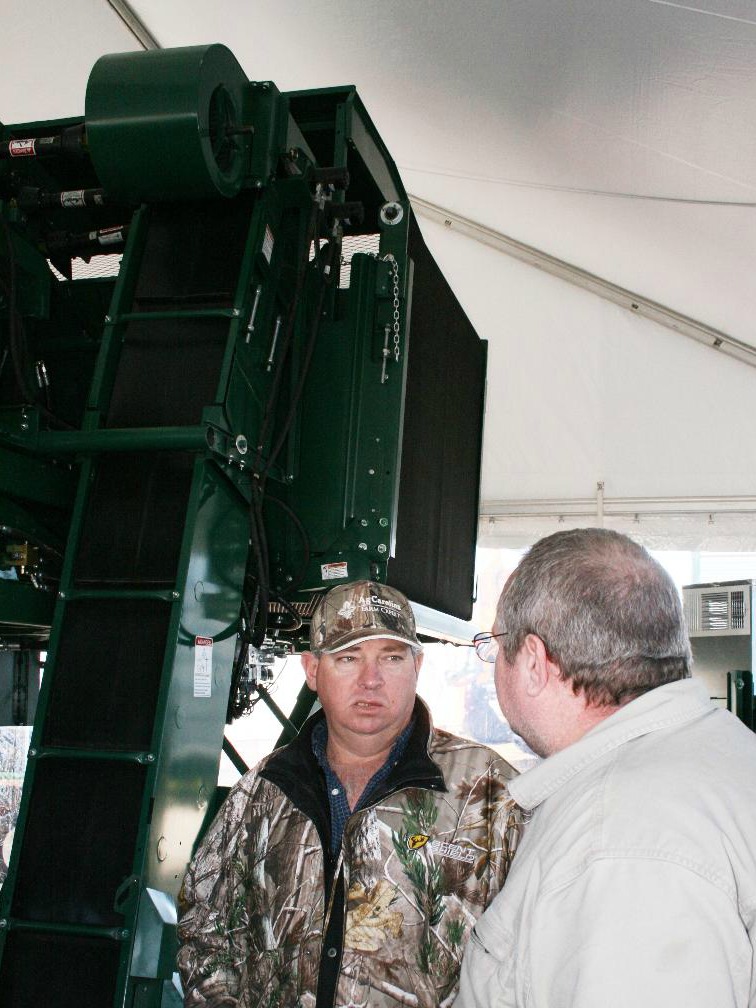
Shopping for a harvesterTime is running out, but the demand for new flue-curing barns continues strong. Dale Hutchins of Carolina Tobacco Services, Bennettsville, S.C., tells Tobacco Farmer Newsletter that he is still building barns, harvesters and other equipment. For barns, the point has already passed where delivery can be guaranteed by July, which is the normal delivery time. But Hutchins expects some orders for late delivery, and he will build some for future sales. "You can't sell them if you don't have them," he says. In the photo, Marty Adams (left) of Knightdale, N.C., got the word on mechanical harvesters from Hutchins at the recent Southern Farm Show.

BURLEY--In Kentucky, Extension tobacco specialist Bob Pearce expects a small increase in burley acreage, perhaps five percent. "Some limited planting is going on," he says. "Normally we would be a little farther on. I would say most of the crop is a week or 10 days behind." As soon as it dries out, planting will get going in full force, he says, and the crop could catch up quickly... In Tennessee, an earlier Extension projection placed plantings at close to last year's level, although the USDA thinks plantings will be down 12 percent in the state.


DARK--In Tennessee and Kentucky, any increase in acreage could be slight, says Andy Bailey, Extension dark tobacco specialist for both states. Planting of fire-cured and dark air-cured has barely begun. "It usually starts up around May 1, but because of the wet weather, full-scale planting probably won't get going until the end of this week," he says...In Virginia, transplanting of the small fire-cured crop was 19 percent complete by May 5, according to USDA.

  
FLUE-CURED--In Georgia and Florida, it appears that acreage increased a little, but tobacco plantings will be nowhere near fencerow to fencerow. "We expected a 10 percent to 15 percent increase, and that appears to be about right," says J. Michael Moore, Extension tobacco specialist. Planting was complete in Florida and nearly complete in Georgia at the beginning of May. "There is actually some tobacco in Florida that is ready for layby already," says Moore...In South Carolina, there will also be a modest increase in acres, says Dewitt Gooden, S.C. Extension tobacco specialist. But he doesn't have a good estimate yet. "We are a little behind in plantings, and we still lack a little of being finished," he says. "But I think all our farmers will get the acreage planted that they wanted"...In North Carolina, flue-cured growers in the East aren't much behind normal. "But they are behind where they would like to be," says Loren Fisher, Extension tobacco specialist. "Our larger growers may be farther behind than smaller ones." Fisher thinks flue-cured plantings in all of N.C. might reach 175,000 acres, although 160,000 acres--about the same as last season--may be closer to the mark...In Virginia, growers worked through Sunday trying to beat the rain predicted this week, says Lunenburg County Extension agent Lindy Tucker. Transplanting there had just begun this week. USDA estimated that through May 5, 12 percent of the Virginia flue-cured crop had been planted.


A substantial amount of GF 318--the still-new flue-cured variety developed by Gwynn Farms and marketed by GoldLeaf Seed--was planted in Georgia and Florida this year. It is comparable to NC 196 but it has mosaic resistance and is seven to 10 days earlier in maturity, says Moore. "Plant it early and it can help fill your barns until the rest of the crop ripens."


A way to save on natural gas? There could be substantial savings in the rate farmers pay for natural gas, says Larry Phipps, a certified utility broker for Options Utility Consulting. "In many cases, the current rates set by utilities do not reflect the lowest possible price," he says. "But we are able to bring competitive pricing that gives farmers the best possible rate." N.C. regulations limit the opportunity to large volume users. "But the savings can be considerable, and other states permit the rate savings for smaller farms." You can get a free audit by calling Phipps at 919 696 4228 or by email at Larry@UtilSav.com.


Steve Pratt
Steve Pratt
New grower leader: The Burley Tobacco Growers Cooperative Association in Lexington, Ky., appointed Steve Pratt general manager in April. He had worked 17 years with the Kentucky Farm Service Agency and earlier for 18 years with the Farmers Home Administration. He replaces Brian Furnish, now owner of International Tobacco Trading Group. "This selection was a long time in coming, but I feel we have made a good selection," said Pat Raines, president of the cooperative. "I am proud to have a person in the office with the experience that Steve has working with the farmers and office staff." Pratt says he is committed to expanding overseas sales for his members. "Our goal is to increase the amount of burley tobacco we produce that meets the demands of the market." He also hopes to increase the number of contracts the cooperative signs.


Another vacancy among tobacco specialists: Scott Bissette, who held the position of tobacco marketing specialist for the N.C. Department of Agriculture, has been named to oversee the N.C. Forest Service. A new specialist will be appointed, but a schedule for choosing that person has not been set. The duties of the position may be revised, sources say.
  
  
DATES TO REMEMBER

Tobacco Barn CO2 Testing Certification Training Workshops
  • May 14, 10 a.m., Jeff Davis County Extension Office, 14 Jeff Davis St., Hazlehurst, Ga.
  • May 16, 10 a.m., Berrien County Extension Office, 516-A CountyFarm Rd., Nashville, Ga.
  • May 22, 10:30 a.m., Candler County Extension Office, 1075 E Hiawatha St., Metter, Ga.
  • May 23, 10 a.m. Huggins Family Farm, 1165 Pleasant Grove Rd., Lynchburg, S.C.

ADVERTISING


A BRIEF HISTORY  OF  NORTH CAROLINA TOBACCO
This softcovNC Tobacco Booker book from History Press recounts the Bright Leaf's contribution to Tar Heel history. A terrific gift for tobacco-oriented individuals. The price is $21.99.  
Also available: A companion work called "Remembering North Carolina Tobacco," also by Yeargin. The price is $19.99. To order, specify which book (or both) you want and send check or money order to Billy Yeargin, 112 N. Webb St, Selma NC 27576. For more information, email Yeargin at tobhistry@aol.com.

Wednesday, April 3, 2013

USDA QUESTIONS: WILL THE EXPECTED BOOM IN ACREAGE REALLY MATERIALIZE?

A farmer transplants flue-cured near Raeford, N.C.


The big crop that was projected for burley and especially for flue-cured has apparently not materialized.  Or at least, not as of the first two weeks of March. That's when USDA's National Agricultural Statistics Service (NASS) surveyed a sample of tobacco farmers and used their responses to prepare its Prospective Plantings report, which was issued last week. Briefly, it said flue-cured growers would increase their acreage by only six percent and burley growers by only two percent. [See the state-by-state analysis below.] I say "only" because all the evidence I heard over the winter was that growers of both types were planning a much more significant acreage increase. That actually is what NASS projects for flue-cured in South Carolina (up 25 percent), Georgia (up 10 percent) and Virginia (up 10 percent). But North Carolina, the major flue-cured state, is projected up only four percent. For burley, meanwhile, Tennessee, the number two state, is projected down 12 percent, and Virginia is projected down a whopping 30 percent. In the 30+ years I have been in this line of work, I have learned that USDA reports usually have a certain amount of credibility. But I don't know about this one--it simply looks off. The high points appear below, and you can find more details athttp://www.nass.usda.gov/ (click Crops & Plants, then follow the prompts). Watch future issues of TFN for further analysis and check my blog (http://modtob.blogspot.com) for the latest news.
--Chris Bickers

USDA-NASS Prospective Plantings Report (3/28/2013) 

Flue-cured:
  • North Carolina-170,000 acres, up four percent;
  • Virginia-22,000 acres, up 10 percent;
  • South Carolina-15,000 acres, up 25 percent;
  • Georgia-11,000 acres, up 10 percent.
  • All flue-cured--218,000 acres, up six percent.
Burley:
  
  • Kentucky--78,000 acres, up five percent;       
  • Tennessee--14,000 acres, down 12 percent;       
  • Pennsylvania--5,100 acres, up nine percent;      
  • North Carolina--2,100 acres, no change;      
  • Ohio--2,000 acres, up five percent;     
  • Virginia--1,900 acres, down 30 percent.      
  • All burley--103,100 acres, up two percent.  
Fire-cured: 16,680 acres, up two percent
Dark air-cured: 5,000 acres, down four percent.
Cigar types: 4,850 acres, up nine percent. 
Southern Maryland: 2,000 acres, down 31 percent. 

In other news:
Two familiar faces in tobacco work are moving on. Danny Peek, Virginia Extension burley specialist, has been named director of the Virginia Extension's Southwest District. Peek, who is now stationed in Abingdon, is holding both positions until a new specialist is hired...Paul Denton, Tennessee Extension tobacco specialist, will retire at the end of May. The university plans to replace him, although the timetable is open. Like Denton, his replacement will divide his time between burley in Tennessee (75 percent) and Kentucky (25 percent). The only change in the job description will be that the new person will have some research responsibilities, Denton says.

By the way, neither Peek or Denton finds the Prospective Plantings projections convincing. Peek is mystified by the Prospective Plantings projection for Virginia burley of only 1,900 acres, 30 percent less than last year. "I was expecting a seven to 10 percent increase!" he says. "I can't believe our acreage will be down that much." He says that buyers still tell him that the mountain burley of Virginia, Tennessee and North Carolina offers some desirable quality characteristics in the current market.
The 12 percent drop projected in Tennessee for burley seems too much to Denton. "I think by the time we finish planting we will have crept back close to last year's acreage," he says. But there has been one obstacle to increased plantings: the changed rotation rules for crop insurance. "Now, you can't get crop insurance for tobacco planted a third consecutive year [on the same land]. That apparently is going to impact more farmers than we might have expected." 
In the Piedmont of North Carolina, auction operator Dennis White of Rural Hall says he is expecting much more than four percent more flue-cured in his area. "I think that the price will lead to more acres than that," he says. He doesn't have a firm figure in mind but says that 10 percent would be closer to the mark. Whatever the increase, White expects to sell more tobacco at Old Belt Tobacco Sales warehouse this year. "We have heard from a lot of farmers who want to sell with us," he says. He has even provided contracts for a few farmers who needed them to arrange financing.
Could the shortage of curing barns have depressed planting intentions of flue-cured? By all reports, used barns are selling at very high prices, and few remain available for sale. And every manufacturer of flue-cured barns I have talked to recently has told me he expects to build all the new barns his facilities will allow. 


A short course on tobacco: A group of farmers and representatives of government and allied industries participated recently in a short course designed to promote efficient, quality tobacco production held recently in Raleigh.
  • Tobacco farmers enrolled in the N.C. State Tobacco Short Course included (from N.C. except as noted): Kyle Norris of Burlington; Archie Griffin of Washington; Garrett Gore and Justin Gore of Nakina; Jason Dixon of Oxford; Jordan Boyette of Clayton; Loren Thornton of Four Oaks; Peyton McDaniel of Whitakers; Phillip Watson of Whitakers; Scott Clayton of Cedar Grove; Shawn Whitt of Rougemont; Tyler Dunn and Jordon Tyson, both of Ayden; Robert Fann and Brittany Tew Fann, both of Salemburg; Curtis Godwin of Dunn; Kristal Jones of Mt. Olive; Will Sheldon Strickland of Mt. Olive; Jed Spain of Plymouth; Justin Williams of Goldsboro; Spencer Davis of Wilson; Halifax County, Va., grower Garland Comer and Pittsylvania County, Va., grower and Extension agent Stephen Barts.

  • Industry and government participants included Shannon Parker of Four Oaks, Alex Sereno and Sandy Yeatts, both of Raleigh, all of the Risk Management Agency; Chris Garris of Gas Appliance Service in Greenville; Phillip Strickland of McLamb Farm Services in Dunn; and Joe West of AgriTechnologies in Clinton; Aurora Toennisson, N.C. State University graduate student in the Entomology Department of Raleigh; and five N.C. Department of Agriculture employees : John Council of the Upper Mountain Research Station, Laurel Springs; Steven Mills, Upper Coastal Plains Research Station, Rocky Mount; Blair Owens and Lloyd Ransom, both of the Border Belt Tobacco Research Station, Whiteville; and regional agronomist Dwayne Tate of Asheville.

The program was conducted by the N.C. Tobacco Foundation in partnership with the College of Agricultural and Life Sciences at N.C. State University. A grant from the N.C. Tobacco Trust Fund Commission helped fund the program.


A make-your-own approach to creating more barn space: The most pressing problem for flue-cured growers this season was featured in one segment of the Tobacco Short Course program. The participants paid a visit to the farm of their fellow student Kristal Jones of Mount Olive and her husband Tony. The attraction was the Jones unusual approach to acquiring more barn space: They are making their own. Using local labor, Tony believes he can "home-make" a bulk barn for about two thirds of the cost of a new commercial unit. Robert Fann of Salemburg, N.C., a short course participant, was impressed. "We have enough barns this year that we don't need to get any more," says Fann. "But seeing Tony build his own barns makes me think I could do it if I had to. I want to talk to him after the season is over and find out if he thinks it is a good strategy." Besides learning opportunities like this, the short course offered "a good opportunity to make contacts with other farm people in the area that I hope to continue for years to come," Fann said. "There should definitely be a residual value from the short course."