Thursday, January 9, 2014

The sequestration threat is over

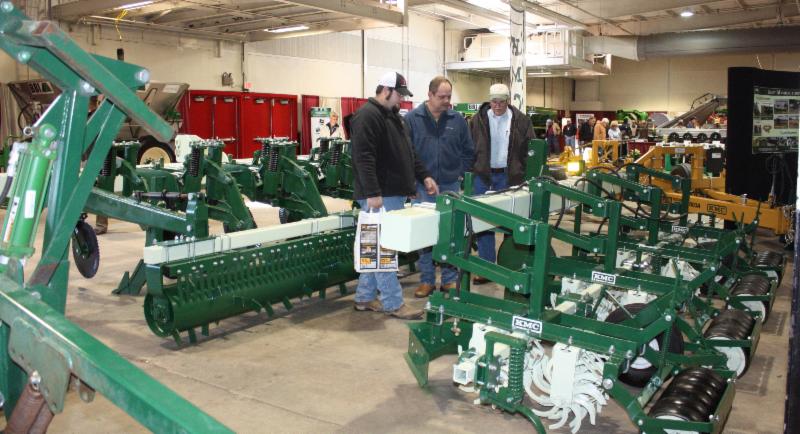
Last year's show
Visitors at last year's Southern Farm Show look over cultivating equipment at the KMC exhibit.

Victory in the sequestration war: Federal buyout payments to tobacco farmers won't be reduced by any across-the-board budget cuts, U.S. Secretary of Agriculture Tom Vilsack said Monday. Funds that had been held back as a result of the "sequestration" cuts during the federal fiscal year are available for this year's payments. Funds held back this year could be used at the start of the next fiscal year in October "to complete the final payment," Vilsack wrote. Larry Wooten, president of the N.C. Farm Bureau told the media, "[This was] a misguided effort all along. But in any event, the real win is that people are [going] to receive these final benefits."

The Southern Farm Show is coming in a month. Below is a list of exhibitors who will have products of interest to tobacco growers on display at the Southern Farm Show, Wednesday, February 5, to Friday, February 7, from 9 a.m. to 4 p.m. each day. The Show is free as is parking. On Friday, the Tobacco Growers Association of North Carolina will hold its annual meeting in Dorton Arena, followed by a hosted meal. For more information, go to http://www.southernshows.com. If I left out any exhibitor who wants to be in this list, let me know via email at chrisbickers@gmail.com. 


This has been a good week to have heat in your burley stripping area. Jerry Rankin, a warehouse operator and farmer in Danville, Ky., said the temperature was four degrees below zero Tuesday morning. When I talked to him in the afternoon it had only gotten up to 10 degrees Fahrenheit. "In temperatures that low, you can't get much tobacco taken down," he says. "And you can't work the leaf in an open barn. You are not stripping it, you are just jerking it." Rankin's stripping room is heated and insulated. "We find that leaf stripped in a heated room will soften a little before it gets dry."


Burley prices are holding firm. Rankin held a contract sale at this warehouse Tuesday, and the average price appeared to be about $2.06:5 per pound. Perhaps because farmers were anxious to deliver before the cold set in, the volume was a floor-busting 700,000 pounds. He expected more-normal volumes of 150,000 pounds on Wednesday and 200,000 pounds on Thursday. "We might end up with a million pounds sold this week," he says. "But we will be lucky to get half of that next week, thanks to the cold."


The saving grace of Bluegrass burley in 2013 has been the color, says Rankin. "The color has been fantastic. But it has not yielded well (in processing). I hope that doesn't cause problems down the road."

Looking ahead to greenhouse seeding: The outdoor temperature when you seed your greenhouse is important. "We can produce viable transplants in 60 degree temperature in the greenhouse," says Matthew Vann, N.C. Extension tobacco specialist. "You can heat the air, but if the temperature outside is low, it may be worthwhile to wait until it is warmer. "For instance, if you are planning to seed on a day when it is 20 degrees outside and weather predictions say it will be 50 degrees two days later, it may pay to wait, Vann says. "You will save some fuel," he says.
  
Seed of the flue-cured variety NC-71 will apparently not be available this season, thanks to certification problems. It has played a big part in variety choice: In North Carolina alone, it accounted for four to six percent of flue-cured acreage in recent years, says Vann. "Some of that acreage may go into NC-196 and K-326," he says.
  
Steaming greenhouse trays has proved to be a good alternative to treating them with methyl bromide, says Vann. "It is just as effective and is better for the environment."
  
Tobacco-related exhibits at next month's Southern Farm Show
  • 221 Taylor Mfg. Curing barns, wood furnaces.
  • 222, 8301 Evans Mactavish Agricraft / World Tobacco. Bulk fertilizer handling equipment. Curing barns.  
  • 227 Kelley Manufacturing Co. Agricultural equipment.
  •  704, 8131 Agri Supply. Agricultural materials.
  • 807 Mechanical Transplanter Co. Transplanters and seeding equipment.
  • 808 BulkTobac (Gas Fired Products). Curing equipment and controls, poultry brooders, pig heating, space heaters.
  • 1002 TriEst Ag Group (Formerly Hendrix and Dail). Fumigation supplies.
  • 1005 Flue Cured Tobacco Services. Curing controls
  • 1015 Yara North America. Fertility products.
    • 1104 GoldLeaf Seed Co. Tobacco seed.  
    • 1116 Cross Creek Seed. Tobacco seed.  
    • 1121 AAA Scale Co.  
    • 1202 Reddick Equipment Company Inc.
    • 1220 F.W. Rickard Seeds. Flue-cured, burley and dark tobacco seed.
    • 1302 Mid-Atlantic Irrigation Co. Irrigation equipment.
    • 3127 and 8611 Benchmark Buildings & Irrigation Inc. Pre-fabricated metal buildings, transplanters and irrigation equipment.
    • 3135 Southern Container Corporation of Wilson. Bale sheets and packaging.  
    • 3522 First Products Inc. Fertilizer boxes for cultivators and tool bars.
    • 3714, 8615 Cureco, Inc. Curing controls.
    • 4037 Hog Slat Inc.
    • 4151 GrassWorks Manufacturing. 
    • 5007 ABI Irrigation. Irrigation equipment.
    • 5023 Walters Air Assist Plant Release System. Plant release system.
    • 5108 MD/Barnmaster of the Carolinas. Farm Buildings.
    • 7025 Drexel Chemical Company. Sucker control chemicals.
    • 7323 Berger. Plant growing mixtures.
    • 7327 Teeterville Garage & Weighing Systems. Moisture controllers for tobacco barns and weighing scales.
    • 8011 Equipmax. Tobacco spray equipment. Sprayer conversions.
    • 8122 Carolina Tobacco Services. Curing barns, mechanical harvesters, heat exchangers.
    • 8150 Long Tobacco Barn Co. Bulk tobacco curing barns.
    • 8701 Tytun Ltd. Bulk flue-curing barns.
    • 8204 Wilson Manufacturing. Farm trailers.
    • 8217 Granville Equipment. Tobacco Machinery. 
      
    Bridging the GAP--again. You will need a grower ID card to participate in any of the GAP Recertification meetings this winter. You can obtain one before the meeting by going online at  www.gapconnections.com and printing it on your printer. It will be scanned at the meeting and will help you keep track of and share your compliance records with potential companies.

    GAP meeting dates: Here are the meeting dates that have I learned so far. Pre-registration by phone is required. Call the number listed for the meeting you want to attend. Look here for listings for other states and other types as they are available.

    North Carolina
    • January 8: Wayne County Extension Center, 208 Chestnut St., Goldsboro, N.C. Phone: 919-731-1520. Starts at 10 a.m.
    • January 9: Wilson County Agricultural Center, 1806 Goldsboro St., Wilson, N.C. Phone: 252-237-0111. Starts at 9:30 a.m.
    • January 9: Johnston County Extension Center, 2736 NC 210 Highway, Smithfield, N.C. Phone: 919-989-5380. Starts at 4 p.m.
    • January 10: The Farmer's Market, 1006 Peachtree St. Rocky Mount, N.C. Phone: 252-459-9810. Starts at 10 a.m.
    • January 20: McSwain Extension Center, 2420 Tramway Rd., Sanford, N.C. Phone: 919-775-5624. Starts at 10 a.m.
    • January 21: Forsyth County Extension Center, 1450 Fairchild Rd. Winston Salem, N.C. Phone: 336-703-2857. Starts at 10 a.m.
    • January 21: Sampson County Ag Expo Center, 414 Warsaw Rd., Clinton, N.C. Phone: 910-592-7161. Starts at 10 p.m.
    • January 22: Caswell County Civic Center, 536 Main St. East, Yanceyville, N.C.. Phone: 336-694-4158. Starts at 10 a.m.
    • January 23: Cunningham Research Station, 200 Cunningham Rd. Kinston, N.C.. Phone: 252-747-5831. Starts at 9:30.
    • January 28: Granville County Expo Center, 4185 US Highway 15 South, Oxford, N.C. Phone: 919-603-1350. Starts at 10 p.m.
    • January 30: Cumberland Co. Ag Expo Center, 301 E. Mountain Dr., Fayetteville, N.C. Phone: 910-321-6872. Starts at 10 p.m.
    • February 3: Pitt County Extension Center, 403 Government Circle Greenville, N.C. Phone: 252-902-1702. Starts at 9:30.
    • February 7: Holshouser Bldg., N.C. State Fairgrounds. During Southern Farm Show. Starts at 1 p.m. Contact your county agent.
    • February 12: Surry County/Yadkin County, N.C. Location to be determined. Phone: 336-371-0189. Starts at 10 a.m.  
     Virginia 
    • January 22, 4 p.m. Meherrin River Hunt Club (near South Hill), 435 Dry Creek Rd., Baskerville, Va. Contact: Taylor Clarke (434-738-6191).
    • January 23, 9 a.m. Southern Piedmont Center, 2375 Darvills Road,  Blackstone, Va. Contact: Margaret Kenny (434-292-5331).
    • January 23, 4 p.m. Olde Dominion Ag Complex, 19783 US Highway 29, South Chatham, Va. Contact: Stephen Barts (434-432-7770).
    • January 27, 10 a.m. Scottsburg Volunteer Fire Department. Scottsburg, Va. Contact: Chris Brown (434-476-2147).
    Kentucky 
    • January 17, 9 a.m. Tobacco Expo, Hyatt Hotel/Lexington Convention Center, 401 West High Street, Lexington, Ky. Contact: Kathy Sanford, 859-252-3561, kathy@burleytobacco.com.
    • January 27, 6 p.m. North Central Ky. Tobacco Meeting, Harrison County Extension Office, 668 New Lair Rd., Cynthiana, Ky. Contact: Gary Carter, 859-234-5510, DL_CES_HARRISON@EMAIL. UKY.EDU.
    • January 28, 6:30 p.m. Central Kentucky Tobacco Meeting, Woodford County Extension Office, 184 Beasley Rd., Versailles, Ky. Contact: Adam Probst, 859-873-4601, DL_CES_WOODFORD@EMAIL. UKY. EDU.
    • January 30, 6 p.m. South Central Kentucky Tobacco Meeting, Lincoln County Extension Office, 104 Metker Tr., Stanford, Ky. Contact: Dan Grigson, 606-365-3238. DL_CES_LINCOLN@EMAIL.UKY. EDU.
    • February 3, 6:30 p.m. South Kentucky Tobacco Meeting, Allen County Extension Office, 200 East Main Street, Scottsville, Ky. Contact: Steve Osborne, 270-237-3146, DL_CES_ALLEN@EMAIL.UKY.EDU.
    • February 6, 10 a.m. Center of Kentucky Tobacco Meeting, Green County Extension Office, 298 Happyville Road, Greensburg, Ky. Contact: Ricky Arnett, 270-932-5311, DL_CES_GREEN@EMAIL.UKY.EDU.
    • February 11, Noon. Wayne/Pulaski County Tobacco Meeting, Wayne County Extension Office, 255 Rolling Hills Blvd., Monticello,   Contact: Glen Roberts, 606-348-8453, DL_CES_WAYNE@EMAIL.UKY.EDU.
    • February 18, 6:45 p.m. Bath/Montgomery Regional Commodity Night, Bath County Extension Office, 2914 E. Hwy. 60, Owingsville, Ky. Contact: Gary Hamilton, 606-674-6121, DL_CES_BATH@EMAIL.UKY.EDU.
    • February 20, 6 p.m. Estill and Powell County Tobacco Meeting, Estill County Extension Office, 76 Golden Court, Irvine, Ky. Contact: Eric Baker, 606-723-4557, DL_CES_ESTILL@EMAIL.UKY.EDU.

    Wednesday, December 18, 2013

    Will the strong demand of 2013 continue?

    Buyers debate the value of flue-cured leaf at an auction in Wilson, N.C., last September.


    It appears now that there is still an upward trend in demand. "But it is hard to predict how far into the future we will see it continue," said N.C. Extension economist Blake Brown at the N.C. Tobacco Day meeting in Smithfield on December 5. "In the near term, demand from China is very robust. They have been trying to increase their purchases of flue-cured tobacco, [not only] in the U.S. but also in other countries. That upward trend has more than offset declines in consumption in the U.S. and other developed countries."

    Prospects for 2014? Brown noted that some companies had already begun signing contracts as of December 5. "That is good news for farmers," said Brown. "It indicates that they haven't been able to solve supply problems with the South American crop." But just this week,Tobacco Farmer Newsletter learned that some companies have slowed down on contracting or have reduced the price. One auction company owner said he fears that some of the 2013 crop may have been sold at a price that just doesn't fit into the Chinese market, and the companies will have to solve that problem before proceeding much farther.

    Why 2013 was no windfall for farmers: The yield of the last flue-cured crop was about 2,000 pounds per acre, well below the normal 2,300 to 2,400 pounds per acre. "That is quite a large loss," said Brown. "Farmers also had to spend more money putting nitrogen on to try to compensate for the rain."

    Technology could change everything: All of the major cigarette manufacturers in the U.S. and Europe have either purchased an e-cigarette company or are developing their own e- product. "We will just have to see how the technology advances, but it's one factor that could really impact the cigarette market in the future as more and more smokers switch to those kinds of products," said Brown. There seems little reason to think that that the e-cigarette industry, no matter how big, will use much American tobacco.  

    After all these years, the flue-cured producers of North Carolina will finally get the chance to vote on whether or not they want a checkoff to fund their growers association. A referendum was recently authorized by the state legislature, and the Tobacco Growers Association of N.C. hopes to hold it sometime in the spring. It will be conducted by mail. TGANC will mail ballots to all active growers it has addresses for, and you can also get a ballot at any GAP meeting or from your county Extension office (and if you still can't get one, call me and I will get one for you). A two thirds vote is needed to pass. Ten cents per hundredweight is proposed, which I am told comes out to about $2.30 an acre and would generate perhaps $300,000 a year in operating income. My editorial opinion: Every N.C. grower should vote for this, to give leaders the stability of support they need to effectively represent them. I was one of the first members of this organization back in 1981, and I was very involved in the effort to obtain a checkoff in 1989. That effort was turned back because the non-producing allotment owners-a powerful group back then-thought it would dilute their influence. Fortunately, the concept of non-producing allotment owner disappeared with the buyout, and I can't think of anyone else who would now oppose such a positive and constructive move. Vote yes!

    Endowing an Extension post: An effort has begun to create an endowed chair of tobacco Extension at North Carolina State University in the name of W.K. (Bill) Collins, longtime tobacco agronomist. But funding will be a challenge, and details are still being worked out.

    ADVERTISING


    Don't get caught without a C&M setter this season


    Gold Eagle Curing Barns
    Taylor Tobacco Barn

    Make high yields and grades


    The Energy Barn


    Tytun

    "A BRIEF  HISTORY  OF  NORTH  CAROLINA  TOBACCO"
    The perfect Christmas gift for tobacco people

    NC Tobacco Book
    Written by historian Billy Yeargin, this softcover book from History Press recounts the Bright Leaf's contribution to Tar Heel history. 

    A terrific gift for tobacco-oriented individuals. Price is $21.99. Also available: A companion work called "Remembering North Carolina Tobacco," also by Yeargin. Price is $19.99. To order, specify which or both books you want and send check or money order to Yeargin at 112 N. Webb St, Selma NC 27576. 

    For more information, email Yeargin at tobhistry@aol.com.

    Friday, December 6, 2013

    GAP RE-CERTIFICATION MEETINGS BEGIN

    North Carolina and Virginia have announced their re-certification meeting schedule for flue-cured tobacco in the new year. Dates and locations follow. Pre-registration by phone is required. Call the number listed for the meeting you want to attend. Burley meetings in N.C. and burley and dark meetings in Virginia will be announced later. Look for listings from other states as they are available.

    North Carolina
    • January 7: Martin County Farmer's Market, 4001 West Main St. Ext. Williamson, N.C. Phone: 252-789-4370. Starts at 10 a.m.
    • January 8: Wayne County Extension Center, 208 Chestnut St., Goldsboro, N.C. Phone: 919-731-1520. Starts at 10 a.m.
    • January 9: Wilson County Agricultural Center, 1806 Goldsboro St., Wilson, N.C. Phone: 252-237-0111. Starts at 9:30 a.m.
    • January 9: Johnston County Extension Center, 2736 NC 210 Highway, Smithfield, N.C. Phone: 919-989-5380. Starts at 4 p.m.
    • January 10: The Farmer's Market, 1006 Peachtree St. Rocky Mount, N.C. Phone: 252-459-9810. Starts at 10 a.m.
    • January 20: McSwain Extension Center, 2420 Tramway Rd., Sanford, N.C. Phone: 919-775-5624. Starts at 10 a.m.
    • January 21: Forsyth County Extension Center, 1450 Fairchild Rd. Winston Salem, N.C. Phone: 336-703-2857. Starts at 10 a.m.
    • January 21: Sampson County Ag Expo Center, 414 Warsaw Rd., Clinton, N.C. Phone: 910-592-7161. Starts at 10 p.m.
    • January 22: Caswell County Civic Center, 536 Main St. East, Yanceyville, N.C.. Phone: 336-694-4158. Starts at 10 a.m.
    • January 23: Cunningham Research Station, 200 Cunningham Rd. Kinston, N.C.. Phone: 252-747-5831. Starts at 9:30.
    • January 28: Granville County Expo Center, 4185 US Highway 15 South, Oxford, N.C. Phone: 919-603-1350. Starts at 10 p.m.
    • January 30: Cumberland Co. Ag Expo Center, 301 E. Mountain Dr., Fayetteville, N.C. Phone: 910-321-6872. Starts at 10 p.m.
    • February 3: Pitt County Extension Center, 403 Government Circle Greenville, N.C. Phone: 252-902-1702. Starts at 9:30.
    • February 7: Holshouser Bldg., N.C. State Fairgrounds. During Southern Farm Show. Starts at 1 p.m. Contact your county agent to register.
    • February 12: Surry County/Yadkin County, N.C. Location to be determined. Phone: 336-371-0189. Starts at 10 a.m.  
     Virginia 
    • January 22, 4 p.m. Meherrin River Hunt Club (near South Hill), 435 Dry Creek Rd., Baskerville, Va. Contact: Taylor Clarke (434-738-6191).
    • January 23, 9 a.m. Southern Piedmont Research Center, 2375 Darvills  Rd., Blackstone, Va. Contact: Margaret Kenny (434-292-5331).
    • January 23, 4 p.m. Olde Dominion Ag Complex, 19783 U. S. Highway 29, South Chatham, Va. Contact: Stephen Barts (434-432-7770).
    • January 27, 10 a.m. Scottsburg Volunteer Fire Department. Scottsburg, Va. Contact: Chris Brown (434-476-2147).

    Tuesday, December 3, 2013

    WHO WILL GROW MORE TOBACCO IN 2014?

    Burley stripping
    Workers strip burley in Milton, N.C., near Danville, Va. 
    Is burley production headed up? The farmer cooperatives seem to think so. The Kentucky-based burley cooperative plans an increase in purchases for 2014. "Our goal is to increase the volume we have under contract for 2014," says Steve Pratt, general manager, Burley Tobacco Growers Cooperative Association (BTGCA) in Lexington, Ky. "This is definitely the direction we want to go in." The Tennessee-based burley cooperative will likely seek more tobacco too, as it responds to a world market for flavor burley that has been very strong for several years, says Daniel Green, chief executive officer of Burley Stabilization Corporation. "We want to buy more tobacco if we can get it grown, and we expect to be competitive in price." 

    The geographical service area for the Tennessee burley cooperative has grown in recent years. In addition to its traditional states of Tennessee, North Carolina and Virginia, it also has growers in Kentucky, Ohio, Indiana, Missouri and Wisconsin. But if the cooperative seeks to increase production in 2014, it will probably be through existing farmers rather than new ones, says Green. 

    New delivery stations: To handle the larger crop that was expected expected in 2013, the U.S. Tobacco Cooperative (USTC) opened new marketing centers in Smithfield, N.C., and Oxford, N.C. Four were already operating in Nashville, Ga.; Mullins, S.C.; Wilson, N.C., and Danville, Va. All six will be in operation again in 2014, says Tommy Bunn, USTC president. BSC is contemplating opening another delivery station, probably in Kentucky. "As it stands now, some of our growers have to drive quite a way to get to our facilities in Springfield and Greeneville, Tn.," says Green.  

    It was a good year for the flue-cured cooperative. USTC paid its members the highest patronage dividend in its history: $.245 per delivered pound. That was 88 percent higher than the previous year. Dividends are paid on the basis of the fiscal year. "This indicates that we had an excellent crop and that the cooperative was able to sell it for a profit," says Bunn. "Another factor was that our consumer products--cigarettes, small cigars and cut tobacco--also did well this year." But Bunn says the flue-cured cooperative hasn't yet made a decision on expansion.

    A chance for good answers to tough production questions appears on tap at the North Carolina Tobacco Day program this Thursday (December 5) from 8 a.m. till 12 p.m. at the Johnston County Extension Center in Smithfield, NC. Among the topics: How to achieve MSPA and H-2A compliance; what is the assessment of energy use in new curing barns; are rotations available that will reduce Palmer amaranth; what competition can we expect from e-cigarettes; and several others, concluding with N.C. Extension economist Blake Brown's take on the tobacco outlook for 2014. 

    The birth of a new burley area: Since deregulation, a small but significant growth of burley has sprung up in Wisconsin. "Most of the growers are Amish," says Green. "They do well. They are looking to grow more." According to another report, about 20 Wisconsin growers experimented with Southern Maryland this year.

    How to control Palmer's amaranth: It's a more important concern now since China complained earlier in the year that seed of this weed, along with crabgrass, foxtail and some others it doesn't like. Spartan could be the ace in the hole since it gives very good control. Aim and Prowl are also effective. Judicious cultivation also helps, and if you get your top and sucker crew to pull them up by hand, that increases the control. The Cadillac treatment is deep tillage with a moldboard plow which can reduce pigweed by about 50 percent, says Vann. Combine it with Spartan and you can get as much as an 80 percent reduction. But deep tillage is expensive, maybe $33 an acre more compared to shallow tillage, says Vann. The best way to keep Palmer's amaranth seed out of tobacco is not to plant it tobacco in infested fields in the first place. What tobacco is most vulnerable to Palmer's seed contamination? Flue-cured that is mechanically harvested, says Vann. Note: Vann will address this topic further at N.C. Tobacco Day.

    A report on tobacco in Pennsylvania: The 2013 crop in the Keystone State could end up being a good one. "The first half of the season was wet, beginning at transplanting," a leaf dealer in Lancaster told Tobacco Farmer Newsletter. "That pushed the crop back two weeks, but that wasn't a problem. Once the rainy period stopped, we had spotty rains here and there, which helped. When the tobacco got in the barns, it cured a little quick, but that didn't end up being a problem either." Industry estimates of production are: Pennsylvania seedleaf (Type 41), 3.7 million pounds. Southern Maryland (Type 32), 6.5 million pounds, down two million pounds from 2012. Burley, 13 million pounds, up perhaps a million pounds over last year.

    Mark your calendar--Southern Farm Show, February 5, 6 and 7, N.C. Fairgrounds, Raleigh, N.C., including the annual meeting of the Tobacco Growers Association of North Carolina, 10 a.m. to 1 p.m., on Friday, February 7.

    A request from the editor to Extension specialists and anyone else holding GAP meetings: Please send me the dates and places and I will publicize in future issues.--Chris Bickers

    Gold Eagle Curing Barns

    Taylor Tobacco Barn


    "A BRIEF  HISTORY  OF  NORTH  CAROLINA  TOBACCO"
    The perfect Christmas gift for tobacco people

    NC Tobacco Book
    Written by historian Billy Yeargin, this softcover book from History Press recounts the Bright Leaf's contribution to Tar Heel history. A terrific gift for tobacco-oriented individuals. Price is $21.99. Also available: A companion work called "Remembering North Carolina Tobacco," also by Yeargin. Price is $19.99. To order, specify which or both books you want and send check or money order to Yeargin at 112 N. Webb St, Selma NC 27576. For more information, email him at tobhistry@aol.com.

    NEW 2014 BARN DESIGN IS READY TO ORDER  THE ENERGY BARN
    It saves on labor costs, reduces energy consumption 
    and cures your tobacco to world-class standards 
          A Quality Cure At An Affordable Cost--Barnes Farming Corporation, Nash County NC

    The Energy Barn from World Tobacco Inc. is built to the highest standards: It uses only quality materials with galvanized steel construction and tongue and groove Coldmatic panels designed to withstand thermal rippling. So, even in humid or difficult conditions, and regardless of stalk positions, your tobacco quality is maximized every time. Our bins are the ideal size for curing consistency.

    The Evans MacTavish Agricraft heat exchanger is the most widely used heat exchanger on the bulk tobacco barn market. It has been proven to be the most efficient. The exchanger is made of 304 stainless steel, all welded construction. The frame is tube steel with insulated panels. 

    So call to place an order at one of the numbers below, and save money on next year's crop with a high-efficiency bulk-curing barn.  

    ENERGY STYLE:  25,000 LBS GREEN TOBACCO CAPACITY
    ECONOMY STYLE:  20,000 LBS GREEN TOBACCO CAPACITY 
     WORLD TOBACCO INC. 
    3709 Nash Street N W Wilson, N.C. 27896. 
    PH: 252-230-1032/252-245-0277/252-243-4006
    Website: www.worldtob.com ● email: info@worldtob.com 
      
    COME VISIT US AT THE 2014 SOUTHERN FARM SHOW, RALEIGH NC
    AT EXHIBITS 222 AND 8301 
    ASK ABOUT OUR SPECIAL SHOW DISCOUNT

     BIG M TOBACCO WAREHOUSE 
    1723 Goldsboro St. SW, Wilson, N.C., 
    in the old Liberty Warehouse

    We will hold both sealed bid auctions
    and live auctions.
    We promise 

    HONEST AND TRUSTWORTHY 
    SERVICE

    For more information, contact:

    --Mann Mullen at 919-496-9033
    --Greg Ray at  252-799-6061  or
    --the warehouse at 252-206-1447.