Thursday, March 22, 2018

A MAJOR LEAF BUYER TURNS ITS BACK ON U.S. BURLEY

A disappearing breed? A burley grower and his crew in east Tennessee prepare a planter for the field in this photo from the TFN files. Attrition in the number of Volunteer State growers is likely, thanks to the loss of AOI contracts.


The world's number two leaf dealer, Alliance One International (AOI), has withdrawn from the American burley market, at least for 2018. In a statement provided to Tobacco Farmer Newsletter, the company said, 

"With U.S. cigarette sales declining at a rate of 3% per year over the past three years and global cigarette sales following a similar trend, demand for the U.S. burley tobacco crop has declined as well. As a result, we made a difficult decision to not contract any burley tobacco this year. We understand the economic impact of that tobacco has on farmers and their local communities, and this decision was not a reflection of the farmers or their crop quality, but rather the change in global demand."
 
Editor's Note: I just have to think there is more to this than the declining market for tobacco products, although I don't doubt that it was a key factorThere might be some issues on the supply side affecting all burley buyers. 

Excess production, for instance: Daniel Green, c.e.o. of Burley Stabilization Corporation (BSC), notes the current market environment for burley is very challenging. "In spite of the drastic declines in American Blend cigarette sales in recent years, growers have continued to produce burley because of the lack of alternative crops, resulting in oversupply," he says. "Tobacco dealers are generally very averse to holding any more inventories than necessary in the current climate."

And what about several developments on the national level?" Among them are the potential regulatory changes being considered by the FDA that might require tobacco to contain much less nicotine," says Green.
 
BSC is still working on its 2018 contracts, Green says, and will probably send letters to its members next week. "We will help them as much as we can."
 
There will definitely be a reduction in burley acreage this year. Will Snell, Kentucky Extension tobacco economist, estimated earlier in the year that the demand for 2018's
crop would be around 110 million pounds. "We could produce that much on 55,000 acres," says Green. "Last year, we planted 89,000 acres."

It looks that way to Tennessee Extension tobacco specialist Eric Walker as well. "It appears that we are looking at a planting cutback of at least one third, and that might be a conservative estimate," he says. "I am not aware of any buyers that might pick up the slack."

The hardest hit areas will probably be those near Hartsville, Tn., where AOI has operated its burley buying station. That would include Trousdale, Smith and Macon counties, all in Tennessee, and nearby Allen County, Ky. Note: Macon has been America's leading burley-producing county in recent years.

A state of shock 
for Tennessee growers"It was like somebody just dropped a bomb," said Macon County grower Cynthia Jones, in an interview with the Macon County Times. "Nobody was expecting it. There was no warning. Everybody is devastated." The commissioner of agriculture took  notice too. "It is heart-breaking to hear the stories of multi-generational operations being forced to shift production focus or cease operations entirely," said Tennessee Commissioner of Agriculture Jai Templeton in a statement. "Many are now facing difficult decisions that will affect their families.

The immediate impact of AOI's exit from burley will be much greater in Tennessee than Kentucky because AOI had already cut back on contracting in the Bluegrass state. "But this is a lessening of demand, so there will be increased competition among growers for the pounds that are out there," says Bob Pearce, Kentucky Extension tobacco specialist.

Farmers should emphasize quality to retain the contracts they have, says Pearce. "Some of the big [quality] concerns this year would be reducing foreign material in cured leaf and keeping pesticide residues in line with industry expectations."

A demonstrated willingness to participate in GAP as much as possible would probably be a good idea. "Getting involved with the GAP Certification program that is being rolled out could help show a commitment to the tobacco industry. But certification may not be feasible for every burley farmer," Pearce says. 
 
In other tobacco news:

As expected, planting has begun in Florida and is expected to begin in Georgia soon after April 1. "Farmers here are preparing for tomato spotted wilt and black shank using all precautions available against them," says J. Michael Moore, Georgia Extension tobacco specialist who also handles tobacco Extension work in Florida.
 
In the Southside of Virginia, it's been wet and cool, so there has been very limited land preparation, says David Reed, Virginia Extension tobacco specialist. Fumigation has been delayed too, and some greenhouses haven't even been seeded yet. So, he doesn't expect much planting till the end of April or early May. 

Virginia flue-cured plantings will definitely be down. "It will be across the board, maybe five percent and probably no more than 10 percent," says Reed.

GAP GROWER TRAINING EVENTS
Check with your local Extension Service office for further details.
All meetings listed here are free and presented in English
  • March 23, 9 a.m. Hoffman Building at Solanco Fairgrounds, Quarryville, Pa.
  • March 23, 1 p.m. Hoffman Building at Solanco Fairgrounds, Quarryville, Pa.
  • March 26, 6 p.m. Nelson County Extension Office, Bardstown, Ky.
  • March 27, 12 p.m. Po Boy's Restaurant, Douglas, Ga.
  • March 27, 6 p.m. Gallia County Extension Office, Gallipolis, Oh.
  • March 27, 6 p.m. Laurel County Extension Office, London, Ky.
  • March 28, 1 a.m. Milton Shetler Farm, Harned, Ky.
  • March 28, 9 a.m. Ivan Hoover Farm, Leitchfield, Ky.
  • March 28, 7 p.m. Southern Hills CTC, Georgetown, Oh.
  • March 29, 1 p.m. University of Kentucky, Lexington, Ky.
  • April 5, 6 p.m. New Deal Tobacco, Weston, Mo.

Monday, March 5, 2018

TRANSPLANTING TO BEGIN SOON


Clipped and ready to go, these flue-cured plants await transplanting in this file photo from eastern North Carolina.
   
There may be a crop or two planted in Florida this week, but most growers there will probably wait till March 20 or later, while Georgians will probably start in earnest around April 7, says J. Michael Moore, Georgia/Florida Extension tobacco specialist. "We will have plants in plenty of time. Farmers are already clipping on a regular basis." Most plants are of good color, he adds. There have been no issues with insects and only a little pythium.

Steaming is catching on in Georgia, says Moore, as a few commercial plant producers are providing steaming as a service to their customers. Farmers are still doing some rinsing of trays. But dipping or rinsing trays in cleanser is only surface cleaning, and it can't provide decontamination of pathogens embedded in the walls of the trays.

In Kentucky, a few steamers have been used but the traditional dip treatment in a 10 percent bleach solution remains the most common strategy, says Bob Pearce, Kentucky Extension tobacco specialist.

Another possibility: Trilogy trays have actually done well in Kentucky testing. "We looked at them side by side with other treatments, and there was little difference in performance," says Pearce. "The biggest issue is price, although it seems like the trays are durable enough to last longer than conventional trays. But many growers are reluctant to make a long-term investment."

A proactive approach to disease control in the greenhouse is a key to growing a quality transplant, says Pearce. Leafspot diseases are a good  example. "You need to begin preventive spray when plants are just big enough to cover the cell," he says. "Spray Manzate once a week, substituting Quadris one week."

AND THE WINNERS WERE:
A number of awards were presented--and one new grower leader was introduced--during the 2018 Southern Farm Show held from January 31-February 2 in Raleigh.

The Tobacco Growers Association of North Carolina presented six awards during its annual meeting on the last day of the show:
  • Distinguished Service Award--Ray Star-ling, Special Assistant to the U.S. President for Agriculture.
  • President's Award--Brandon and Clint Strick-land, Salemburg, N.C.
  • Outstanding Director--Tim Yarbrough, a Caswell County, N.C., tobacco grower and past president of TGANC.
  • Lifetime Century Member -- Richard Reich, N.C. Department of Agriculture, Agricultural Services Assistant Commissioner,  Reich retired at the end of February.
  • Extension Service Award--Hannah Burrack, N.C. Extension Service entomologist.
  • Farm Family of the Year--Rouse Ivey Family Farms, Duplin County, N.C.
The Tobacco Farm Life Museum presented two awards at its annual "Breakfast with the Commissioner" on the last day of the show:
  • Innovative Farmer of the Year--Justin and Holly Miller, Cherry Hill Farm, Advance, N.C.
  • Excellence in Agriculture--Bobby Wellons,  Tobacco Marketing Specialist, USDA AMS, Princeton, N.C.
The North Carolina Department of Agriculture presented its export award during the Ag Development Forum on the second day of the show:
  • N.C. Exporter of the Year--Scott Farms of Lucama, N.C. Accepting the award was Linwood "Sonny" Scott Jr., president and co-owner of the farm.
The U.S. Tobacco Cooperative (USTC) introduced its new Chief Executive Officer:
Fulford
  • Robert B. Fulford Jr., whose appointment took place the week of the show. Fulford previously was Vice President--Leaf Operations for Reynolds American Incorporated and earlier held senior level positions with R.J. Reynolds Tobacco and with Brown & Williamson. "Robert has a track record of strong leadership, [which when] combined with his deep industry knowledge, makes him uniquely qualified to lead USTC successfully into the future," said Andrew Shepherd, a Blackstone, Va., farmer and chairman of the USTC board. Ed Kacsuta, USTC's Chief Financial Officer, said Fulford is the best choice to lead the cooperative. "He has been a successful executive, and more importantly, he's a great fit with our culture and core values. We're delighted that he has accepted the position." 
(Note: This piece appeared in slightly different form in an earlier edition.)

Sunday, February 25, 2018

A GOOD START IN THE GREENHOUSE

A new tool for transplanting: This new FMax transplanter from Ferrari in Italy, seen here on display at the recent Southern Farm Show, can plant continuously on different soil types without requiring an adjustment. "You can run from red clay to sand without missing a lick," says Don Watkins of Granville Equipment, which is distributing the transplanter in the U.S. It can be built for two to eight rows, he adds. 

Seeding is well under way in eastern North Carolina, says Matthew Vann, N.C. Extension tobacco specialist. And it is getting started in the west, he adds. "It is going pretty well so far. The ambient air temperatures have been good." 

The only problem: Overcast conditions have reduced the light available for germination. "We like to see four or five consecutive days of clear, sunny skies when we seed," says Vann. "However, cloudy conditions do not seem to have caused any major issues to date."

When will transplanting begin in N.C.? To this point, one might expect that plants will get to the field in a timely manner, starting maybe April 15 to 20. "But we usually have some growers who want to get out sooner," Vann says.

Report from Ontario: Contracting is for the most part complete in Canada's tobacco-growing area of southern Ontario, says David VanDeVelde, flue-cured grower in Delhi, Ontario. Official statistics won't be available for a while, but VanDeVelde believes acreage pla-nted will be down slightly from 2017, when 193 growers contracted for 18,491 acres. In 2016, 195 growers contracted for 15,353 acres. VanDeVelde is the new chair of Ontario Flue Cured Tobacco Growers marketing board.

North of the border, labor is out of sight: Quite a few Canadian tobacco growers attended the  Southern Farm Show in Raleigh earlier this month. Among them were Paul and Desiree Arva of Mount Pleasant, Ontario, who came down from Canada looking for labor-saving tobacco machinery. "We just had a big increase in in the minimum wage," they said. "We need to find any way we can to reduce the labor we need to produce a crop." 

VanDeVelde confirmed Arva's report, noting that there had been a 23 percent increase in Canada's minimum wage in the past year. "Farmers are definitely looking for labor-saving equipment." Most tobacco labor is brought in from the Caribbean and Mexico. All Canada's tobacco, by the way, is flue-cured. Substantially all of it is grown in Ontario.


Zimbabwe down: Plantings of the 2017/18 tobacco crop in Zimbabwe is down 5.5 percent from the same period last year, to 104,397 hectares, according to the Tobacco Industry and Marketing Board in that country. The decline is largely attributed to the late onset of rains in the previous summer, when planting takes place. Flue-cured is the leading type in Zimbabwe.


Malawi suffering drought: Thanks to an intense drought, Malawi's tobacco production for this year was estimated at about 149 million kilograms in January, almost 12.8 percent less than international market demand, a national survey showed. Another survey will be released in March, and there is some optimism about what it will say. "At the time of assessment, much of the crop, especially in the Southern Region, was affected by the dry spell," said Kaisi Sadala, chief executive officer of the Tobacco Control Commission. "We are expecting that, with the advent of rainfall now, the picture should be different when we are doing the last crop assessment." Last year, the country grew about 124 million kg of all types of tobacco. Burley is by far the leading type.

Industry report: Vaping benign? A public health agency in England created a controversy a few weeks ago when it issued a review of the available evidence that concluded that vaping poses only a fraction of the health risk of tobacco smoking and should be encouraged among smokers seeking health benefits. Unfortunately, that doesn't help tobacco farmers because vaping products contain essentially no tobacco.

Date To Remember: On March 2 at 10 a.m., the annual meeting of Tobacco Associates Inc. will take place at the Wilson County Agricultural Center, 1806 S. Goldsboro St., Wilson, N.C.


GAP GROWER TRAINING EVENTS
Check with your local Extension Service office for further details.
All meetings listed here are free and presented in English.
  • February 26, 4 p.m. Central City, Ky.
  • February 26, 6 p.m. Lafayette, Tn.
  • February 26, 6 p.m. Bowling Green, Ky.
  • February 27, 10:30 a.m. Morehead, Ky.
  • February 28, 10 a.m. Hardinsburg, Ky.
  • Feb 28, 10:30 a.m. Owensboro, Ky.
  • March 1, 10 a.m. Campbridge City, In.
  • March 1, 10:30 a.m. Hopkinsville, Ky.
  • March 2, 10:30 a.m. Lexington, Ky.
  • March 6, 2:30 p.m. Mayfield, Ky.
  • March 7, 6 p.m. Greeneville, Tn.
  • March 7, 1 p.m. Nashville, Ga.
  • March 12, 10:30 a.m. Tifton, Ga.
  • March 13, 10:30 a.m. Marion, S.C.
  • March 13, 1 p.m. Murray, Ky.
  • March 19, 9 a.m. Mechanicsville, Md.
  • March 20, 1 p.m. Quarryville, Pa.
  • March 20, 9 a.m. Quarryville, Pa.
  • March 20, 6:30 p.m. Glasgow, Ky.
  • March 20, 6:30 p.m. Gray, Tn.
  • March 20, 7 p.m., Georgetown, Ohio. 
  • March 21, 10 a.m. Wilson, N.C. 
  • March 21, 9 a.m. New Holland, Pa.
  • March 21, 1 p.m. New Holland, Pa.
  • March 22, 1 p.m. Turbotville, Pa.
  • March 22, 9 a.m. Turbotville, Pa.
  • March 22, 7 p.m. Bedford, Ky.
  • March 26, 6 p.m. Bardstown, Ky.
  • March 28, 7 p.m. Georgetown, Oh.

Sunday, February 18, 2018

TRAY SANITATION TOPS TOBACCO GROWER SHOPPING LISTS AT SOUTHERN FARM SHOW


With Dorton Arena looming in the background, farmers confer in front of the Company Wrench display at the Southern Farm Show on February 1. The display included the JCB Teleskid (just visible at left), the first skid steer or compact tracked loader with a telescopic boom on the market. It attracted a steady stream of visitors, as seen here.


How to sanitize float trays: Since the loss of methyl bromide, steam cleaning trays at a water temperature at 176 degrees for at least 30 minutes has become a popular strategy for replacing fumigation. At the Southern Farm Show in Raleigh, N.C., at the end of January, three brands of "steamers" attracted a stream of interested farmers:
  • The newest was the Agri-Steamer sanitation system from Evans MacTavish in Wilson, N.C. The Agri-Steamer offers 800- to 1,900-tray capacity with access doors at both ends that allow for easy loading and unloading.
  • Long Equipment Mfg. in Tarboro, N.C., which introduced its Steaming Eagle steamer at the 2016 Southern Farm Show, now is marketing a "second generation" unit called the Steaming Eagle XL, which can be operated at a much faster speed than the original Steaming Eagle.
  • Carolina Greenhouses of Kinston, N.C., entry into the market is called the Steamerator. The conventional sized unit holds approximately 840 trays. The company also markets a small steamer called the "Mini" for limited acreage. It steams approximately 240 trays per rotation.
There is another strategy for sanitizing. Beltwide Inc. of Tampa, Fl., makes its Trilogy Tray from injection-molded plastic, and it is expected to last longer than standard expanded polystyrene. The Trilogy Tray is much easier to sanitize: Simply spray with a high-pressure water hose or pressure washer. No need for a steamer. Belt-wide says Trilogy Trays are more durable. But cost is an issue.


A high-clearance spra-yer tailor-made for tobacco attracted a lot of attention at the Raleigh show. Randy Watkins, co-owner of Gran-ville Equipment, said the 420TS sprayer is fitted with a 420-gallon tank, a John Deere premium cab and a Deere diesel engine. It has three-speed transmission and all-wheel drive. A simple nozzle rotation allows for different chemical applications like contact sucker, fungicide and broadcast.
More on heat-not-burn products:  The Tobacco Growers Association of N.C. voted at its annual meeting February 2 to support--with a couple of conditions--the HNB concept. "We would support a product that uses quality U.S. tobacco," said Graham Boyd, the executive vice president of the organization. "But we want to see it manufactured in the U.S. of 100 percent U.S. tobacco."

One problem will likely arise if the industry con-verts to HNB, said Blake Brown, N.C. Extension eco-nomist, who spoke at the Tobacco Growers Associ-ation of N.C. Meeting. The requirements of HNB pro-duction seem certain to make it more expensive to produce. "Will buyers be willing to pay these higher costs?" he asked.

Editor's Note: Watch for more coverage of the South-ern Farm Show and the tob-acco growers meeting in the next issue of Tobacco Farmer Newsletter.

Report from overseas: Zimbabwe's export incentive for leaf growers has been raised from five percent to 12.5 percent for the 2018 tobacco marketing season. As in the past, the new incentive will be paid directly into the grower's bank account on a monthly basis, according to a statement from the Reserve Bank of Zimbabwe. The statement warned tobacco growers "to desist from selling their tobacco to middlemen, as doing so would result in...losing out on the Export Incentive."


First estimate of 2018 production: Universal Leaf issued its first estimate of leaf production for 2018 on February 6. It predicts:
  • Flue-Cured--The world total is estimated at 8,177 million green pounds, down three percent from the previous season. Brazil's crop is estimated at 1,322 million green pounds, down three percent from last season, while the USA's crop is estimated at 430 million green pounds, up less than one percent from last season. The PRC flue-cured crop is estimated at 3,858 million green pounds, down eight percent from last season.
  • Burley--The world total will be up 15 percent at 1,303 million green pounds. Brazil's burley crop is estimated at 165 million green pounds, up 6.6 percent, while the USA crop is down an estimated 1.5 percent at 143 million green pounds. The PRC burley crop is estimated at 143 million green pounds, same as last season.
  • Oriental--The world total is up nearly five percent at 392 million green pounds.
  • Dark Air-Cured--The world total is up 11.5 percent at 255 million green pounds.

DATES TO REMEMBER
GAP GROWER TRAINING EVENTS
Check with your local Extension Service office for further details.
All meetings listed here are free and presented in English.
  • February 19, 12 p.m. Carthage, Tn.
  • February 22, 1 p.m. West Union, Oh.
  • February 23, 1 p.m. Paoli, In.
  • February 19, 6 p.m. Hartsville, Tn.
  • February 20, 4:30 p.m. Clarksville, Tn.
  • February 20, 6 p.m. Sharpsburg, Ky.
  • February 21, 8:30 a.m. Lawrenceburg, Tn.
  • February 22, 6 p.m. Maysville, Ky.
  • February 26, 4 p.m. Central City, Ky.
  • February 26, 6 p.m. Lafayette, Tn.
  • February 26, 6 p.m. Bowling Green, Ky.
  • February 27, 10:30 a.m. Morehead, Ky.
  • February 28, 10 a.m. Hardinsburg, Ky.
  • Feb 28, 10:30 a.m. Owensboro, Ky.
  • March 1, 10 a.m. Campbridge City, In.
  • March 1, 10:30 a.m. Hopkinsville, Ky.
  • March 2, 10:30 a.m. Lexington, Ky.
  • March 6, 2:30 p.m. Mayfield, Ky.
  • March 7, 6 p.m. Greeneville, Tn.
  • March 7, 1 p.m. Nashville, Ga.
  • March 12, 10:30 a.m. Tifton, Ga.
  • March 13, 10:30 a.m. Marion, S.C.
  • March 13, 1 p.m. Murray, Ky.
  • March 19, 9 a.m. Mechanicsville, Md.
  • March 20, 1 p.m. Quarryville, Pa.
  • March 20, 9 a.m. Quarryville, Pa.
  • March 20, 6:30 p.m. Glasgow, Ky.
  • March 20, 6:30 p.m. Gray, Tn.
  • March 20, 7 p.m., Georgetown, Ohio. 
  • March 21, 10 a.m. Wilson, N.C. 
  • March 21, 9 a.m. New Holland, Pa.
  • March 21, 1 p.m. New Holland, Pa.
  • March 22, 1 p.m. Turbotville, Pa.
  • March 22, 9 a.m. Turbotville, Pa.
  • March 22, 7 p.m. Bedford, Ky.
  • March 26, 6 p.m. Bardstown, Ky.


ADVERTISING


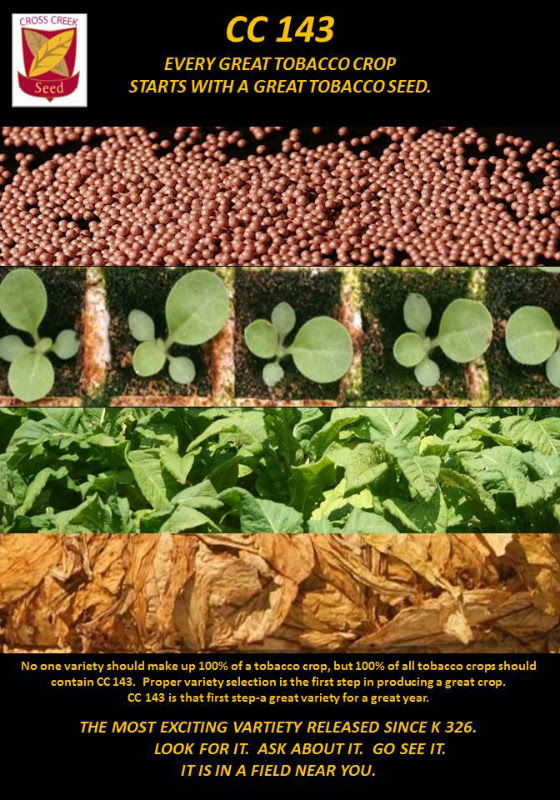
CC143


Monday, January 29, 2018

THE LATEST IN TOBACCO MACHINERY--AND WHERE TO SEE IT

Machinery on the floor at the Southern Farm Show.
Show time coming up: The Southern Farm Show starts Wednesday, January 31, and runs through Friday at the North Carolina State Fairgrounds in Raleigh. Gates open at 9 a.m. and close at 4 p.m. Admission is free and there is no charge for parking. For more information, go to https://southernshows.com. See list of tobacco-related exhibitors below.

Growers meet: The annual meeting of the Tobacco Growers Association will take place at the show on Friday, February 2. It starts at 10 a.m. in the Holshouser Building and ends at lunch. GAP training will be available afterward.

A show in Tennessee: The Tn-Ky Tobacco Expo will take place February 6, at the Robertson County Fairgrounds in Springfield, Tn. The show runs 8 a.m. to 1:30 p.m., with GAP Training available, and a sponsored lunch will end with a panel made up of Andy Bailey, UT/UK tobacco specialist; Joe Beeler, UT research associate; Emily Pfeufer, UK plant pathologist and Eric Walker, UT/UK tobacco specialist.

Heated tobacco products heating up: A new category of smoking implement-heat not burn or HNB--is making a big impression on foreign markets, though not yet in the U.S. But if it is approved by FDA becomes as popular here as in, for instance, Japan, it could become a significant end use of American tobacco.

The HNB concept revolves around rechargeable electronic device that looks like a pen and heats specially designed tobacco units, generating a tobacco flavored nicotine "aerosol" that the consumer inhales through the mouth. The heat never reaches the level of combustion.

The possibility that U.S. leaf might have a place in HNB industry was a hot topic at the Tobacco Workers Conference in Myrtle Beach, January 15-17. Some observations that were heard:
  • The HNB market is a "whole different ball game," said Blake Brown, NC Extension economist. It  could potentially be a "game changer" for the tobacco industry, he said.
  • HNB products contain much less tobacco than do combustible cigarettes--perhaps one third to one half--but the tobacco will have to be of higher quality.
  • It is expected that this tobacco will have to be grown on largescale farms, so flue-cured growers seem more likely to produce HNB tobacco than burley growers (but that could change).
  • Growers in Italy and the United States are the likeliest candidates to grow it, Brown said, although Brazil could perhaps get into it also.
  • Lamina only: HNB tobacco is strictly a lamina product and will contain no stems, says J. Michael Moore, Georgia Extension tobacco specialist
  • Quality will be very important, and growers will have to adhere strictly to the Good Agricultural Practices (GAP) recommended by the industry. Moore has seen evidence that companies will stress complete freedom in the leaf from residues of certain chemicals and some may have begun already.
  • Not enough sugar? Moore thinks a higher sugar content may prove desirable to HNB manufacturers. "Farmers could probably achieve that by producing a little riper crop," he says.

GAP GROWER TRAINING EVENTS
Check with your local Extension Service office for further details.
All meetings listed here are free and presented in English.
    • January 30, 9 a.m. Sanford, N.C.
    • January 31, 10 a.m. Scottsburg, Va.
    • February 1, 6 p.m. Stanford, Ky.
    • February 2, 1:30 p.m. Raleigh, N.C. (Southern Farm Show).
    • February 5, 9 a.m. Lillington, N.C.
    • February 5, 4:30 p.m. Franklin, Ky.
    • February 5, 6 p.m. Scottsville, Ky.
    • February 6, 8 a.m. Springfield, Tn. (Ky-Tn Tobacco Expo).
    • February 8, 5 p.m. Albany, Ky.
    • February 8, 6 p.m. New Tazewell, Tn.
    • February 13, 6 p.m. Athens, Tn.
    • February 13, 1 p.m. Scottsburg, In. 
    • February 13, 6 p.m. Vevay, In. 
    • February 19, 12 p.m. Carthage, Tn.
    • February 22, 1 p.m. West Union, Oh.
    • February 23, 1 p.m. Paoli, In.
    • February 19, 6 p.m. Hartsville, Tn.
    • February 20, 4:30 p.m. Clarksville, Tn.
    • February 20, 6 p.m. Sharpsburg, Ky.
    • February 21, 8:30 a.m. Lawrenceburg, Tn.
    • February 22, 6 p.m. Maysville, Ky.
    • February 26, 4 p.m. Central City, Ky.
    • February 26, 6 p.m. Lafayette, Tn.
    • February 26, 6 p.m. Bowling Green, Ky.
    • February 27, 10:30 a.m. Morehead, Ky.
    • February 28, 10 a.m. Hardinsburg, Ky.
    • Feb 28, 10:30 a.m. Owensboro, Ky.
    • March 1, 10 a.m. Campbridge City, In.
    • March 1, 10:30 a.m. Hopkinsville, Ky.
    • March 2, 10:30 a.m. Lexington, Ky.
    • March 6, 2:30 p.m. Mayfield, Ky.
    • March 7, 6 p.m. Greeneville, Tn.
    • March 7, 1 p.m. Nashville, Ga.
    • March 12, 10:30 a.m. Tifton, Ga.
    • March 13, 10:30 a.m. Marion, S.C.
    • March 13, 1 p.m. Murray, Ky.
    • March 20, 6:30 p.m. Glasgow, Ky.
    • March 20, 6:30 p.m. Gray, Tn.
    • March 21, 10 a.m. Wilson, N.C.
    • March 22, 7 p.m. Bedford, Ky.
    • March 26, 6 p.m. Bardstown, Ky.
DATES TO REMEMBER
  • January 31-February 2, 9 a.m. Southern Farm Show. N.C. State Fairgrounds, Raleigh, N.C. See below for exhibitor list.
  • February 2, 10 a.m. Annual Meeting, Tobacco Growers Association of N.C., Holshouser Building, N.C. State Fairgrounds (in conjunction with Southern Farm Show). Meeting ends with lunch.
  • February 6, 8 a.m. Tn-Ky Tobacco Expo. Robertson County Fairgrounds in Springfield, Tn. The show ends with lunch.
SOUTHERN FARM SHOW EXHIBITORS

Exhibits of interest to tobacco growers listed by their location on the N.C. State Fairgrounds. 

Jim Graham Bldg.  
  • 222 Evans Mactavish Agricraft.
  • 227 Kelley Mfg. Co. Agricultural equipment.
  • 704 (also 8131) Agri Supply. Agricultural materials.
  • 807 Mechanical Transplanter Co. Transplanters, seeding equipment.
  • 808 BulkTobac (Gas Fired Products). Curing equipment and controls.
Kerr Scott Bldg. 
  • 1015 Yara North America. Fertility products.
  • 1002 TriEst Ag Group. Fumigation supplies.
  • 1107 Flue Cured Tobacco Services. Curing controls.
  • 1104 GoldLeaf Seed Co. Tobacco seed.
  • 1114 BeltWide Inc. Transplant technology.
  • 1115 Transplant Systems. Greenhouse systems.  
  • 1116 Cross Creek Seed. Tobacco seed.
  • 1121 AAA Scale Co.
  • 1201 Carolina Greenhouse & Soil Company.
  • 1202 Reddick Equipment Company Inc.
  • 1302 Mid-Atlantic Irrigation Co.
Exposition Bldg.
  • 3127&8609 Benchmark Buildings & Irrigation. Transplanters/irrigation.
  • 3135 Southern Container Corporation of Wilson. Bale sheets and packaging.  
  • 3311 Flame Engineering. Weed control with flame.
  • 3522 First Products Inc. Fertilizer boxes for cultivators and tool bars.
  • 3605 MarCo Mfg. Tobacco machinery.
  • 4018 Conklin Company. AgroVantage System to boost genetic potential.
  • 4035 Bio-Organic Catalyst.
Scott Tent
  • 7025 Drexel Chemical Company. Sucker control chemicals.
  • 7027 ABI Irrigation. Irrigation equipment.
 Tent 1
Outdoors
  • 8039 Vause Equipment Co. Farm equipment.
  • 8206 Wilson Manufacturing. Farm trailers
  • 8204 Equipmax. Tobacco spray equipment.
  • 8217 Granville Equipment. Tobacco Machinery.
  • 8510 Walters Air Assist Plant Release System. Plant release system. 
  • 8301 De Cloet SRL. Tobacco machinery.
  • 8507 World Tobacco. Bulk fertilizer handling equipment. Curing barns.
  • 8546 & 227 Kelley Mfg. Co. Agricultural equipment.
  • 8701 Tytun Ltd. Bulk flue-curing barns.
  • 8705 Long Tobacco Barn Co. Bulk tobacco curing barns. 

Wednesday, January 24, 2018

HOW TO GET STARTED ON YOUR 2018 CROP

No more tobacco presence: The University of Tennessee has ended tobacco research at the Research & Education Center in Greeneville, Tn. See "End of an era" below.


Steaming trays 30 minutes at 176°F is an excellent alternative to fumigation for sanitizing greenhouse trays, says Lindsey Thiessen, N.C. Extension plant pathologist. "[But] growers who know greenhouse transplants were a source of TMV or black root rot should dispose of the trays that were used to produce them and purchase new ones."

It was cold in early January, but if you have had problems with tomato spotted wilt virus, let's hope for some more. "Colder winters may suppress thrips populations and the spread of TSWV among weeds, resulting in a smaller inoculum source in the spring," says Thiessen. "A relatively warm winter before the field season allows thrips to be active during much of the winter, spreading the disease among weed hosts, as well as increasing thrips survival and increasing their populations."

Workman makes a big move in the burley/dark seed market: Rickard's dark and burley varieties have been bought by Workman Tobacco Seed Co. of  Murray, Ky. Richard Price, vice president of Workman, says his company has purchased Rickard's seed lots of burley and dark tobacco. "All of our seed will continue to be available through our dealers," he says. "We have ample supply of seed for the season." Thanks to the purchase, Workman's offerings now include the burley varieties HB 4488PLC, HB 3307PLC, HB 04PLC, NCBH 129LC and R7-12LC and the dark fired varieties PD 7305LC, PD 7309LC, PD 7318LC, PD 7319LC, PD 7312LC and Shirey LC. Earlier, Champion Seed bought Rickard's flue-cured varieties (See TFN December II 2017).

What burley varieties will be tops in 2018? Price predicts that four varieties will dominate the burley seed market this season: NC-7, KT 215, KT 209 and HB 4488. "These varieties will account for the lion's share of the business," he says.

New dark variety: There is a relatively new dark fire-cured variety on the market this year. It comes from the KY-TN seed program and is called KT D17LC. "It has potential to be a very good variety for our producers," says Price. It has superior yield, quality and black shank resistance compared to current commercial varieties, according to Extension sources. Workman has KT D17LC ready for shipment to its dealers, Price says.

End of an era: After 85 years, tobacco research at the Tennessee Research & Education Center located in Greeneville, Tenn., has come to an end. To increase efficiency, University of Te-nnessee administrators have elected to concentrate all the state's tobacco research for all three types grown in the state [burley and both dark types] at the Highland Rim Research & Education Center in Springfield. There will be one exception: The Kentucky-Tennessee tobacco breeding program will continue at the Greeneville station, at least for the moment.

Will the quality of research be affected? There are certainly some agronomic differences between the two locations. The elevation at the Greeneville station is about 1,400 feet above seal level and about 700 feet at the Springfield station. Soil types and weather patterns differ to some degree also. But Ellis doesn't expect these factors to prove a barrier to tobacco research. "I don't see any danger of research not getting done here, as long as someone needs it," says Rob Ellis, the director of both stations.

The Greeneville station is not going away. Research will continue in Greeneville on beef production, field crops and other topics. Ellis says there may be some reductions in staff at some point in the future. No staff changes are expected at the Springfield station for now, he adds...The station was opened in 1932, specifically for research on burley.


GAP GROWER TRAINING EVENTS
Check with your local Extension Service office for further details.
All meetings listed here are free and presented in English.

    • January 23, 9 a.m. Winston-Salem, N.C.
    • January 23, 9 a.m. Blackstone, Va.
    • January 23, 9:30 a.m. Dover, Tn.
    • January 23, 1 p.m. Nashville, Ga. 
    • January 24, 9 a.m. Williamston, N.C.
    • January 24, 4 p.m. South Hill, Va.
    • January 25, 9 a.m. Greenville, N.C.
    • January 25, 2 p.m. Clinton, N.C.
    • January 25, 4 p.m. Chatham, Va.
    • January 26, 9 a.m. Shelbyville, Ky.
    • January 26, 9 a.m. Kinston, N.C.
    • January 26, 1 p.m. New Castle, Ky.
    • January 29, 9 a.m. Goldsboro, N.C.
    • January 30, 9 a.m. Sanford, N.C.
    • January 31, 10 a.m. Scottsburg, Va.
    • February 1, 6 p.m. Stanford, Ky.
    • February 2, 1:30 p.m. Raleigh, N.C. (part of the Southern Farm Show).
    • February 5, 9 a.m. Lillington, N.C.
    • February 5, 4:30 p.m. Franklin, Ky.
    • February 5, 6 p.m. Scottsville, Ky.
    • February 6, 8 a.m. Springfield, Tn. (part of Ky-Tn Tobacco Expo).
    • February 8, 5 p.m. Albany, Ky.
    • February 8, 6 p.m. New Tazewell, Tn.
    • February 13, 6 p.m. Athens, Tn.
    • February 13, 1 p.m. Scottsburg, In. 
    • February 13, 6 p.m. Vevay, In. 
    • February 19, 12 p.m. Carthage, Tn.
    • February 22, 1 p.m. West Union, Oh.
    • February 23, 1 p.m. Paoli, In.
    • February 19, 6 p.m. Hartsville, Tn.
    • February 20, 4:30 p.m. Clarksville, Tn.
    • February 20, 6 p.m. Sharpsburg, Ky.
    • February 21, 8:30 a.m. Lawrenceburg, Tn.
    • February 22, 6 p.m. Maysville, Ky.
    • February 26, 4 p.m. Central City, Ky.
    • February 26, 6 p.m. Lafayette, Tn.
    • February 26, 6 p.m. Bowling Green, Ky.
    • Feb 27, 10:30 a.m. Morehead, Ky.
    • Feb 28, 10:30 a.m. Owensboro, Ky.
    • March 1, 10 a.m. Campbridge City, In.
    • March 1, 10:30 a.m. Hopkinsville, Ky.
    • March 2, 10:30 a.m. Lexington, Ky.
    • March 6, 2:30 p.m. Mayfield, Ky.
    • March 7, 6 p.m. Greeneville, Tn.
    • March 7, 1 p.m. Nashville, Ga.
    • March 12, 10:30 a.m. Tifton, Ga.
    • March 13, 10:30 a.m. Marion, S.C.
    • March 13, 1 p.m. Murray, Ky.
    • March 20, 6:30 p.m. Glasgow, Ky.
    • March 20, 6:30 p.m. Gray, Tn.
    • March 21,  10 a.m. Wilson, N.C.

DATES TO REMEMBER
  • January 31-February 2, 9 a.m. Southern Farm Show. N.C. State Fairgrounds, Raleigh, N.C. See below for exhibitor list.
  • February 2, 10 a.m. Annual Meeting, Tobacco Growers Association of N.C., Holshouser Building, N.C. State Fairgrounds (in conjunction with Southern Farm Show). Meeting ends with lunch.


SOUTHERN FARM SHOW EXHIBITORS

Exhibits of interest to tobacco growers listed by their location on the N.C. State Fairgrounds, January 31 through February 2. This list courtesy of Southern Shows Inc. This list will appear again in the next issue of TFN. Corrections and additions welcomed. See email address and phone number at the top.

Jim Graham Bldg.  
  • 222 Evans Mactavish Agricraft.
  • 227 Kelley Mfg. Co. Agricultural equipment.
  • 704 (also 8131) Agri Supply. Agricultural materials.
  • 807 Mechanical Transplanter Co. Transplanters, seeding equipment.
  • 808 BulkTobac (Gas Fired Products). Curing equipment and controls.
Kerr Scott Bldg. 
  • 1015 Yara North America. Fertility products.
  • 1002 TriEst Ag Group. Fumigation supplies.
  • 1107 Flue Cured Tobacco Services. Curing controls.
  • 1104 GoldLeaf Seed Co. Tobacco seed.
  • 1114 BeltWide Inc. Transplant technology.
  • 1115 Transplant Systems. Greenhouse systems.  
  • 1116 Cross Creek Seed. Tobacco seed.
  • 1121 AAA Scale Co.
  • 1201 Carolina Greenhouse & Soil Company.
  • 1202 Reddick Equipment Company Inc.
  • 1302 Mid-Atlantic Irrigation Co.
Exposition Bldg.
  • 3127&8609 Benchmark Buildings & Irrigation. Transplanters/irrigation.
  • 3135 Southern Container Corporation of Wilson. Bale sheets and packaging.  
  • 3311 Flame Engineering. Weed control with flame.
  • 3522 First Products Inc. Fertilizer boxes for cultivators and tool bars.
  • 3605 MarCo Mfg. Tobacco machinery.
  • 4018 Conklin Company. AgroVantage System to boost genetic potential.
  • 4035 Bio-Organic Catalyst.
Scott Tent
  • 7025 Drexel Chemical Company. Sucker control chemicals.
  • 7027 ABI Irrigation. Irrigation equipment.
 Tent 1
Outdoors
  • 8039 Vause Equipment Co. Farm equipment.
  • 8206 Wilson Manufacturing. Farm trailers
  • 8204 Equipmax. Tobacco spray equipment.
  • 8217 Granville Equipment. Tobacco Machinery.
  • 8510 Walters Air Assist Plant Release System. Plant release system. 
  • 8301 De Cloet SRL. Tobacco machinery.
  • 8507 World Tobacco. Bulk fertilizer handling equipment. Curing barns.
  • 8546 & 227 Kelley Mfg. Co. Agricultural equipment.
  • 8701 Tytun Ltd. Bulk flue-curing barns.
  • 8705 Long Tobacco Barn Co. Bulk tobacco curing barns.