Saturday, July 27, 2019

WHERE YOU CAN AUCTION FLUE-CURED LEAF

Making merger a reality: Kenneth Kelly (center) describes his plans for a new auction warehouse company combining Wilson, N.C., companies Horizon Ltd. and Big M Tobacco. Listening are employees Fred Sorrell (left) and Billy "Buzzard" Nichols. Kelly will manage the new auction, which will be held in the Big M warehouse in Wilson. 

There will be one new flue-cured auction this season. The Virginia-Carolina Tobacco Warehouse is located at 11621 US Hwy. 15 South in Clarksville, Va. It is roughly halfway between Raleigh and Richmond and five miles north of the N.C. state line. Call 434 736 2130 for more information. This warehouse will be operated by Mac Bailey and his family who were until recently the owners of Baileys cigarette brands and who as buyers strongly supported auction sales since they were revived about 10 years ago.

But there will be one less flue-cured warehouse in Wilson, N.C. Big M Tobacco, which occupied the historic warehouse at the corner of Goldsboro St. and Ward Blvd., has merged with Horizon Ltd., which for the last three years has conducted auctions in a building on Black Creek Road, will conduct both live and silent auctions once a week in the Big M building. Speak to Kenneth Kelly at 252 292 8822 for more information ...A long history: The Goldsboro St./Ward Blvd. building was the Liberty Tobacco ware house for many years before it was acquired by Big M. Before that it was the Centre Brick warehouse. It was built in 1950.

The American Tobacco Exchange will again offer live auctions at its location on  2101 Miller Rd. in Wilson. Call auction manager Tommy Faulkner at 910 585 2708 for more information. "This could be a good crop in this area," Faulkner says. "We have had unusually hot and dry weather up till this week. But now we have gotten some water, and the temperature has backed off."

Old Belt Tobacco Sales will conduct live auctions again this season in his warehouse near Rural Hall, says owner Dennis White. Call him at 336 416 6262 for more information. The Rural Hall area got two inches or more of rain Tuesday to end what had been a bit of a hot, dry spell. Tobacco reacted very well. "It has been a hot summer, but the temperatures have been lower since heavy rains fell on July 23," White says. Farmers in the area around Winston-Salem have just started priming. "We seem to have the best crop we've had in several years," he says. "It appears to be heavy with good quality."

Watch for a report on burley auctions in a future issue of Tobacco Farmer Newsletter.

In other tobacco news:


FLUE-CURED


The heat wave and drought had created some up and down crops in much of North Carolina prior to July 23. In Franklin County, N.C., north of Raleigh, some tobacco there was only knee high, while some was head height. In Craven County, between Greenville and Wilmington, heat and lack of rainfall had stressed crops and delayed field work, and insect pests had reached threshold levels in a few scattered fields.


In Virginia, flue-cured growers got relief from the heat and drought a week sooner than N.C., when rainstorms fell Monday through Thursday last week. In Greensville County on the Southside, 1 ½ to three inches fell in most places. Water was standing in some fields, causing some drowning. In some locations it was too wet to get equipment in for herbicide applications.

In Georgia, an estimated 28 percent of the crop had been harvested, while in South Carolina, 74 percent had been topped and 10 percent harvested.

BURLEY & DARK

In Kentucky, precipitation from remnants of Tropical Storm Barry fell early last week in many tobacco areas. But it was followed later in the week by excessive heat, and the crop showed signs of stress. An estimated 37 percent of the crop was blooming, and 15 percent had been topped by July 22.

In Tennessee, little field work could be done last week, due to off and on rain showers. Topping and sucker control progressed as producers could get into fields. The crop generally looks good. "However, we could use a little drier weather for a while," said an Extension agent. The USDA report estimated that 43 percent of the tobacco had been topped.


The season started out wet, and it stayed wet in Macon County, Tennessee, and Monroe and Allen Counties in neighboring Kentucky. "One farmer with 100 acres of burley got four inches of rain in two hours last Friday (July 19). It fell hard, and the soil already had had too much water," says Keith Allen, Macon Co. Extension director. I am not sure if he is going to make anything." One small bit of good news. "It has been sunny with lower humidity this week, and we have been able to get field work done."

Yield potential has definitely been lowered in this area, which lies north and east of Nashville, says Allen, but as with tobacco everywhere, good weather from now to season's end could lead to some recovery. Allen makes a very rough estimate of production in the county at 2 ½ million to three million pounds, a big reduction from the seven million plus pounds of just a few years ago. Much of that is due to reduced plantings since Alliance One ceased buying American burley before last season. It formerly bought a lot of burley in this area.


DATES TO REMEMBER

GAP Farm Safety & Compliance Events:

GAP Connections will host a number of Farm Safety & Compliance Training Events this summer. Attendees will rotate through interactive stations as they learn about safety and compliance topics required by the GAP Program. Registration is free except that at some, there will also be an opportunity to earn CPR & AED certification during the events at a registration fee of $25. You must pre-register. For more details, visit www. gapconnections .com or call GAP Connections at (865) 622-4606. Dates and places appear below.

  • August  5, 5 p.m. Danville, KY. English. Includes CPR Certification (Growers only). $25.

  • August 5, 5 p.m. Danville, KY. English. Free.
  • August 7, 9 a.m. Hardinsburg, KY. English. Free.
  • August 7, 9 a.m. Hardinsburg, KY. English. $25.
  • August 7, 2 p.m. Hardinsburg, KY. English. Free.
  • August 7, 2 p.m. Hardinsburg, KY. English. Includes CPR Certification(Growers only). $25.
  • August 9, 9 a.m. Gallatin, TN. English. Free.
  • August 9, 9 a.m. Gallatin, TN. English. Includes CPR Certification (Growers only). $25.

  • August 9, 2 p.m. Gallatin, TN. English. Free.
  • August 9, 2 p.m. Gallatin, TN. English. Includes CPR Certification (Growers only). $25.


Saturday, July 13, 2019

A FIVE PERCENT SMALLER FLUE-CURED CROP?

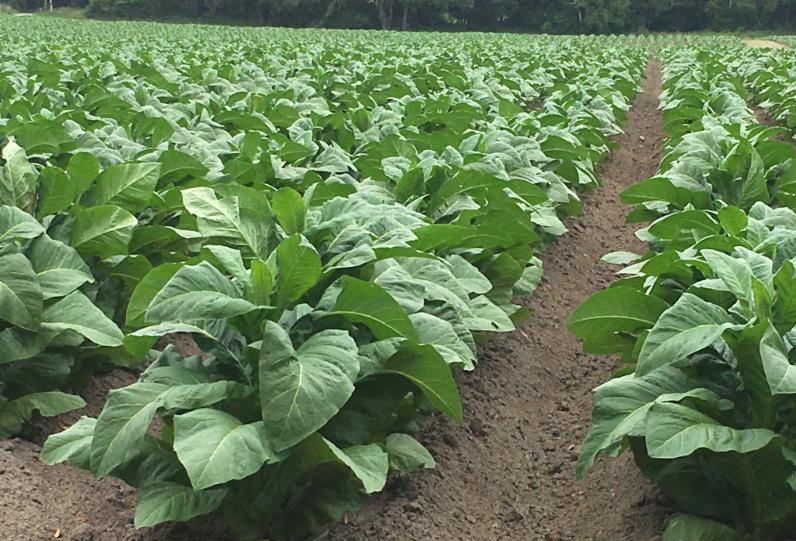
A flue-cured field in Wilson, N.C.

USDA PROJECTION:

Flue-cured production in the United States has been projected at 320 million pounds by USDA. That would be five percent less than in 2018 and the lowest production for this type on record. Area harvested, projected at 159,000 acres, is 20 percent below last year and 6,000 acres less than USDA projected in March. Yield for the 2019 flue-cured is forecast at 2,015 pounds per acre, 303 pounds above last year. USDA will estimate production of burley and other types and flue-cured again in August.

Field reports:

FLUE-CURED

In Virginia, in Greensville County in the southeast corner of the state, almost all tobacco has been topped, the county agent reports. Two rain events last week brought much needed moisture. In neighboring Brunswick County, storms last weekend brought wind and spotty showers. The rain helped, but more is needed 

In North Carolina, a good rain is also needed in much of the Piedmont. The high temperatures and  humidity are leading to stress, says Paul Westfall, Extension agent in Granville County. "Tobacco is looking good in some areas, not so good in others." Topping and sucker control is under way, he adds. 

In South Carolina, 100 percent of the crop has been planted, 45 percent has been topped, but none harvested. In Georgia, all has been planted, 68 percent has been topped and roughly seven percent has been harvested.

BURLEY AND DARK

In Kentucky, the crop is 95 percent set with 12 percent in bloom.

In Tennessee, all but seven percent of the crop has been set, and nine percent topped. In Cheatham County, just west of Nashville, pop up showers, producing heavy rain at times, reportedly kept most or the field work to a minimum last week. Some tobacco was topped and sucker control applied. In Wilson County, just east of Nashville, spotty rains across the county caused feast for some growers and famine for others. "Feast folks cannot get field work done, and famine folks need rain," said Extension agent A. Ruth Correll.

In Virginia, Grayson County in the Blue Ridge mountains had yet to see a significant dry spell of the type you expect most years by July 8. But it reportedly has not been excessively wet, meaning that growing conditions have been good.

In western North Carolina: 96 percent of the burley crop had been set by July 8. Weather conditions last week were reportedly on the warm side with slightly above average temperatures. Scattered rain showers and afternoon thunderstorms limited some field activities in Yancey County, on the Tennessee line--most areas receiving between 1.75 to three inches of rain for the week.

In other tobacco news:

Another foreign competitor! The southwest African country of Namibia is cooperating with a Chinese company in a proposed joint venture to create a 10,000-hectare tobacco-producing operation in the country's northeast. To put that in perspective, that level of plantings would be about equal to what South Carolina and Georgia together planted last year. The venture has obtained some but not all of the government approvals it will need for the project, which will also produce corn. The type to be grown has not been specified but is assumed to be flue-cured, since that is what China has typically imported. Whatever the type, the tobacco will be  100 percent exported to China.


DATES TO REMEMBER
  • July 22, 8:30 a.m. N.C. Organic Commodities Field Day. Ends 12:30 p.m., followed by lunch. Cunningham Research Station, 200 Cunningham Rd., Kinston, N.C.
  • July 23, 9 a.m. Tobacco Tour-Field Day, Upper Coastal Plain Research, 2811 Nobles Mill Pond Rd., Rocky Mount, N.C. Ends approximately 3 p.m.   Register at  ncsu.qualtrics.com/jfe/form/SV_ex791rQ0C8LZ5dj.
  • August 13, 9 a.m. The Kentucky Burley Tobacco Industry Tour will be held at the University of Kentucky Spindletop Research Farm in Lexington. It will end about 3 p.m. Please note: The event will last one day only.

GAP Farm Safety & Compliance Events:
GAP Connections will host a number of Farm Safety & Compliance Training Events this summer. Attendees will rotate through interactive stations as they learn about safety and compliance topics required by the GAP Program. Registration is free except that at some, there will also be an opportunity to earn CPR & AED certification during the events at a registration fee of $25. You must pre-register. For more details, visit www.gapconnections.com or call GAP Connections at (865) 622-4606. Dates and places appear below.
  • August  5, 5 p.m. Danville, KY. English. Includes CPR Certification (Growers only). $25.
  • August 5, 5 p.m. Danville, KY. English. Free.
  • August 7, 9 a.m. Hardinsburg, KY. English. Free.
  • August 7, 9 a.m. Hardinsburg, KY. English. $25.
  • August 7, 2 p.m. Hardinsburg, KY. English. Free.
  • August 7, 2 p.m. Hardinsburg, KY. English. Includes CPR Certification(Growers only). $25.
  • August 9, 9 a.m. Gallatin, TN. English. Free.
  • August 9, 9 a.m. Gallatin, TN. English. Includes CPR Certification (Growers only). $25.
  • August 9, 2 p.m. Gallatin, TN. English. Free.
  • August 9, 2 p.m. Gallatin, TN. English. Includes CPR Certification (Growers only). $25.

Tuesday, July 2, 2019

HARVEST BEGINS IN THE DEEP SOUTH

There's been some early black shank in Georgia (above) but so far it has been manageable, in part because of adoption of a three-pronged control strategy. "Our growers have done a good job of finding resistant varieties and then implementing the three-step control program: Orondis and Ridomil in the transplant water, Presidio at first cultivation and Ridomil at layby cultivation,"says J. Michael Moore, Extension tobacco specialist. "It should be followed on any farm that has a history of black shank."

HARVEST BEGINS IN THE DEEP SOUTH

FLUE-CURED

Harvest has begun in Florida and Georgia. "But just by a few farmers," says Moore. "It will get going in earnest starting next week." It appears to be a good crop so far, he says. "We are finishing topping and sucker control now." Plantings in Georgia and Florida appear to have been reduced 30 to 35 percent, says Moore. "We might wind up with acreage in the 8,250 acre range," he says. He doesn't see much interest in growers in planting beyond their contracts. 

South Carolina: Farmers haven't started harvesting. "Normally, we would expect to start by the first week of July but that isn't happening this year," says William Hardee, S.C. area Extension agronomy agent. "The crop is just not
ready. Due to the dry weather, we are a little behind schedule, and in some areas, we have seen some premature    flowering." Scattered thunder storms accom-panied by winds blew down tobacco, mainly in the GreenSea/ Nichols area. "Wounded roots opened the door for serious bacterial wilt infestation," says Hardee.  Note: Plantings are definitely down in South Carolina. Hardee says acreage--which was around 14,000 acres last season--could be as low as 10,000 this year.


North Carolina: Farmers have experienced extreme heat and drought since early May. "But it's been broken by extreme rainfall in short spurts or isolated thunderstorms that build almost out of nowhere," says Matthew C. Vann, N.C. Extension tobacco specialist. "All things considered, we really do have a fine crop with a lot of potential remaining ahead of us."

Rain is in the forecast, and farmers will gladly take it, says Vann. "I'd argue that a good soaking rain that gives us an inch or a little more will finish pushing most of this crop into flowering. 

There have been few widespread issues in N.C. There was some sand blasting and hail early on that resulted in replanting. "Since then, the major issue has been excessive rain, felt hardest in parts of eastern Wake County," Vann says. 


Virginia: In Greensville County, topping will reportedly start soon. First observations of hornworm eggs and larvae feeding on tobacco leaves were made last week.


BURLEY AND DARK

Kentucky: Heavy ongoing rains in June in western Kentucky damaged burley and dark. "One farmer nearby got nine inches of rain in eight days," says Rod Kuegel of Owensboro. "We didn't get quite that much but I expect to have to bush hog sometobacco, which is something we rarely do."  For the area, he thinks there has already been a 20 percent loss.

Tennessee: All but eight percent of the crop had been set by June 30. Four percent had been topped. In Macon County near Nashville, an overa-bundance of rain and storms have halted set-ting and all field work. In Cheatham County, also near Nashville, very little field work could be done last week until Friday or Saturday due to pop-up thunderstorms with heavy rains. In Robertson County, north of Nashville, angular leafspot has appeared in dark fire-cured on several farms.

North Carolina: 91 percent of the burley crop has been planted. Drier weather conditions last week allowed growers to get into fields in Yancey County in the mountains.

DATES TO REMEMBER
  • July 22, 8:30 a.m. N.C. Organic Commodities Field Day. Ends 12:30 p.m., followed by lunch. Cunningham Research Station, Kinston, 200 Cunningham Rd., Kinston, N.C.
  • July 23, 9 a.m. Tobacco Tour-Field Day, Upper Coastal Plain Research, 2811 Nobles Mill Pond Rd., Rocky Mount, N.C. Ends approximately 3 p.m.  Register at  ncsu.qualtrics.com/jfe/form/SV_ex791rQ0C8LZ5dj.
  • August 13 9 a.m. The Kentucky Burley Tobacco Industry Tour will be held at the University of Kentucky Spindletop Research Farm in Lexington. It will end about 3 p.m. Note: The event will last one day only.

GAP Farm Safety & Compliance Events:
GAP Connections will host a number of Farm Safety & Compliance Training Events this summer. Attendees will rotate through interactive stations as they learn about safety and compliance topics required by the GAP Program. Registration is free except that at some, there will also be an opportunity to earn CPR & AED certification during the events at a registration fee of $25. You must pre-register. For more details, visit www.gapconnections.com or call GAP Connections at (865) 622-4606. Dates and places appear below.

  • July 9, 10 a.m. New Holland, PA. English. Free.
  • July 11, 9 a.m. Wylliesburg, VA. English. Includes CPR Certification(Growers only). Registration $25.
  • July 11, 9 a.m. Wylliesburg, VA. English / Spanish. Free.
  • August  5, 5 p.m. Danville, KY. English. Includes CPR Certification(Growers only). $25.
  • August 5, 5 p.m. Danville, KY. English. Free.
  • August 7, 9 a.m. Hardinsburg, KY. English. Free.
  • August 7, 9 a.m. Hardinsburg, KY. English. $25.
  • August 7, 2 p.m. Hardinsburg, KY. English. Free.
  • August 7, 2 p.m. Hardinsburg, KY. English. Includes CPR Certification(Growers only). $25.
  • August 9, 9 a.m. Gallatin, TN. English. Free.
  • August 9, 9 a.m. Gallatin, TN. English. Includes CPR Certification (Growers only). $25.
  • August 9, 2 p.m. Gallatin, TN. English. Free.
  • August 9, 2 p.m. Gallatin, TN. English. Includes CPR Certification (Growers only). $25.


Tuesday, June 18, 2019

CROP REPORT: A GOOD START FOR MOST GROWERS

Working young tobacco: A burley grower supervises field work on a small farm in Harrison County,Ky. File photo by Chris Bickers.

BURLEY

Kentucky tobacco looks good early: Topping will probably start on burley by the first of July, says Bob Pearce, Kentucky Extension tobacco specialist. "A few may start sooner. There are no issues in the field so far. I would say at least 70 percent is planted, and we are in good shape to get the rest planted soon." He has seen no major shortage of plants, he says. 
In Tennessee, 80 percent has been transplanted. In Virginia, 96 percent of the burley, and in North Carolina, burley is 74 percent set. In Yancey County in western N.C., soil conditions had been very wet at the beginning of the week ending the 16th because of the heavy rains the week before, but conditions improved enough by mid week to allow some field work.


FLUE-CURED


In Virginia, flue-cured is 98 percent set in the field. Continued rain has added to the existing moderate flooding In Brunswick County in the southeast part pf the state. Several roads were closed. Some ponding occurred in fields. In  Appomattox County in central Virginia, it had been dry, so rain fall last week came as a relief. Hard dry soil had been a problem, but after the rain, tobacco farmers were able to walk and replant later-planted fields as needed. So stands should be good.

In South Carolina, Horry County in the Pee Dee received much needed rain over the weekend. The tobacco crop, which had been suffering from drought, showed improvement going forward. The crop is completely set out, and more than 30 percent has been topped. 

In neighboring Georgia, an estimated 22 percent has been topped.
In North Carolina, flue-cured got off to a fast start in the Old Belt. Around Winston-Salem, N.C., planting is for all practical purposes complete, and much of the crop is a little ahead of schedule. "A lot of it is laid by already," says Dennis White, owner of Old Belt Tobacco Sales auction warehouse in Rural Hall, N.C., north of Winston. "Usually we don't expect that till the Fourth of July. There are a few who may start pulling the second week of July."

in other tobacco news

A few Piedmont growers quit after last season, says White. "But those who stayed in tobacco look to have planted about the same acreage as last year."
Burley planting on nontraditional farms in the Piedmont seems to have nearly disappeared, says White. "We have sold some burley at our auction in the past, but I don't know if there will be any to sell this year."

One more opinion on H2A workers in burley: Mark Turner of Livermore, Ky., began using guest workers to grow burley and dark air-cured tobacco six years ago and says it has proved a godsend. "It is expensive to bring in H2A workers, but I think it is still cheaper than relying on local labor," he says. "With H2As, you know you will have enough help to get your crop harvested in a timely manner." There is a definite price to not getting things done when they need to be done, says Turner, "and that happens when you depend on local help."
DATES TO REMEMBER

July 22, 8:30 a.m. N.C. Organic Commodities Field Day. Till 12:30 p.m., followed by lunch. Cunningham Research Station, Kinston, 200 Cunningham Rd., Kinston, N.C.

July 23, 9 a.m. Tobacco Tour-Field Day, Upper Coastal Plain Research, 2811 Nobles Mill Pond Rd., Rocky Mount, N.C. Ends approximately 3 p.m.

August 13 9 a.m. The Kentucky Burley Tobacco Industry Tour will be held at the University of Kentucky Spindletop Research Farm in Lexington. It will end about 3 p.m. Note: The event will last one day only.

Safety and compliance: GAP Connections will host 11 Farm Safety & Compliance Training Events this summer. The free training events are presented in English and Spanish. Attendees will rotate through interactive stations as they learn about safety and compliance topics required by the GAP Program. There will also be an opportunity to earn CPR & AED certification during the events at a registration fee of $25. You must pre-register. Visit www.gapconnections.com or call GAP Connections at (865) 622-4606. Dates and places appear below.
GAP Farm Safety & Compliance Events:

  • June 18, 9 a.m.-12 p.m. & 2-5 p.m. Rest-A-Bit Farm, Pinetops, NC.
  • June 20, 9 a.m.-12 p.m. & 2-5 p.m. Lasley Family Farm, Ruffin, NC.
  • July 9, 10 a.m.- 2 p.m. Garden Spot Fire Rescue, New Holland, PA.
  • July 11, 9 a.m.-12 p.m. Ferrell Farm, Wylliesburg, VA.
  • August 5, 5-8 p.m. Danville Tobacco Services, Danville, KY.
  • August 7, 9 a.m.-12 p.m. & 2- 5 p.m. Breckinridge County Extension Office, Hardinsburg, KY.
  • August 9, 9 a.m.-12 p.m. & 2-5 p.m. Gallatin Redrying & Handling, Gallatin, TN.
 GAP annual training events: 

  • Jun 20, 9 a.m. Blackstone, VA
  • Jun 25, 5 p.m. Hopkinsville, KY.

Tuesday, June 4, 2019

GROWERS TOPPING IN FLORIDA, STILL PLANTING IN KENTUCKY & TENNESSEE


.
First to top in 2019? Kenneth Dasher of Live Oak, Fl., used a mechanical topper on his flue-cured last Thursday. He sent in a hand crew to finish cleaning it up Saturday.

Harvest just ahead: "It looks like we will begin harvesting in about two weeks," says flue-cured grower Kenneth Dasher of Live Oak, Fl. "Some other farmers around here may start sooner." The big problem so far has been the intense heat. "We had four days in a row when it got to 100 degrees or above," Dasher says. "We have had to put a lot of water to it." But so far, he hasn't had much sun scald.


In Georgia, the crop is completely set, and one per cent has been topped. Even  irrigated fields in some counties are struggling due to too many pivots being on the same pump. "Many of these were not being turned off in an attempt to keep up with the demands of the crop," says Seth McAllister, Terrell County Extension agent.

In South Carolina, planting is complete and topping ready to begin shortly. In Horry County, the leading tobacco county, some much-needed rain was received last week, says Rusty Skipper, Extension agent. "But it could be too little too late for some corn crops in the eastern part of the county," he says.

Most flue-cured in North Carolina looks good at this point, says Matthew Vann, N.C. Extension tobacco specialist. There has been some hail to go along with   high temperatures, but with good weather from here on, the damage could be incon-sequential. It was so dry early that one can reasonably expect heal-thy root systems. It wasn't till the last week of May that rain began to fall. "Much of the crop will soon be ready for layby, and a few growers have already started," he says. "First contact appli-cations of sucker control chemicals will probably begin around the end of June in the Border Belt."

In Virginia, 88 percent of the flue-cured has been transplanted, 77 percent of the fire-cured has been transplanted and 71 percent of the burley has been transplanted, according to USDA. In Appomattox County, where all three types are grown, wet weather has delayed tobacco transplanting and the cultivation of already transplanted tobacco, says Bruce Jones, Extension agent. "We have experienced extremely wet soil conditions for the past seven days." Tobacco plants still in the greenhouses are holding reasonably well, he says.

In Tennessee, 39 percent of the burley had been transplanted. In Cheatham County, just west of Nashville, a little rain fell on June 30. "We were getting a little dry," says Extension agent Ron Barron. "Most all of the early tobacco has been set, due to two previous weeks of dry weather."


In Kentucky, transplanting was 49 percent complete. That is well behind the 57 percent completed by this date a year ago. Fieldwork was interrupted at times by heavy rain, which in some cases led to standing water in low lying areas, says USDA. Despite the adverse conditions, farmers were able to make planting progress last week.

A new cigarette containing no leaf other than flue-cured--The U.S. [Flue-Cured] Tobacco Cooperative has announced that it will soon launch a new super-premium cigarette made entirely of leaf grown by its grower members. Called Manitou, it will be a cigarette of the "Virginia" or "British" type, meaning it will contain only flue-cured tobacco (and water). Virtually all other American cigarette brands are made using a blend of flue-cured, burley and oriental tobaccos. Called the "American" blend, it has been the dominant U.S. type since soon after Richard Joshua Reynolds introduced it in the Camel brand in 1914. Before that, the "British" blend was the market leader in this country.


Manitou packaging


Manitou will be marketed by USTC's consumer products division, Premier Manufacturing of Chesterfield, Mo. Some observers have suggested that Manitou will compete with Natural American Spirit cigarettes, which are thought to contain a high percentage of flue-cured. It was not apparent from a USTC statement if Manitou will be manufactured in the cooperative's factory in Timberlake, N.C.

What does Manitou mean? It is a Native American word referring to the primitive life force in all of us.

DATES TO REMEMBER

July 22, 8:30 a.m. N.C. Organic Commodities Field Day. Till 12:30 p.m., followed by lunch. Cunningham Research Station, Kinston, 200 Cunningham Rd., Kinston, N.C.

July 23, 9 a.m. Tobacco Tour-Field Day, Upper Coastal Plain Research, 2811 Nobles Mill Pond Rd., Rocky Mount, N.C. Ends approximately 3 p.m.


GAP training events: 
  • Jun 12, 9 a.m. Lancaster, PA.
  • Jun 25, 5 p.m. Hopkinsville, KY.

Monday, May 20, 2019

NINETY DEGREE HEAT THREATENS GEORGIA-FLORIDA TOBACCO

.

The flue-cured in the Deep South looked good
a week ago, as in this north Florida field 
(above).But intense heat caused some 
sun scald (right, in south Georgia)to 
set in."About the only thing 
to do about it is to irrigate to make sure soil 
moisture meets the needs of the plants," 
says J. Michael Moore, Extension tobacco specialist.


A wave of 90-degree temperatures has struck tobacco in Georgia and Florida, and they are expected to continue for the rest of this week. They could slow the good start the crop had gotten, says J. Michael Moore, Georgia Extension tobacco specialist. "We had a beautiful crop a week ago, but now the soil moisture is beginning to be depleted." Farmers are seeing some sun scald. "About the only thing to do about it is to irrigate to make sure soil moisture meets the needs of the plants," Moore says.
When you cultivate in intense heat, try to disturb as little of the existing root system as you can, says Moore. There is a danger of breaking turgor, or aninterruption of the movement of water into the plant. Much of the Georgia crop will soon be ready for layby.
But Florida is farther along: At least one Floridi-an may be applying contact sucker control this week, Moore adds. "This farmer had planted the second week of March," he says.
On the bright side,  Geor-gia and Florida have suf-fered very low levels of tomato spotted wilt virus and low levels of budworm so far. "There have been no other appreciable insect or disease problems to this point," Moore says...Transplanting is complete in both states.
Reports from the field (from USDA Crop Progress and Condition surveys): 
  • South Carolina--Statewide, 95 percent of the crop was transplanted by May 12. In Horry County, tobacco is reportedly doing well for this time in the growing season.
  • North Carolina--Statewide, 79 percent of the flue-cured crop and 16 percent of the burley crop was transplanted. In Alamance County, transplantingmade great progress last week, but that will be slowed if it doesn't rain. Tobacco is doing well. But there have been a few reports of seedling disease or possible herbicide injury in a few fields. In Franklin County, plants look good in the field with no ma-jor issues. In Craven County, isolated ar-eas of tobacco farm-ers had to replant a few fields due to strong winds and rains. 
  • Virginia--Through May 12, 36 percent of the flue-cured crop had been transplanted, 17 percent of the fire-cured crop had been transplanted 17 and 13 percent of the burley crop had been transplanted. 
  • Kentucky--Seventeen percent of the crop had been transplanted through May 19. Supply of transplants were reportedly 92 percent adequate.
Editor's Note: A bit of hope. This may be wishful thinking, but I just can't help but think the trade war with China will be resolved by market opening. Both sides--but especially China--have too much to lose. Even if it is resolved, there is no telling if China would buy any of our leaf from this crop. But I feel like they would, since their go-to source of flue-cured, Zimbabwe, appears to have produced a short crop. The Chinese could go to Brazil, but I don't think they like the Brazili-an government any more than they like ours. Cigarette demand in the developed world, meanwhile, has continued to decline, but at a more or less predictable rate; I am not very good at numbers, but it seems to me that if China did come back on the U.S. market to any significant degree, there might not be any excess of tobacco to meet the resulting demand. If our leaf supplies are short but are of average or better quality, the market could be fairly strong. But a bumper crop and/or poor quality could scuttle that faint hope.


DATES TO REMEMBER

GAP training events:
  • Jun 25, 5 p.m. Hopkinsville, KY.

Saturday, May 4, 2019

TRANSPLANTING AT FULL THROTTLE


Workers load trays on a transplanter on a flue-cured farm near Raeford, N.C., in this file photo by Chris Bickers.

In fact, transplanting in the Deep South is done. The last of the Georgia crop was transplanted by April 27, says J. Michael Moore, Georgia Extension tobacco specialist. Florida's tobacco had gone in earlier. "We have had good weather generally," he says. "There weren't a lot of extra plants, but we had enough."

The earliest Georgia tobacco was planted around the end of March and it is growing well, but tobacco planted after that is growing slowly. It has been dry the last two weeks, and that may have suppressed tomato spotted wilt. 'There has been very little tomato spotted wilt so far, but we may see more once it starts raining," Moore said. He suspects planting will be down about 30 percent when all is said and done.


Growers  in   the  Coastal Plain of North Carolina are transplanting at full tilt. The fields that have been transplanted are about a week behind average in development. That's partly because some growers delayed seeding until they had a clear idea about the contracts that were going to be available to them. "It has only been in the last two weeks that the conditions for transplanting were good," says Matthew Vann, N.C. Extension tobacco specialist on May 3. "We had warm soil, warm temperatures and the soil was not saturated."


Now, the crop looks good, says Vann. The southern and central Coastal Plain is leading the pack, as you would expect. The Old Belt will begin planting in earnest next week." The greenhouse season went really well and there appears to be an ample supply of plants.


In South Caroli-na, farmers in Horry, the leading leaf county, has had favorable co-nditions for set-ting plants and are doing so at a fast pace, accor-ding to Rusty Skipper Extension agent. USDA estimated  transplanting was 27 percent complete for the state as of April 29.


Good weather is helping Kentucky growers get into the field. "We have had a little planting, but I doubt we are up to five percent yet," says Bob Pearce, Kentucky Extension tobacco specialist. "So far, it has been the best  start to a season we've had in some time." He thinks plantings in Kentucky may be down 20 percent.

Growers in Virginia had just started transplanting through April 28. According to USDA, Virginia flue-cured was four percent transplanted and burley and fire-cured were two percent transplanted.


He may be in a minority, but Scott Travis of Cox's Creek, Ky., still uses small balers to bale his burley. "I have three," he says. "I bought one big baler, but it didn't work out for me."

To go entirely to big bales, Travis would have had to buy two more big balers (one for each grade) and modify his physical facilities for all three to fit. "All told, it would have cost $50,000," he says. "In this tobacco economy, that didn't make sense." Besides, it's a whole lot easier to control moisture in the small bales, he says.

He ran into resistance from tobacco companies to the small bales. He has bypassed that by selling his crop at auction, mostly at Farmers Warehouse in Danville, Ky.

Bailey bails out: The small independent cigarette manu-facturer S&M Brands Inc. of Keysville, Va., has ceased ope-rations. Its doors were closed in March after the company was sold to an unidentified buyer, according to newspaper reports. S&M has manufactured the discount brands Baileys, Tahoe and Riverside, among others, for the past 25 years. It was launched by tobacco growers Mac Bailey and his son Steven. The Baileys will retain--at least for the moment--their leaf dealer business Golden Leaf Tobacco Co. No word yet as to whether Golden Leaf will participate in any of the tobacco auctions. They will continue growing tobacco as has been a family tradition since the 1800s.


The basics of hemp production, Part 4: Industrial hemp seed is quite sensitive to lack of soil moisture at planting, and it could readily contribute to stand failures. So seed should be planted in soils with adequate moisture to encourage rapid germination. This also impacts weed control: Without the availability of labeled herbicides, you must rely heavily on rapid development and closure of the hemp canopy to reduce or eliminate weed competition. Adequate soil temperature (50oF) and moisture at planting will help accomplish this.--D.W. Williams, University of Kentucky, and Rich Mundell, Kentucky Tobacco R&D Center


DATES TO REMEMBER

GAP training events:
  • Jun 25, 5 p.m. Hopkinsville, KY
__________________________________________________________________________

________________________________________________________________________________________