|
Monday, June 3, 2013
WHERE TO FIND AN AUCTION FOR 2013


Wednesday, May 8, 2013
THE SEASON BEGINS
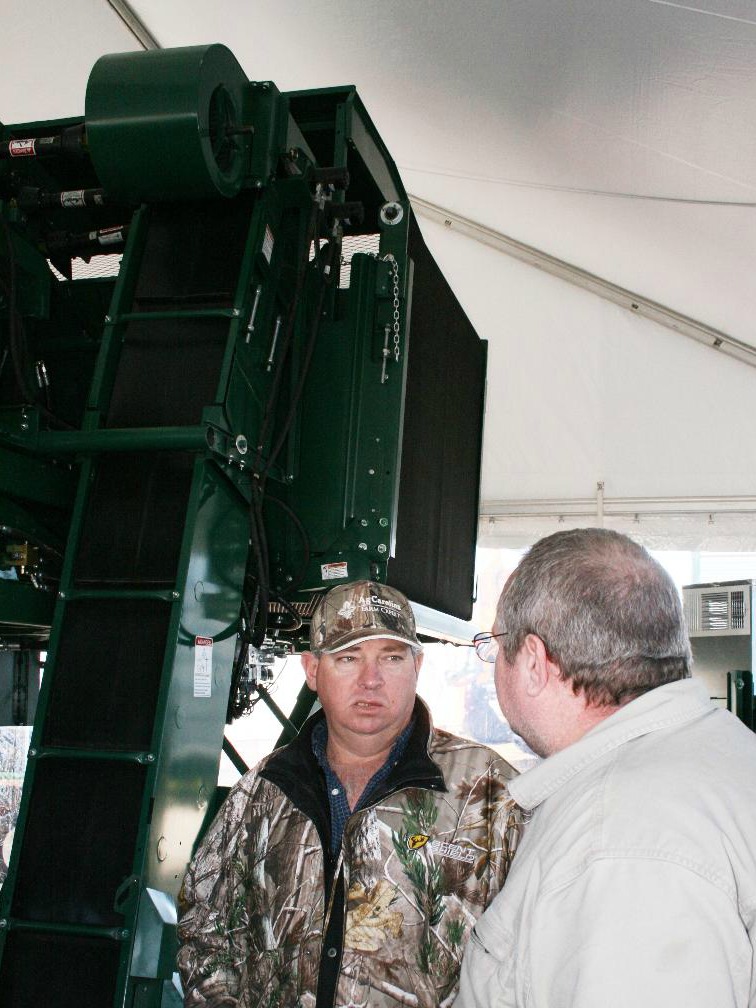 Time is running out, but the demand for new flue-curing barns continues strong. Dale Hutchins of Carolina Tobacco Services, Bennettsville, S.C., tells Tobacco Farmer Newsletter that he is still building barns, harvesters and other equipment. For barns, the point has already passed where delivery can be guaranteed by July, which is the normal delivery time. But Hutchins expects some orders for late delivery, and he will build some for future sales. "You can't sell them if you don't have them," he says. In the photo, Marty Adams (left) of Knightdale, N.C., got the word on mechanical harvesters from Hutchins at the recent Southern Farm Show.
BURLEY--In Kentucky, Extension tobacco specialist Bob Pearce expects a small increase in burley acreage, perhaps five percent. "Some limited planting is going on," he says. "Normally we would be a little farther on. I would say most of the crop is a week or 10 days behind." As soon as it dries out, planting will get going in full force, he says, and the crop could catch up quickly... In Tennessee, an earlier Extension projection placed plantings at close to last year's level, although the USDA thinks plantings will be down 12 percent in the state.
DARK--In Tennessee and Kentucky, any increase in acreage could be slight, says Andy Bailey, Extension dark tobacco specialist for both states. Planting of fire-cured and dark air-cured has barely begun. "It usually starts up around May 1, but because of the wet weather, full-scale planting probably won't get going until the end of this week," he says...In Virginia, transplanting of the small fire-cured crop was 19 percent complete by May 5, according to USDA.
A substantial amount of GF 318--the still-new flue-cured variety developed by Gwynn Farms and marketed by GoldLeaf Seed--was planted in Georgia and Florida this year. It is comparable to NC 196 but it has mosaic resistance and is seven to 10 days earlier in maturity, says Moore. "Plant it early and it can help fill your barns until the rest of the crop ripens."
A way to save on natural gas? There could be substantial savings in the rate farmers pay for natural gas, says Larry Phipps, a certified utility broker for Options Utility Consulting. "In many cases, the current rates set by utilities do not reflect the lowest possible price," he says. "But we are able to bring competitive pricing that gives farmers the best possible rate." N.C. regulations limit the opportunity to large volume users. "But the savings can be considerable, and other states permit the rate savings for smaller farms." You can get a free audit by calling Phipps at 919 696 4228 or by email at Larry@UtilSav.com.
 |
| Steve Pratt |
New grower leader: The Burley Tobacco Growers Cooperative Association in Lexington, Ky., appointed Steve Pratt general manager in April. He had worked 17 years with the Kentucky Farm Service Agency and earlier for 18 years with the Farmers Home Administration. He replaces Brian Furnish, now owner of International Tobacco Trading Group. "This selection was a long time in coming, but I feel we have made a good selection," said Pat Raines, president of the cooperative. "I am proud to have a person in the office with the experience that Steve has working with the farmers and office staff." Pratt says he is committed to expanding overseas sales for his members. "Our goal is to increase the amount of burley tobacco we produce that meets the demands of the market." He also hopes to increase the number of contracts the cooperative signs.
Another vacancy among tobacco specialists: Scott Bissette, who held the position of tobacco marketing specialist for the N.C. Department of Agriculture, has been named to oversee the N.C. Forest Service. A new specialist will be appointed, but a schedule for choosing that person has not been set. The duties of the position may be revised, sources say.
DATES TO REMEMBER
Tobacco Barn CO2 Testing Certification Training Workshops
- May 14, 10 a.m., Jeff Davis County Extension Office, 14 Jeff Davis St., Hazlehurst, Ga.
- May 16, 10 a.m., Berrien County Extension Office, 516-A CountyFarm Rd., Nashville, Ga.
- May 22, 10:30 a.m., Candler County Extension Office, 1075 E Hiawatha St., Metter, Ga.
- May 23, 10 a.m. Huggins Family Farm, 1165 Pleasant Grove Rd., Lynchburg, S.C.
| ADVERTISING |
|
Wednesday, April 3, 2013
USDA QUESTIONS: WILL THE EXPECTED BOOM IN ACREAGE REALLY MATERIALIZE?
 |
| A farmer transplants flue-cured near Raeford, N.C. |
The big crop that was projected for burley and especially for flue-cured has apparently not materialized. Or at least, not as of the first two weeks of March. That's when USDA's National Agricultural Statistics Service (NASS) surveyed a sample of tobacco farmers and used their responses to prepare its Prospective Plantings report, which was issued last week. Briefly, it said flue-cured growers would increase their acreage by only six percent and burley growers by only two percent. [See the state-by-state analysis below.] I say "only" because all the evidence I heard over the winter was that growers of both types were planning a much more significant acreage increase. That actually is what NASS projects for flue-cured in South Carolina (up 25 percent), Georgia (up 10 percent) and Virginia (up 10 percent). But North Carolina, the major flue-cured state, is projected up only four percent. For burley, meanwhile, Tennessee, the number two state, is projected down 12 percent, and Virginia is projected down a whopping 30 percent. In the 30+ years I have been in this line of work, I have learned that USDA reports usually have a certain amount of credibility. But I don't know about this one--it simply looks off. The high points appear below, and you can find more details athttp://www.nass.usda.gov/ (
--Chris Bickers
USDA-NASS Prospective Plantings Report (3/28/2013)
Flue-cured:
- North Carolina-170,000 acres, up four percent;
- Virginia-22,000 acres, up 10 percent;
- South Carolina-15,000 acres, up 25 percent;
- Georgia-11,000 acres, up 10 percent.
- All flue-cured--218,000 acres, up six percent.
Burley:
- Kentucky--78,000 acres, up five percent;
- Tennessee--14,000 acres, down 12 percent;
- Pennsylvania--5,100 acres, up nine percent;
- North Carolina--2,100 acres, no change;
- Ohio--2,000 acres, up five percent;
- Virginia--1,900 acres, down 30 percent.
- All burley--103,100 acres, up two percent.
Fire-cured: 16,680 acres, up two percent
Dark air-cured: 5,000 acres, down four percent.
Cigar types: 4,850 acres, up nine percent.
Southern Maryland: 2,000 acres, down 31 percent.
In other news:
Two familiar faces in tobacco work are moving on. Danny Peek, Virginia Extension burley specialist, has been named director of the Virginia Extension's Southwest District. Peek, who is now stationed in Abingdon, is holding both positions until a new specialist is hired...Paul Denton, Tennessee Extension tobacco specialist, will retire at the end of May. The university plans to replace him, although the timetable is open. Like Denton, his replacement will divide his time between burley in Tennessee (75 percent) and Kentucky (25 percent). The only change in the job description will be that the new person will have some research responsibilities, Denton says.
By the way, neither Peek or Denton finds the Prospective Plantings projections convincing. Peek is mystified by the Prospective Plantings projection for Virginia burley of only 1,900 acres, 30 percent less than last year. "I was expecting a seven to 10 percent increase!" he says. "I can't believe our acreage will be down that much." He says that buyers still tell him that the mountain burley of Virginia, Tennessee and North Carolina offers some desirable quality characteristics in the current market.
The 12 percent drop projected in Tennessee for burley seems too much to Denton. "I think by the time we finish planting we will have crept back close to last year's acreage," he says. But there has been one obstacle to increased plantings: the changed rotation rules for crop insurance. "Now, you can't get crop insurance for tobacco planted a third consecutive year [on the same land]. That apparently is going to impact more farmers than we might have expected."
In the Piedmont of North Carolina, auction operator Dennis White of Rural Hall says he is expecting much more than four percent more flue-cured in his area. "I think that the price will lead to more acres than that," he says. He doesn't have a firm figure in mind but says that 10 percent would be closer to the mark. Whatever the increase, White expects to sell more tobacco at Old Belt Tobacco Sales warehouse this year. "We have heard from a lot of farmers who want to sell with us," he says. He has even provided contracts for a few farmers who needed them to arrange financing.
Could the shortage of curing barns have depressed planting intentions of flue-cured? By all reports, used barns are selling at very high prices, and few remain available for sale. And every manufacturer of flue-cured barns I have talked to recently has told me he expects to build all the new barns his facilities will allow.
A short course on tobacco: A group of farmers and representatives of government and allied industries participated recently in a short course designed to promote efficient, quality tobacco production held recently in Raleigh.
- Tobacco farmers enrolled in the N.C. State Tobacco Short Course included (from N.C. except as noted): Kyle Norris of Burlington; Archie Griffin of Washington; Garrett Gore and Justin Gore of Nakina; Jason Dixon of Oxford; Jordan Boyette of Clayton; Loren Thornton of Four Oaks; Peyton McDaniel of Whitakers; Phillip Watson of Whitakers; Scott Clayton of Cedar Grove; Shawn Whitt of Rougemont; Tyler Dunn and Jordon Tyson, both of Ayden; Robert Fann and Brittany Tew Fann, both of Salemburg; Curtis Godwin of Dunn; Kristal Jones of Mt. Olive; Will Sheldon Strickland of Mt. Olive; Jed Spain of Plymouth; Justin Williams of Goldsboro; Spencer Davis of Wilson; Halifax County, Va., grower Garland Comer and Pittsylvania County, Va., grower and Extension agent Stephen Barts.
- Industry and government participants included Shannon Parker of Four Oaks, Alex Sereno and Sandy Yeatts, both of Raleigh, all of the Risk Management Agency; Chris Garris of Gas Appliance Service in Greenville; Phillip Strickland of McLamb Farm Services in Dunn; and Joe West of AgriTechnologies in Clinton; Aurora Toennisson, N.C. State University graduate student in the Entomology Department of Raleigh; and five N.C. Department of Agriculture employees : John Council of the Upper Mountain Research Station, Laurel Springs; Steven Mills, Upper Coastal Plains Research Station, Rocky Mount; Blair Owens and Lloyd Ransom, both of the Border Belt Tobacco Research Station, Whiteville; and regional agronomist Dwayne Tate of Asheville.
The program was conducted by the N.C. Tobacco Foundation in partnership with the College of Agricultural and Life Sciences at N.C. State University. A grant from the N.C. Tobacco Trust Fund Commission helped fund the program.
A make-your-own approach to creating more barn space: The most pressing problem for flue-cured growers this season was featured in one segment of the Tobacco Short Course program. The participants paid a visit to the farm of their fellow student Kristal Jones of Mount Olive and her husband Tony. The attraction was the Jones unusual approach to acquiring more barn space: They are making their own. Using local labor, Tony believes he can "home-make" a bulk barn for about two thirds of the cost of a new commercial unit. Robert Fann of Salemburg, N.C., a short course participant, was impressed. "We have enough barns this year that we don't need to get any more," says Fann. "But seeing Tony build his own barns makes me think I could do it if I had to. I want to talk to him after the season is over and find out if he thinks it is a good strategy." Besides learning opportunities like this, the short course offered "a good opportunity to make contacts with other farm people in the area that I hope to continue for years to come," Fann said. "There should definitely be a residual value from the short course."


Friday, March 22, 2013
The outlook for this season is looking awfully good
 |
| A flue-cured grower near Raleigh, N.C., clips his plants. |
A new variety that performed very well in demonstrations in 2012 will be planted on about 500 farms this season. CC 143 harks back to K 326 in many characteristics but generally performs better. "It produces better quality, high to very high yields, a bright style of leaf and excellent holding ability," says Sam Baker, Cross Creek vice president. "What's more, it has very high resistance to Granville wilt and both races of black shank." Are seed sales up? Yes, says Baker who expects a three to four percent increase in flue-cured plantings this year in North Carolina and Virginia, the two states where his company does business.
Watch
for the April issue of Tobacco Farmer Newsletter on or close to
April 1. It will include a full report on USDA's planting projections
for this year's crop.
What is happening in other tobacco-producing countries? Several Tobacco Farmer Newsletter readers have written recently with reports on the upcoming crop (in Canada) and the upcoming markets in Zimbabwe and Zambia.
What is happening in other tobacco-producing countries? Several Tobacco Farmer Newsletter readers have written recently with reports on the upcoming crop (in Canada) and the upcoming markets in Zimbabwe and Zambia.
- Canada: An increase in acreage of about 20 percent appears on the way in southern Ontario. Tobacco farmers are generally quite happy about this. The stretch from 2000 to 2009 was extremely hard on our industry here, and the producers deserve some optimism for a change. It looks like farmers have contracts targeting for about 62.5 million pounds for this crop. The trade was looking for a little more, perhaps 65+ million pounds, so a farmer was able to sign a contract for whatever he wanted to grow, as long he had the barns for it. But barn space was frequently an issue. Prices on used barns have escalated. Barns of the popular line De Cloet Classics (2000 series) are selling for their original purchase price--if you can find them for sale. There isn't a moth-balled yard of curing barns that doesn't have tire tracks around it, regardless of age.
- Zimbabwe: Zimbabwe's tobacco quality is good. But production will be greatly reduced due to prolonged moisture stress. I personally have put in seven hectares of dry land tobacco. Not enough significant rains have fallen yet to quench and save the dry land crop from wilting.
- Zambia: Marketing will begin March 22. Production of the flue-cured crop should be in the region of about 25 million kilos of flue cured and about the same of burley though these figures are distorted by tobacco smuggled in from Malawi. A very wet January has affected the late flue-cured crop, which was planted in November and December and is planted by small-scale growers. The crop from these plantings has not developed well, and yields of plus or minus 1,500 pounds per acre are expected. Earlier plantings (from mid-August to October) are good to very good quality-wise but yields per hectare are down averaging around 2,800 pounds per acre when the norm should be over 3,500 pounds per acre. Merchants have told growers here that there is an oversupply of mediocre and poor quality tobacco on the world market, and only ripe oily styles will fetch top dollar. Farmers have responded to this and adjusted their growing and curing techniques accordingly. They are producing quality rather than quantity.
A note from the editor: I recently had the chance to renew an old friendship when I ran into Dwight Watson of Gold Rock, N.C. Dwight was famous for the high quality of his tobacco in the Eighties and Nineties. In 2003 he made an ill-fated trip to Washington, D.C., and ended up in legal trouble. That is all history. Now, he has retired from farming and is concerned with the disproportionate number of children of Gulf War veterans who have been born with physical abnormalities. At the time I saw him, he was setting up a foundation called Camp MP Jack to help veteran families with children special needs of this type. If it is successful, he hopes eventually it can help any child with special needs...But he still has tobacco on his mind, and right now he is very worried that the state Attorneys General and the federal lawsuit still being heard by Gladys Judge Kessler could devastate future domestic consumption. "It seems to me that the Attorneys General have sued the tobacco industry for obeying laws they made us obey," he says. Another concern: The presence of dicamba and other contaminants coming in on foreign leaf could be a problem for the American tobacco industry if they show up in manufactured cigarettes. By the way, if contaminants are really a problem, Watson suggests taking a portion of the selling price of cigarettes and using it to pay American farmers to grow tobacco organically.
Wednesday, March 6, 2013
ARE THERE REALLY ENOUGH BARNS TO CURE THIS CROP?
 |
| At the Long Tobacco Barn production facility in Tarboro, N.C., worker Nelson Robinson assembles a fan housing for a new box barn. |
The concern just won't go away that there may not be enough flue-curing barns to meet the needs of growers in 2013. One of the reasons is the apparent rise in value of used barns: In one auction sale in eastern North Carolina last Saturday, used barns that were over 15 years old sold for only a few thousand dollars less than new barns of the same brand and type. That phenomenon has been observed frequently this winter. With the resale value of used box barns so high, it has been suggested that buyers are afraid there won't be enough new barns to go around. Could this be true? I asked four barn manufacturers who have proven reliable observers of this scene in the past for their assessment of the situation:
- Bob Pope of Long Tobacco Barn Co., Tarboro, N.C., says, "We have taken a lot of barn orders already but are not anywhere near our maximum capacity. It's just a matter of scaling up production to meet demand." Long is now completing fabrication of its first run of 2013 barns and will start its second run in mid March. The last run will come off the line beginning in mid May. That probably won't be all. "Based on what some farmers have told us, we expect to start a third run in mid-May, for delivery before the crop lets loose in the field," he says. Pope says the company's production facility (above) is the only one dedicated to manufacturing curing barns and is staffed by the same workforce that has been producing them for many years. You can reach Pope at (252) 908 3442 or bpope@long tobaccobarn.com.
- World Tobacco in Wilson, N.C., is well into its first run and has completed several barns already. "We have capacity to build more than are already on order, but we need to get new orders soon, preferably by March 15," says Eric Scaion, president of World Tobacco. "At some point, barn components that we don't make ourselves may no longer be available for this season." For more information, contact Billy Price at (252) 230-1032 or at wlpricejr@ myglnc.com.
- Dale Hutchins at Carolina Tobacco Services in Bennettsville, S.C., says he is not sure he can build many more curing barns by the end of June than the 110 already in the production schedule. He is willing to take orders for later delivery, but that doesn't always work. "I had to turn down one order today because the man had to have the barns on his farm by July 1," he says. Hutchins says he might possibly add another shift. "But I would need to see the demand ramped way up." For more information, contact Hutchins at (843) 479 3804 or at DALE@TobaccoEquipment.com.
- Finally, Ron Taylor of Taylor Manufacturing is franklydoubtful that a shortfall of barns is likely. His company, which has been building barns for a couple of months and is selling more every day, can build a whole lot more if the orders are there. "At one time in the past, we built 15 barns a day, and we still have the same infrastructure and a core group of the individuals that built those barns," he says. "We look forward to this challenge and whatever demands it might make on us." A shortage of components could conceivably occur. "But I talk with my suppliers regularly and they all tell me they are well prepared for any additional demand," Taylor says. He thinks a greater danger is that the price of the raw materials needed for curing barns might increase so much that manufacturer margins would be reduced too low. "It is definitely a supplier's market out there," he says. But this whole discussion is speculative because "there are no credible numbers out there as to what demand is," he says. Contact Taylor at (910) 862 1000 or at tmi@intrstar.net.
There could still be help from Canada. Tytun Ltd. of Simcoe, Ontario, has made the management decision to sell bulk-curing barns in the United States this year and as of today (Wednesday) has taken orders for 14, with some other orders in the works. "We are looking for a location to build them somewhere in the states," says president Larry Huszczo. "If we have to, we will build them here, but the freight is about $4,500 per barn, so our first choice would be an American facility." One way or another, Tytun will definitely have barns to sell. You can contact Huszczo (Hooz Cho) at (519) 428 0044 or at Larryh@waltec.ca.
In other news:
Look for more international trade agreement negotiations in the not so distant future, says U.S. Senator Richard Burr (Republican, N.C.). That could be good for tobacco growers. "We ought to have trade agreements with everyone around the world that we can. The biggest beneficiary...is going to be a state like North Carolina, because agriculture is the 800-pound gorilla that the U.S. has to [put into] play in international markets." Burr is also optimistic about the possibility of immigration reform in 2013. "I have great hope that we are going to be able to do something this year [that will be] something that 99 percent of you would agree embraces everything you believe."
Using tobacco in a rotation along with deep tillage has improved control of Palmer's amaranth in research in North Carolina, says Matthew Vann of the N.C. Extension Crop Science department. "It buries the Palmer amaranth seed deep enough where it can't germinate," he says. The findings are part of a three-year study where a rotation of flue-cured, cotton and soybeans are tested with deep and shallow tillage, Spartan Charge and Command herbicides and hand removal of the weeds. Just one year has been completed.
A good season in Pennsylvania: Despite slightly fewer acres, growers of the tobacco types grown in Pennsylvania produced nearly 23 million pounds in 2012, said a newspaper report. That's 11 percent more than in 2011. And it is more than double what was produced in 2005, when deregulation allowed growers to plant burley for the first time. Very good weather was one of the reasons. Burley is averaging $2.05 a pound, reported Lancaster Farming. That is 10 to 15 cents more than in the past. Half the 2012 production was burley; the rest was Pennsylvania seedleaf, Southern Maryland and a small amount of dark air-cured.
Saturday, February 16, 2013
WHY SO MANY FEEL SO OPTIMISTIC ABOUT 2013

The outlook was bright at the Southern Farm Show in Raleigh, N.C., and the annual meeting of the Tobacco Growers Association of North Carolina [TGANC] which took place on the show's last day. "I am not sure I can remember a year in the last 20 where we had the optimism among farmers that we have this year," N.C. Extension economist Blake Brown told the growers association meeting. Cause for all the cheer? Production for the type was a healthy 473 million pounds in 2012, and the average price--at about $2 a pound--was the highest it's been since before the buyout.
Demand looks good for 2013, but will flue-cured growers be able to meet it? TGANC president Brent Leggett, a flue-cured grower from Nashville, N.C., told his members that any grower with a reputation for producing quality leaf seemed able to sign contracts for as much as he wanted, sometimes for more than he can reasonably expect to produce. But not all those contracts were getting signed because alternatives crops wee in some cases more appealing. "Tobacco continues to find itself fighting for acres," said Leggett. "As long as alternative crops prices hover at all-time high levels--[plus] labor and social concerns--and as long as tobacco continues to creep upward in costs of production and increased exposure concerns, every grower will agonize over exactly how much to plant." So while there may be more than 500 million pounds of demand for flue-cured, Leggett openly doubted that flue-cured production would exceed 480 million pounds, barring exceptional weather.
Will there be enough plants to go around? Charles Tart of Dunn, N.C., sells greenhouse transplants with capacity to supply 700 acres. "We are booked solid already," Tart said. "If I had three more greenhouses, I could have booked them too."
Is tobacco becoming politically acceptable once again as an economic force in the Tar Heel state? One positive indication might be that the governor of North Carolina addressed the N.C. growers association meeting for the first time in more than 10 years. The new N.C. governor, Pat McCrory (right), said agriculture will be the segment of the economy that helps get N.C. out of the current recession. "The tobacco growers are going to lead the way for us," said McCrory. He plans to help. "When I go on international trips, one of the first things I'm going to mention is tobacco exports," he said.
It was a good show for equipment manufacturers. "This show has certainly been the best of the four farm shows I have attended," said Eric Scaion, president of World Tobacco Inc., a curing barn manufacturer in Wilson, N.C. Afterward, he added, "I have a good feeling for this year. The coming season could be the best for our company"...Bob Pope of Long Barns in Tarboro, N.C., said his company sold some barns at the show and had some serious inquiries as well. "Farmers are not beating our doors down, but sales are better this year than they have been." Long is still taking orders but there is some urgency for getting your order in, he said. "We can take orders for new bulk barns as late as April."
Bringing the infrastructure back up to date. The farmers who visited the Cureco® Inc. exhibit at the show seemed to be excited about 2013, said Mack Grady and Galen Creel. "We have received a very good reception," said Grady, whose company manufacturers the Cureco automatic tobacco barn temperature and humidity controls. "We have more orders than usual for this time of year." The controls were going primarily into existing barns, Creel said. "But we are also receiving orders from farmers who are buying new barns. These will be installed when the new barns are delivered to the farm. The update of the tobacco infrastructure has begun." Fuel savings, time management because of less time spent adjusting barn conditions and better quality tobacco are the main benefits of automatic curing controls, said Grady. The ability to monitor barns via Internet is another advantage. Anyone who buys controls from Cureco will get professional installation, service and technical support from the Cureco team. [Editor's note: In the January issue I reported that one can buy Cureco controls built into a new barn at the factory. I have been reliably informed that the only way to get a real Cureco control is to purchase directly from Cureco Inc. at 252-569-1714.]
World burley production headed up: Higher global prices--reflecting the depleted level of non-committed stocks-are expected to lead to a more than 20 percent increase in world burley production in 2013 as Africa and South America rebound, said Will Snell, Kentucky Extension economist, in the recent Kentucky Agricultural Economic Outlook for 2013. "If labor issues can be addressed, price incentives provided, and a decent growing/curing season evolves, market conditions may enable the Kentucky tobacco industry to approach $400 million in sales for the 2013 crop," said Snell.
Dark types stable: Dark air-cured and fire-cured prices and plantings should stay relatively constant this year, said Snell. Sales of smokeless products that use dark tobacco are expected to grow. Fire-cured production in this country rose three percent in 2012 to 53.3 million pounds, while dark air-cured production fell seven percent to 14.9 million pounds. Prices in 2013 may be close to or slightly higher than 2012 averages: $2.56 per pound for fire-cured and $2.28 per pound for dark air-cured.
_______________________________________
.jpg)

|

 and water tight, Coldmatic panels designed to withstand thermal rippling. Our kilns (barns) "Energy" deliver consistent, positive air flow along with desired humidities and temperatures.

Subscribe to:
Posts (Atom)