Thursday, August 23, 2018

 the rain has caused the crop to "green up." "It is going to be a challenge to get what we need to get done in August. The crop might come off all at one time. But there is time to finish what we need to finish if it will stop raining. We need drying time. All told, we still have the possibility of a good crop."
 crop looks good in Lee County, N.C. (south-west of Raleigh), says Zachary Taylor, county Extension agent. "[But] some fields greened up with recent rains and will be very late ripening. Frost may be a concern before all of the crop is in the barn."


Wednesday, August 1, 2018
HARVEST SEASON WELL UNDER WAY FOR FLUE-CURED


Thursday, July 19, 2018
SIX PERCENT LESS FLUE-CURED?

The best of a bad-looking crop: Rob Glover of Bailey, N.C. stands in his best tobacco field on July 17. A hot dry summer has left much of the U.S. flue-cured crop in poor condition, but enough rain could still rescue it. You can see this field at the N.C. Organic Cropping Systems Field Day on July 23, beginning at Bailey. See below for details and for some of Glover's experiences growing organic.
|
USDA released its first estimate of 2018 tobacco production on July 12, based on early June surveying. The estimate covered flue-cured only and forecast this season's production at 432 million pounds, down six percent from 2017. Acreage was estimated at 204,500 acres, two percent below last year, while yield per acre was forecast at 2,111 pounds, down 88 pounds from a year ago. The majority of the crop was rated in good to fair condition. USDA said.
Among the individual states, USDA estimated production at: NC--down 7.5 percent at 331.8 million pounds. VA--down 4.3 percent at 48.4 million pounds. GA-no change at 26.25 million pounds change. SC--no change at 25.2 million pounds.
Progress reports from Extension workers in individual states.
NORTH CAROLINA (Flue): The crop in eastern North Carolina has been through a lot, thanks to a wet early-season and a prolonged hot, dry spell over the past month," says Matthew Vann, N.C. Extension tobacco specialist. "We got some rain in places on July 17 and may get a little more Friday or Saturday. Every milliliter will be needed, and we need more."The lower stalk leaf is firing up fast east of Raleigh. "Farmers are hustling to get the lower stalk leaf off the stalk as soon as they can," Vann says. "You see farmers knocking off their bottom leaves with leaf removal equipment."That's probably a good idea. "Leaves grown under the conditions we've had could present market-ing challenges," One of the worst things about the weather in the Coastal Plain this year is that the transition from wet to extremely hot and dry took place almost overnight, Vann says.
NORTH CAROLINA (Burley): In the N.C. mountains, scattered thunderstorms brought significant rainfall to parts of the county the week ending on the July 15. But other parts remained dry. "There was some localized flash flooding," says Stanley Holloway, Yancey County Extension agent. "However, little to no crop damage occurred." Overall, the burley crop is looking pretty good, he says. But black shank is showing up in a few fields.
TENNESSEE: The dry spell has been less severe in much of east Tennessee than in N.C., says Don Fowlkes, manager of agronomy, Burley Stabilization Corporation. "We have been dry for the most part, but the crop has held on pretty well. Most--though not all--of the areasthat needed rain got it this week. The stand is not as good or as uniform as we would like but it is acceptable." The crop was late set, and the June heat made for stand losses and more resetting than normal. Now some is approaching topping. Fowlkes hopes topping will get done on time. On a crop like this, that will be important, he says. Farmers in east Tennessee appear to have reduced plant populations, he says. "The goal is to try to produce more red and reddish leaf."
VIRGINIA: In Appomattox County in the central district, farmers are hopeful for rain. "Tobacco farmers continue to work on weed control, and many will be topping by the middle to end of the week," says Bruce Jones, county Extension agent. "Irrigation will start on tobacco as well if rainfall is not received." In the southeast, Brunswick Extension agent Cynthia Gregg says flue-cured tobacco is being pulled and cured now. "We are in need of rain." In southern Virginia, Pittsylvania Extension agent Stephen Barts says drought conditions continue to worsen, and row crops are suffering in the high heat conditions.
OTHER STATES: In South Carolina, 60 percent of the crop is topped and 10 percent is harvested. In Georgia, 92 percent is topped and 35 percent is harvested. In Kentucky, 12 percent is topped and 33 percent is blooming.
What's the one indispensable step to take when you start out in organic tobacco? "Make sure you have enough organic land for rotation," says Rob Glover, who farms in Bailey, N.C. That can be a real challenge, but Glover has found enough suitable land for his 40 acres of organic as well as 40 of PRC. He rotates tobacco with fescue and wheat, sweet potatoes, and wheat and soybeans. "Fescue fits in well behind tobacco," says Glover, who grew his first organic tobacco in 2012.
DATES TO REMEMBER:
N.C. State will host two tobacco events in three consecutive days later this month. The first will be an:
*Note: Hotels are available in North Raleigh (Crabtree Valley Mall area) and Oxford (I-85/Hwy 96 area) for those intending to stay in the area. Hotel blocks will not be reserved by NCSU.
|
Wednesday, July 11, 2018
A MID-SEASON REPORT FROM THE FIELD
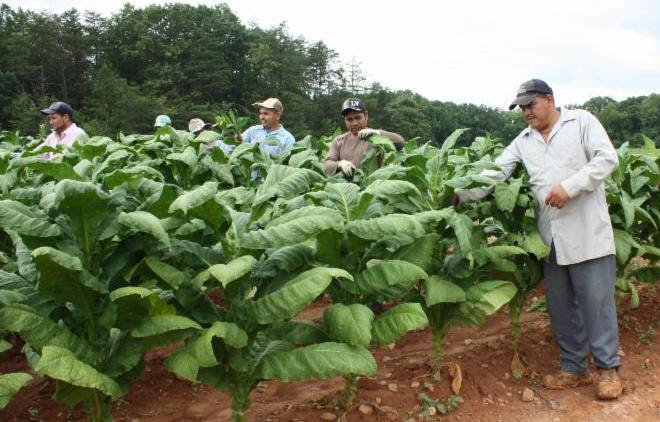
A migrant crew tops a field of flue-cured tobacco near King in the Old Belt of North Carolina. File photo by editor Chris Bickers.
|
GEORGIA-FLORIDA: It has been wet in Georgia and Florida, but that hasn't stopped a few growers from beginning harvest. "It has just been on a small scale," said J. Michael Moore, Ga. Extension tobacco specialist. "I expect it to get going in earnest this week." The crop isn't pretty at this time. "The rain damaged the lower leaves," he said.
KENTUCKY-TENNESSEE: Kentucky scientists didn't finish planting their demonstration plots at the University research farm in Lexington until July 5. That was several days later than expected because of excess precipitation. "We have had too much rain on this farm," said Bob Pearce, Kentucky Extension tobacco specialist. There was 1.3 inches on Sunday (July 1) and a little more on Monday and Tuesday, making for a late crop. But UK didn't plant the last burley in the state. "We have a few farmers still planting. But the crop is pretty much set," said Pearce on July 7. "There has been heavy rain over many parts of the state, but it has been spotty. Topping is just beginning in some areas." Statewide, NASS reported that 16 percent of the crop had been topped, and two percent was in bloom. In neighboring Tennessee, meanwhile, NASS said five percent of the crop had been topped.
THE CAROLINAS: North Carolina/growers need more rain, said Matthew Vann, N.C. Extension tobacco specialist. "Considering the stressors this crop has faced, it probably is better than it should be. The next 10 days will tell." Farmers, especially in the East, are well into sucker control. "A few growers have been harvesting for a week or two. That will pick up shortly." NASS reported that in South Carolina, 46 percent of the crop had been topped by July 9 and three percent had been harvested. Harvest will come later in the Piedmont. "Because of the weather, some farmers in the area were not able to transplant as early as they wanted to," said Vann. "An area along the Virginia border extending from Stokes to Granville counties got nine to 13 inches of rain in one week at the beginning of June. They got all their rain at once." Topping has started in almost all tobacco fields in Franklin County, N.C., north of Raleigh. "We are experiencing right much Granville wilt again in tobacco fields this year along with a little herbicide injury," said Charles Mitchell, Franklin County Extension agent. "There has also been a little wind damage to the tobacco crop."
VIRGINIA: Lunenburg County Extension agent Lindy Tucker said during the week of the Fourth that conditions had been dry for a few weeks following a wet early summer. "We received a good, much-needed rain Friday evening [July 6] that offered some relief from

the heat as well," said Tucker. "Tobacco is hold-ing," she added. In Greens-ville County, Extension agent Sara Rutherford said half the tobacco was flowering as of July 8. "Heading is anticipated in the next few days," she said. In Brunswick County, Ex-tension agent Cynthia Gregg said flue-cured pro-ducers were topping and applying sucker control. "A few have begun pulling lower leaves," she said.
CANADA: In Southern Ontario, most crops appeared to get off to a good start, according to a report from the Canadian Tobacco Research Foundation. The majority of the crop was planted in May, the report said, and cultivation began in mid-June. In the field, few problems have been reported except for some fumigant injury. Most growers will be topping soon.
APPOINTMENTS
Mitchell Richmond, who recently earned a doctorate in Integrated Plant and Soil Science from the University of Kentucky, has taken the position of team leader for the Canadian Tobacco Research Foundation, located in Tillsonburg. He replaces Dan Van Hooren, who retired. Richmond earned his bachelor's degree from Morehead State University in Kentucky.
DATES TO REMEMBER:
N.C. State will host two tobacco events in three consecutive days later this month. The first will be an:
*Note: Hotels are available in North Raleigh (Crabtree Valley Mall area) and Oxford (I-85/Hwy 96 area) for those intending to stay in the area. Hotel blocks will not be reserved by NCSU.
|
ADVERTISING
|
 
|
 |
 
EAST TENNESSEE: The end of transplanting burley should come in the next few weeks. "We are not finished now but should be soon," says Don Fowlkes, manager of agronomy with Burley Stabilization Corporation in Greeneville. "As of Wednesday, we were about three fourths complete, which is a little behind the calendar." A wet May delayed it getting in the field. "But now it is growing off nicely in most cases." There should be enough plants to service all the remaining acreage. "But plant supply was questionable at one point." In the neighboring burley states, NASS estimated that 57 percent of the burley crop had been planted in western North Carolina and 81 percent in southwest Virginia by June 10.
SOUTH CAROLINA: Planting has been complete in for several weeks, says William Hardee, S.C. area Extension agronomy agent in Conway. "So far, the crop looks pretty good. Much of the crop has been laid by. Sucker control has begun. We have a good bit of tomato spotted wilt virus in some places but in others not so bad, along with some soilborne disease and water stress." All in all, at this point, a good crop should certainly be in reach as long as the weather cooperates, he says.
NORTH CAROLINA: In Lee County, the tobacco crop is coming on fast and looking good for the most part, says Zachary Taylor, County Extension agent, But spotty areas were lost or damaged due to drowning, he adds. In Franklin County, disease started showing up last week, says Charles Mitchell, County Extension agent. "We saw some TSW and Granville Wilt showing up in some fields."
BLACK PATCH: Fire-cured setting in western Kentucky and central Tennessee is probably 70 percent complete, while dark air-cured setting is about 75 percent, says Andy Bailey, K-T Extension dark tobacco specialist. There have been some major problems with pythium in the float beds and severe transplant shock in some fields where tender plants got very hot in dry conditions immediately after transplanting. "Those and other conditions lead to more hand resetting than we are accustomed to," says Bailey. "We got our first black shank samples confirmed this week on the earliest planted tobacco, which is about five to six weeks old." But none of these situations is bad enough that the crop can't grow out of it. The remainder of dark acres ought to be set by June 25, he says.
As everywhere else, acres are down in the Black Patch too, but not by too much, says Bailey. USST lowered contracts by about 14 percent, and American Snuff raised its contracts five to 10 percent.
The relatively new fire-cured variety, KT D17L appears to be doing well in its first full year in the field, says Bailey. It features the best available resistance to the two strains of black shank: 10 to Race 0 and 6 to Race 1.
Spread of dark types? There are persistent rumors that some farmers in central Tennessee are planting dark types on land that has not been in dark before, or at least not recently. But there is no information on how this tobacco will be marketed.
Alexander "Sandy" Stewart of Carthage, N.C., has been appointed assistant commissioner of agricultural services for the N.C. Department of Agriculture. "With Dr. Stewart's extensive research background, I expect he will bring outside-the-box critical thinking skills to challenges
DATES TO REMEMBER:
|


Monday, June 4, 2018
END IN SIGHT FOR TRANSPLANTING
| |||||||||||||||||

 approaching 25 percent of the crop," says Pearce. There are several good advantages to conservation tillage. "But you have to remember that it requires a little higher level of management of the tobacco plus you have to manage the cover crop as well." The major benefit is improved conservation plus fewer trips across the field, he says. A special transplanter is needed, like the C&M Trium transplanter with a no-till option shown above.
 impassable. Several tobacco fields had some washes." Burley plantings for the state were estimated 58 complete, flue-cured 74 percent complete and fire-cured 63 percent complete.



Subscribe to:
Posts (Atom)