Tuesday, January 9, 2018

WHY TSNA'S COULD BE A BIG PROBLEM


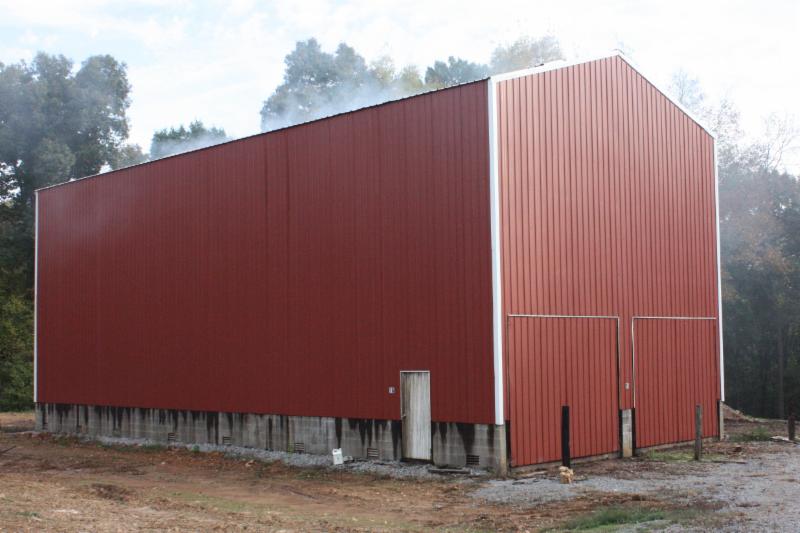
A fire-curing barn for dark tobacco "smokes" near Clarksville, Tn.
Could fire-cured tobacco production be on the way to extinction? Dark fire-cured tobacco is facing a serious potential challenge from a proposal made last year by the Food and Drug Administration to limit levels of NNN, a tobacco-specific nitrosamine (TSNA), to no more than 1 ppm in finished smokeless tobacco products. Although several production practices may influence NNN accumulation, the biggest factor by far is the weather during the curing season. "Generally, we see higher NNN in wetter curing seasons, and lower NNN in dryer curing seasons," says Andy Bailey, Extension tobacco specialist covering dark tobacco in Kentucky and Tennessee. "It ispossible for a grower to do everything in his control and still see NNN levels above 1 ppm if a wet curing season occurs. We don't believe this proposed standard is achievable consistently every year with our current technology." For now, fire-cured growers should produce a crop that is as low in TSNAs as possible, says Bailey. Here are some tips on how to do that:

  • Don't harvest or house wet tobacco,
  • Use plenty of ventilation while curing. Adding air through the tobacco with bottom ventilators should be a standard practice.
  • Start firing within one week of housing..
  • Keep curing temperatures no higher than 130 degrees for no more than four to five days, even during the drying stage.
  • Nitrogen application has an effect on all this, but fire-cured growers in the Black Patch are already following the fertilization practices that could help.
  • There will eventually be help from breeding, with several varieties with lower potential to produce NNN in the pipeline.
Final numbers on flue-cured: At 209,500 acres, harvested area of U.S. flue-cured was down slightly from 213,500 acres in 2016. Yield was estimated at 2,254 pounds peracre, over 200 pounds more than the 2016 yield of 2,021. Consequently, production in 2017 is forecast at 472,200 pounds, up from 431,450 pounds in 2016.

Will there be too much burley ... again?  Following a much smaller crop last year, African growers are increasing production, says Will Snell, Kentucky Extension tobacco economist. As predicted earlier, a global surplus is likely in the coming year. "Demand conditions for U.S. burley remain soft in the international market, with global cigarette consumption falling and ample, less expensive foreign burley supplies available to buyers," he says. "U.S. burley exports fell 24 percent in 2016 and are down more than 15 percent late in 2017."

The only visa program available for agricultural labor in crop season 2018 will be H-2A, says Rick Alexander, Executive Director, Agriculture Workforce Management Association. There has been much talk of a proposed H2C program, but it will not materialize in time for 2018, if ever. "A description of the H-2A program and all the required forms are on our website at www.awmalabor.com," he says. Alexander and Snell will be two of four featured speakers at the Burley Tobacco Growers Cooperative Association Annual Meeting in Lexington, Ky., on Thursday. Others will be Greg Harris, president, Council for Burley Tobacco, and Daniel Green, president, International Tobacco Growers Assn. The Council for Burley Tobacco Annual Meeting will take place at the same site Friday.

Funding for lighting upgrades: You may be able to obtain a grant of at least $1,500 up to a maximum of $500,000 toward renewable energy systems through USDA's Rural Energy for America Program (REAP).  If you are a customer of Duke Energy, you may also be able to qualify for that company's Rebate program, which is designed to absorb up to 75 percent of the cost of qualifying lighting upgrades. Application should be made through Elite Lighting, which is cooperating with Duke Energy in this program. For a free energy assessment and more information, you can contact Natalie Pulley, Elite Lighting, at 919-369-3943 or natalie@elitelighting.com.

Finally, a note from the editor: One of my pastimes is collecting Native American handicrafts. Late last year, I attended a festival for tribes in North Carolina, and at one of the handicraft stands, I came across this little pottery turtle (photo). It is hand made of red and white clay by Senora Lynch of the Haliwa Sapponi tribe near War-renton,  N.C. She had etched a stylized tobacco plant on the turtle's shell and in fact has it growing from a stylized ear of corn. Well, I found it very cheering: The little "tobacco turtle" seemed to speak of good fortune for our commodity in the coming year. Not surprisingly, the figurine is now in my possession. But Senora has plenty more, I am sure. For more information, contact her at (252) 257-5771 /jetndal@yahoo.com.

We hope you have enjoyed the January I issue of Tobacco Farmer Newsletter. If you haven't signed on to receive the newsletter regularly, please email me  at chrisbickers@gmail.com.--Chris Bickers


GAP GROWER TRAINING EVENTS
Check with your local Extension Service office for further details.
All meetings listed here are free and presented in English.
  • January 10, 9 a.m. Rocky Mount, N.C.
  • January 11, 9 a.m. Smithfield, N.C.
  • January 12, 9 a.m. Lexington, Ky. (in conjunction with Tobacco Expo).
  • January 12, 9 a.m. Oxford, N.C.
  • January 22, 9 a.m. Yanceyville, N.C.
  • January 22, 6 p.m. Dixon, Ky.
  • January 23, 9 a.m. Winston-Salem, N.C.
  • January 23, 9 a.m. Blackstone, Va.
  • January 23, 9:30 a.m. Dover, Tn.
  • January 24, 9 a.m. Williamston, N.C.
  • January 24, 4 p.m. South Hill, Va.
  • January 25, 9 a.m. Greenville, N.C.
  • January 25, 2 p.m. Clinton, N.C.
  • January 25, 4 p.m. Chatham, Va.
  • January 26, 9 a.m. Shelbyville, Ky.
  • January 26, 9 a.m. Kinston, N.C.
  • January 26, 1 p.m. New Castle, Ky.
  • January 29, 9 a.m. Goldsboro, N.C.
  • January 30, 9 a.m. Sanford, N.C.
  • January 31, 10 a.m. Scottsburg, Va.
  • February 1, 6 p.m. Stanford, Ky.
  • February 2, 1:30 p.m. Raleigh, N.C. (in conjunction with Southern Farm Show).
  • February 5, 9 a.m. Lillington, N.C.
  • February 5, 4:30 p.m. Franklin, Ky.
  • February 5, 6 p.m. Scottsville, Ky.
  • February 6, 8:30 a.m. Springfield, Tn. (in conjunction with Kentucky-Tennessee Tobacco Expo).
  • February 8, 5 p.m. Albany, Ky.
  • February 8, 6 p.m. New Tazewell, Tn.
  • February 13, 6 p.m. Athens, Tn.
  • February 19, 12 p.m. Carthage, Tn.
  • February 19, 6 p.m. Hartsville, Tn.
  • February 20, 4:30 p.m. Clarksville, Tn.
  • February 20, 6 p.m. Sharpsburg, Ky.
  • February 21, 8:30 a.m. Lawrenceburg, Tn.
  • February 22, 6 p.m. Maysville, Ky.
  • February 26, 4 p.m. Central City, Ky.
  • February 26, 6 p.m. Lafayette, Tn.
  • February 26, 6 p.m. Bowling Green, Ky.
  • March 1, 10 a.m. Campbridge City, In.
  • March 6, 2:30 p.m. Mayfield, Ky.
  • March 7, 6 p.m. Greeneville, Tn.
  • March 12, 10:30 a.m. Tifton, Ga.
  • March 13, 10:30 a.m. Marion, S.C.
  • March 13, 1 p.m. Murray, Ky.
  • March 20, 6:30 p.m. Glasgow, Ky.
  • March 20, 6:30 p.m. Gray, Tn.
DATES TO REMEMBER
  • January 11, 4 p.m. Burley Tobacco Growers Cooperative Association Annual Membership Meeting. Lexington, Ky. Convention Center, 4 p.m. (in conjunction with Tobacco Expo). 
  • January 12, 12 noon. Council for Burley Tobacco Annual Meeting. Lexington (Ky.) Convention Center (in conjunction with Tobacco Expo). 
  • January 15-18. Tobacco Workers' Conference. Hilton Myrtle Beach Resort, Myrtle Beach, S.C.
  • January 17-18, 10 a.m. S.C. AgriBiz and Farm Expo Florence (S.C.) Civic Center at the junction of I-95 and I-20.
  • January 31-February 2, 9 a.m. Southern Farm Show. N.C. State Fairgrounds, Raleigh, N.C.
  • February 2, 10 a.m. Annual Meeting, Tobacco Growers Association of N.C., Holshouser Building, N.C. State Fairgrounds (in conjunction with Southern Farm Show). Meeting ends with lunch.

ADVERTISING


For more information, visit www.BestTransplanter.com


CC143


Bickers Editing Service, 903-9 Shellbrook Ct., Raleigh, NC 27609

Saturday, December 23, 2017

A NEW SOURCE OF SEED FOR FLUE-CURED GROWERS

Signup for GAP training at the Southern Farm Show several years ago. See below for dates and locations of GAP meetings in January and February. File photo by Chris Bickers.

One seed company gets out of flue-cured. Another gets in. 
Champion Seed, a 60-year-old company that specializes in vegetable seed, has acquired exclusive rights to market F.W. Rickard's flue-cured varieties after January 1. No change is expected in sales procedures for 2018: If you want Rickard flue-cured seed, simply go to the retailer that has sold them to you before, says Zeb James, Champion sales representative in Arapahoe, N.C. He is not taking orders himself, but if you have questions about the new arrangement, you may call him at 252-637-8903.

Stripping slowed: In parts of the Burley Belt, late November and early December were very dry. That interfered with stripping plans. Now, in some areas, farmers have a lot of tobacco still hanging in barns. East Tennessee is one such place. "We hope we have better conditions for stripping in January than we had in December," says Don Fowlkes, manager of agronomy for Burley Stabilization Corporation in Greeneville, Tn. "Tobacco hasn't come in and out of order much at all. Quality is a mixed bag."

Despite some late planting--and some very late harvesting--the 2017 flue-cured crop turned out fairly well for most growers in the N.C. Piedmont, says Tim Hambrick, N.C. Area Extension tobacco agent stationed in Winston-Salem. "They have a little more money in their pockets than last year," he says. There is a need for some invest-ment on many farms, but not much is likely to be made, due to uncertainty. This season will be remembered for its length: Harvest went well into November here, says Hambrick, in part because rains delayed some planting until late June.

Parts of the fire-cured crop in the Black Patch of Kentucky and Tennessee were harvested later than is desirable too, says Andy Bailey, Extension dark tobacco specialist. This should be avoided whenever possible. "We usually don't do as well with fire-cured that is cut after November 1. The tobacco normally has had some frost damage by that time, and it is more difficult to maintain temperatures that are needed for fire-curing once the weather gets colder in November." He says that is the case even with the newer, tighter barns.

Crop value up in the Commonwealth: The value of the Kentucky tobacco crop rose to around $350 million in 2017, up significantly from the $283 million taken in in 2016, according to University of Kentucky agricultural economists. A better growing season resulted in a higher quantity and quality crop for both burley and dark farmers.

Fewer flue-cured barns for sale? Because the dropout of growers is likely to be less due to the good season we just experienced,  not as many used barns--especially not quality barns--will come on the market, says Bob Pope, owner of Long Equipment Manufacturing Company of Tarboro, N.C. On a related note: His company's name has changed from Long Tobacco Barns to Long Equipment Manufacturing, to reflect the broader product line that it now offers.

Meeting demand: Jim Schneeberger has been named Senior Vice President of Leaf Operations and Sales for the U.S. Tobacco Cooperative, part of an effort to better meet international and domestic demand for U.S. flue-cured tobacco while driving volume and growth, according to a USTC announcement. He had previously been USTC vice president for business development.

Briefly noted: Flue-cured grower Jerome Vick of Wilson County, N.C., and machinery manufacturers Randy and Don Watkins, of Granville Equipment Co. in Oxford, N.C., were named "Tobacco Greats" at the recent 2017 N.C. Tobacco Day in recognition of the significant contributions  they have made to the tobacco industry.

GAP GROWER TRAINING EVENTS
Check with your local Extension Service office for further details.
All meetings listed here are free and presented in English.
  • Jan. 8, 9 a.m.  Wilson, N.C.
  • Jan. 9, 9 a.m. Yadkinville, N.C.
  • Jan. 10, 9 a.m., Rocky Mount, N.C.
  • Jan. 11, 9 a.m., Smithfield, N.C.
  • Jan. 12, 9 a.m. Oxford, N.C.
  • Jan. 22, 9 a.m. Yanceyville, N.C.
  • Jan. 22, 6 p.m. Dixon, Ky.
  • Jan. 23, 9 a.m. Winston-Salem, N.C.
  • Jan. 23, 9 a.m. Blackstone, Va.
  • Jan. 23, 9:30 a.m. Dover, Tn.
  • Jan. 24, 9 a.m. Williamston, N.C.
  • Jan. 24, 4 p.m. South Hill, Va.
  • Jan. 25, 9 a.m. Greenville, N.C.
  • Jan.  25, 2 p.m., Clinton, N.C.
  • Jan. 25, 4 p.m. Chatham, Va.
  • Jan. 26, 9 a.m. Kinston, N.C.
  • Jan. 29, 9 a.m. Goldsboro, N.C.
  • Jan. 30, 9 a.m. Sanford, N.C.
  • Jan. 31, 10 a.m. Scottsburg, Va.
  • Feb. 2, 1:30 p.m. Raleigh, N.C. (at Southern Farm Show).
  • Feb. 5, 9 a.m. Lillington, N.C.
  • Feb. 5, 4:30 p.m. Franklin, Ky.
  • Feb. 6, 8:30 a.m. Springfield, Tn.
  • Feb. 8, 6 p.m. New Tazewell, Tn.
  • Feb. 13, 6 p.m. Athens, Tn.
  • Feb. 19, 12 p.m. Carthage, Tn.
  • Feb. 19, 6 p.m. Hartsville, Tn.
  • Feb. 20, 4:30 p.m. Clarksville, Tn.
  • Feb. 21, 8:30 a.m. Lawrenceburg, Tn.
  • Feb. 26, 4 p.m. Central City, Ky.
  • Feb. 26, 6 p.m. Lafayette, Tn.
  • Mar 7, 6 p.m. Greeneville, Tn.
  • Mar 20, 6:30 p.m. Gray, Tn.
DATES TO REMEMBER
  • January 11, 4 p.m. Burley Tobacco Growers Cooperative Association Annual Membership Meeting. Lexington, Ky. Convention Center, 4 p.m. (in conjunction with Tobacco Expo). 
  • January 12, 12 noon. Council for Burley Tobacco Annual Meeting. Lexington (Ky.) Convention Center (in conjunction with Tobacco Expo). 
  • January 17-18, 10 a.m. S.C. AgriBiz and Farm Expo Florence (S.C.) Civic Center at the junction of I-95 and I-20.
  • January 31-February 2, 9 a.m. Southern Farm Show. N.C. State Fairgrounds, Raleigh, N.C.
  • February 2, 10 a.m. Annual Meeting, Tobacco Growers Association of N.C., Holshouser Building, N.C. State Fairgrounds (in conjunction with Southern Farm Show). Meeting ends with lunch.
Editor's Note: We hope you have enjoyed the December II issue of Tobacco Farmer Newsletter. If you haven't signed on to receive the newsletter regularly, please email me  at chrisbickers@gmail.com.--Chris Bickers

Wednesday, December 6, 2017

EARLY PROJECTIONS: BURLEY CONTRACTS DOWN, DARK CONTRACTS STABLE


The global supply/demand balance for burley improved entering 2017 following three years of excess supplies and dwindling demand, says Will Snell, Kentucky Extension tobacco economist. "Demand conditions for U.S. burley remain soft in the international market." U.S. burley exports fell 24 percent in 2016 and are down more than 15 percent so far in 2017, he says "Alternatively, imports of burley tobacco into the U.S. market have continued to gain market share, comprising one-half to two-thirds of all burley used by U.S. cigarette manufacturers in recent years." Domestic cigarette sales are expected to fall three to four percent in 2017, matching the historical annual decline of nearly 30 percent over the past decade, he says.

Despite deteriorating demand conditions, the outlook for the current U.S. burley marketing season is benefitting from a large decline in African burley production this past year, Snell says. "Kentucky burley yields will be higher, and overall the quality of the 2017 crop appears favorable for buyers." Good quality crops should average in the low to mid $1.90s, up a few cents from the past two seasons, he says. But Africans are boosting production in 2018 which will likely lead to a global surplus in the coming year. "Consequently, the early outlook is for a reduction in U.S. burley contract volume in 2018, especially if the 2017 crop comes near the level currently projected by USDA."

The dark tobacco outlook looks much brighter than does burley's. "After a dismal 2016 dark tobacco crop, the size and quality of the 2017 dark tobacco crop rebounded considerably this past season," says Snell. "USDA has the dark tobacco crop exceeding 70 million pounds, com-pared to less than 50 million pounds in 2016." Annual snuff consumption is still growing, but at a slower pace. Prices for this year's dark crop should continue to average around $2.40 per pound for dark air-cured and $2.75 per pound for dark fire-cured. "Look for dark tobacco contract volume to remain relatively constant for the coming year," says Snell.

Burley stripping is over half way complete in Kentucky. "It is a fairly decent crop," says Bob Pearce, Extension tobacco specialist. The quality is the best in several years." He hasn't seen enough crops to make a good estimate of the state's production, but he thinks USDA's most recent estimate of Kentucky burley--132 million pounds--is probably at least 10 percent too high.

The progress is similar in Tennessee, where Eric Walker, Tn. Extension tobacco specialist, says stripping is proceeding at an average pace or better. "Some farmers are not far from being done," he says.

No new varieties for burley or flue-cured this season, but Pearce says the relatively new burley variety from the Kentucky-Tennessee program--KT 215--seems to be catching on with growers because of its good resistance to Race 1 black shank. It is also resistant to fusarium wilt but has no resistance to potato virus Y.

GAP GROWER TRAINING EVENTS
North Carolina (Flue-cured)
  • January 8, 9 a.m.-12 p.m. Wilson County Ag. Ctr., 1806 Goldsboro St., Wilson.
  • January 9, 9 a.m.-12 p.m. Yadkin County Extension, 2051 Agricultural Way, Yadkinville.
  • January 10, 9 a.m. - 12 p.m. Edgecombe/Nash County, Farmers' Market, 1006 Peachtree St., Rocky Mount.
  • January 11, 9 a.m.-12 p.m. Johnston County Extension Office.
  • January 12, 9 a.m.-12 p.m. Granville County Expo & Convention Center, 4185 US-15, Oxford. 
  • January 22. 9 a.m. - 12 p.m. Caswell County Civic Center, 536 Main St, Yanceyville. Also for farmers from Person, Alamance, Guilford and Orange Counties.
  • January 23, 9 a.m.-12 p.m. Forsyth County Extension Office., 1450 Fairchild Rd # 6, Winston-Salem.
  • January 24, 9 a.m.-12 p.m. Martin County Farmers Market, 4001 W Main Street Extn., Williamston.
  • January 25, 9 a.m.-12 p.m. Pitt County Cooperative Extension Office.
  • January 25, 2p.m. - 5p.m. Sampson County Ag Expo Center. Duplin County included.
  • January 26, 9 a.m.-12 p.m. Lenoir County Shrine Club, 1558 US-70, Kinston. Greene/Lenoir/Jones/Craven/Carteret Counties included.
  • January 29, 9 a.m.-12 p.m. Wayne County Extension Office.
  • January 30, 9 a.m.-12 p.m. Lee County Extension Office. 
DATES TO REMEMBER
  • December 7, 8 a.m. N.C. Tobacco Day 2017. Johnston County Extension Center, 2736 N.C. Hwy. 210, Smithfield, N.C. Meeting ends with lunch.
  • January 17-18, 10 a.m. S.C. AgriBiz and Farm Expo Florence (S.C.) Civic Center at the junction of I-95 and I-20.
  • January 31-February 2, 9 a.m. Southern Farm Show. N.C. State Fair Grounds, Raleigh, N.C.
  • February 2, 10 a.m. Annual Meeting, Tobacco Growers Association of N.C., Holshouser Building, N.C. State Fairgrounds (during Southern Farm Show). Meeting ends with lunch.


Thursday, November 16, 2017

HOW OUR COMPETITORS ARE DOING


 In Malawi, buyers inspect burley tobacco on the Lilongwe auction floor. 

Flue-cured: The 2018 Brazil flue-cured crop--which is currently  in the field--has been projected at a volume of just under 1.3 billion pounds. That is slightly lower than the 1.37  billion  pounds  reported  for  the  crop  harvested  earlier  this  year,  says Blake Brown, N.C. Extension economist.   Both crops are/were well above the recent low of 1.01  billion  pounds in  2016.  The 2017 Zimbabwe crop -- for which marketing ended recently--is estimated to have been 403 million pounds, down from
442 million pounds in 2016. The 2017 average price per pound in Zimbabwe is expected to have been about $1.34 per pound, which is about the same as in 2016. "A stronger Brazi-lian Real and a larger (US) 2017 crop should lead to higher exports for the 2017 crop," he says.

Burley: In Malawi, our strong competitor in burley, international buyers have asked for production of about 375 million kilograms from the 2017/18 crop, according the national Tobacco Control Commission. This is a 10 percent increase from the 2016/17 volume. But that may not be as significant as it sounds: Production fell well short of demand in the season just ended with only 240 million kilograms coming to market against the stated demand of 350 million kilograms. The commission's Chief Executive Officer, David Luka, said, "This 10 percent increase in demand could be a result of the undersupply of tobacco the market experienced in the just-ended season."

The dark types had better luck in harvesting on schedule than flue-cured and burley, but still, some was cut late. In Trigg County, Ky., some fire-cured was still being cut the first week of November. That is risky, says Andy Bailey, Extension dark tobacco specialist. "We usually don't do well with fire-cured that is cut after November 1. There is less chance of good curing weather after that." The rainfall was favorable for most of the dark-producing area in the fall, although there were some heavy rains associated with Hurri-cane Irma, especially around Springfield, Tn., causing some damage.
Bailey's rough estimate of dark production?Maybe 56 to 57 million pounds of fire-cured and 16 to 18 million pounds of dark air-cured. Both estimates are one to two million pounds less than USDA's last Crop Report. Yield might be 3,200 pounds per acre for fire-cured and 2,800 pounds per acre for dark air-cured, he adds. Both are close to average. "What I have seen is pretty good," says Bailey. "It is a hundred times better than last year" when bad weather seriously reduced yields.

If any tobacco is still left in the field in North Carolina, it probably will stay there. "Jack Frost got his due over the weekend [November 11 and 12], and I wouldn't think there would be much useable leaf after that," says Matthew Vann, N.C. Extensiontobacco specialist. "Most of our growers were finished by October 20, but there was an area north of Oxford, N.C., on up to the Virginia state line where the crop was behind. There was a mad dash to finish and some had to harvest much later than normal."

This flue-cured season will be remembered for its early disease outbreaks, especi-ally tomato spotted wilt virus, says Vann. "It was the worst I have ever observed. We even saw some very mild cases in the Middle Belt, which is unheard of. We (the N.C. Extension tobacco team) are working on management strategies to deal with the disease." Breeding might eventually help--at the present time, no varietal resistance is available.

Welcome to the November II issue of Tobacco Farmer Newsletter. If you haven't signed on to receive the newsletter regularly or need to change an address, please click on "Join our mailing list" and follow the prompts. For more information, you can call me at 919-789-4631 or email me at chrisbickers@gmail.com.         --Chris Bickers

A Letter to the Editor

PRICE RELIEF MORE NEEDED NOW THAN PRODUCTION INCREASES
We spend so much time talking about production. But the most pressing issues we face now are the price we receive for our tobacco and the wage that we pay H2A workers. I have made 38 tobacco crops in my life time, and I have never seen the situation this bad financially, even in the days when we were paying 25 cents into the no net cost program. I have been working H2A workers since 1985. The wage then was $3.95. It has increased over the years, but in the last 10 years, it has gotten out of hand. Growers are reluctant to admit it, but their workers are making more money than they are. I am a member of Virginia Agricultural Growers Association and am currently its treasurer. In 2017 we brought in 1,600 workers to Virginia growers. Less than 10 years ago we were bringing in over 3,000. You can see the trend: More acres, less farmers. If we continue down this path of reduced price and increased wage and production cost, tobacco production will soon die here in Virginia. We are all afraid of upsetting the tobacco companies and losing our contracts, but someone must speak. I pray that our leadership will be more vocal to the companies about this wage issue. If the Adverse wage continues to increase without an increase in price (which is unlikely), all of this will be a moot point. Tobacco farmers are at the bottom of the food chain and everyone else is feeding off us!--Tom Blair, Pittsylvania County, Va. 
DATES TO REMEMBER
  • December 7, 8 a.m. N.C. Tobacco Day 2017. Johnston County Extension Center, 2736 N.C. Hwy. 210, Smithfield, N.C. Meeting ends with lunch.
  • January 17-18, 10 a.m. S.C. AgriBiz and Farm Expo Florence (S.C.) Civic Center at the junction of I-95 and I-20.
  • January 31-February 2, 9 a.m. Southern Farm Show. N.C. State Fair Grounds, Raleigh, N.C.
  • February 210 a.m. Annual Meeting, Tobacco Growers Association of N.C., Holshouser Building, N.C. State Fair Grounds (during Southern FarmShow). Meeting ends with lunch.

ADVERTISING


For more information, visit www.BestTransplanter.com


CC143


Tuesday, November 7, 2017

FLUE-CURED AND BURLEY PROJECTIONS KEEP DROPPING

Burley wilts in the field near Lafayette, Tn.
How credible are USDA's recent estimates? As reported in the last issue, in its October Crop Production Report, USDA projected the U.S. flue-cured crop at 472.2 million pounds, up 9.8 per cent from 2016, and U.S. burley at 165.6 million pounds, up 18.5 percent from 2016. Both projections seemed too optimistic to me, so I went to two of the best sources I know of production in this country:
  • Flue-cured: Graham Boyd, executive vice president of the Tobacco Growers Association of N.C., thinks 405 to 410 million pounds is much more likely since the yield was reduced by weather factors. "Mostly too wet early in locations that cause the crop to grow fast and wash out its weight potential," he says. Tomato spotted wilt was a factor too.
  • Burley: Daniel Green, chief execu-tive officer of Burley Stabilization Corporation, estimated this burley crop will likely end up between 135 to 140 million pounds. "We had excess rain across much of the growing region late in the season," he says. "Some areas drowned out, but the real problem was leaf that grew too fast." 
Hurricane alert: Torrential rains in September associated with Hurricane Harvey and to a lesser extent Hurricane Irma caused burley in the fields to start growing again. Much of the leaf looked great going in the barn, but is coming out on the thin side. The curing environment may have also been affected negatively, as many growers are reporting some "housey" burley. One way or another, yield was reduced in the major growing areas.
A fortuitous dry spell: A late-season drought worked in favor of east Tennessee burley farmers this season, says grower Jeff Aiken of Telford, Tn., near Johnson City. "There was adequate rainfall most of the spring and summer, but it was unusually dry in August and September." That aided in harvest and barning, he says. "We were never run out of the field because of rain." But then it did start raining in mid October, and that helped curing. "With moisture in the air, farmers were better able to get the desirable color." Aiken barned the last of his burley on October 6, a little behind schedule since frost strikes in east Tennessee some years by that time. "But the first significant frost in this area didn't come until the last week of October," he says.
Stripping nearly half completed: The central Kentucky burley crop experienced weather conditions similar to east Tennessee. There had been some delays due to tropical storms, but a favorable stretch of weather contributed to a speedy end of harvest (see Tobacco Farmer Newsletter, October II). USDA estimated that 45 percent of the Kentucky crop had been stripped by November 5.
The Virginia flue-cured crop ran late but all of it has been harvested now, says David Reed, Virginia Extension tobacco specialist. "We had a lot off it harvested in October," he says. That used to be considered late, but harvests continuing well in October have become the trend in recent years, he says. "One thing that worked in our favor: we haven't had a general killing frost yet." He describes Virginia's crop as good with reasonable quality. Yields were good too. "If we are short of what was contracted, it isn't by much." He expects production to fall in the 50 to 51-million-pound range.
The flue-cured crop in North Carolina is very usable, says Rick Smith, president of Independent Leaf Tobacco in Wilson, N.C. "In some areas it is close to vintage." And it could get still better. "There are still some farmers in Old Belt who haven't finished harvesting," he says. "The predictions are that there is no danger of a frost this week, so they may yet get it all in.
To "cross" the GAP, you'll have to scan. In an effort to keep the U.S. Tobacco GAP program "honest and fair for all who participate," GAP Connections (GAPC) will be instituting a new policy beginning in January, says Amy Rochkes, GAPC Training and Resource Coordinator. To do that, GAPC will require you to present identification (such as a driver's license) and your Grower ID Card, which will be scanned at the end of the training session. You can scan only your own Grower IDcard, not those of family members or landlords. You have to attend the entire GAP training session--late arrivals will be recorded at the discretion of GAPC Staff. GAP Connections will not add training after the event without verifying attendance with Extension personnel. You can find more information about the Annual GAP Training using the GAP Connections Grower App on the iPhone or Android, by visiting www. gapconnections.com or by following GAP Connections on Facebook.

New president: Barry Bush of Cookeville, Tn., was elected the new president of Burley Stabilization Corporation in Springfield, Tn., at the organization's annual meeting in October. He replaces George Marks of Clarksville, Tn., who passed away in July. Bush has been succeeded as vice president by Dean Bates of Gallatin, Tn.


For more information, visit www.BestTransplanter.com


CC143


Friday, October 27, 2017

HOW MUCH TOBACCO DID YOU REALLY PRODUCE THIS YEAR?


Contestants at the tobacco-tying contest at the N.C. State Fair show off their stringing ability. The wining team was the " Looping Fools" of Maple Hill (not shown). Team members Sandy and Ken Jones of Maple Hill and Michael Sunday of Holly Ridge looped their stick of tobacco in 51.67 seconds.


The last USDA production estimate for 2017 was issued earlier this month. It included extremely optimistic estimates for flue-cured, burley and the two dark types. But several normally reliable sources have suggested that the projections--especially for Kentucky burley and N.C. flue-cured--may be way too high. Take the USDA projections (following) for what they seem to be worth and I will try to get a more credible report in the next issue of Tobacco Farmer Newsletter about a week from now.

FLUE-CURED 
  • North Carolina--374.9 million pounds, up nine percent. 
  • Virginia--49.5 million pounds, up two percent. 
  • Georgia--25 million pounds, down 12 percent. 
  • South Carolina--22.8 million pounds, down seven percent. 
  • All flue cured--472.2 million pounds, up 9.8 per cent.
BURLEY 
  • Kentucky--132.3 million pounds, up 23.9 percent. 
  • Tennessee--18 million pounds, up 11.1 percent. 
  • Pennsylvania -- 11.25 million pounds, down 9.8 per cent.
  • Virginia--2.36 million pounds, down 6.1 percent. 
  • North Carolina--1.7 million pounds, down five percent.
  • All burley--165.6 million pounds, up 18.5 percent. 
FIRE-CURED--57.9 million pounds, up 46.5 percent.
DARK AIR-CURED--19.44 million pounds, up 94 percent.
PENNSYLVANIA SEEDLEAF--4 million pounds, up four percent.
SOUTHERN MARYLAND--2.5 million pounds, no change.  
                  
In other tobacco news...
Flue-cured growers and many with a sentimental attachment to the type came to the North Carolina State Fair in Raleigh on October 13 to celebrate this year's crop. Flue-cured leaf was brought down from the nearby Oxford Research Station to provide the basic material for the fair's annual tobacco-tying contest. As the contestants tied their leaf on strings, several growers reviewed their experiences growing bright tobacco in 2017.

Hustling to finish harvest: Carl Watson, the tobacco research specialist responsible for growing the crop at the Oxford,  research station, said he expected that harvest on the station would continue until the end of thisweek. "That's quite late for us," he said. Several farmers north of the station are still harvesting too. I have seen some of them 'borrowing' barns from neighbors who are finished, to speed things up. But if we can avoid extremely cold weather, I think this crop will all get out of the field." It got dry during harvest, said Watson. "We were having a problem of bruising of the leaves. So, we quit harvesting for a time and watered again."
Good quality: Sam Crews of Oxford, N.C., said poundage was down on his farm. "But it was generally good quality. The top of the stalk looked good. I am sure this crop will fare well in foreign markets."
Lowerstalk short: Thomas Shaw of Henderson, N.C., north of Durham, said his crop was average. "The wet weather early was a problem, but we overcame that." Heat late in the season delayed harvest, and he finished October 11, late for his area. "We are a little short on pounds, due to the weather extremes. The heat early took its toll, leaving us a little short on lower stalk leaf. Then at harvest, some fields were too wet and some too dry.  Selling this crop has been a challenge."
Harvest of the Kentucky burley crop is probably complete by now, says Bob Pearce, Kentucky Extension tobacco specialist. "But some of it hasn't been in the barn long." Difficulty obtaining labor slowed harvest on some farms, and tropical storms slowed some others. "Still, we had a favorable stretch of weather to get the last of the crop in, and curing got off to a good start." Curing seems to be going fairly well for the first tobacco that was harvested early. But the later-harvested could face a problem if temperatures turn downward. "An average of 60 to 90 degrees is ideal for curing," says Pearce. "If it is lower, you run the risk of curing green."


Editor's Noter: I hope you have enjoyed the October II issue of Tobacco Farmer Newsletter. If you haven't signed on to receive the newsletter to your email address, or if you need to change an address, please call me at 919-789-4631 or email me at chrisbickers@gmail.com.--Chris Bickers